Promotional price valid on web orders only. Your contract pricing may differ. Interested in signing up for a dedicated account number?
Learn More
Learn More

Description
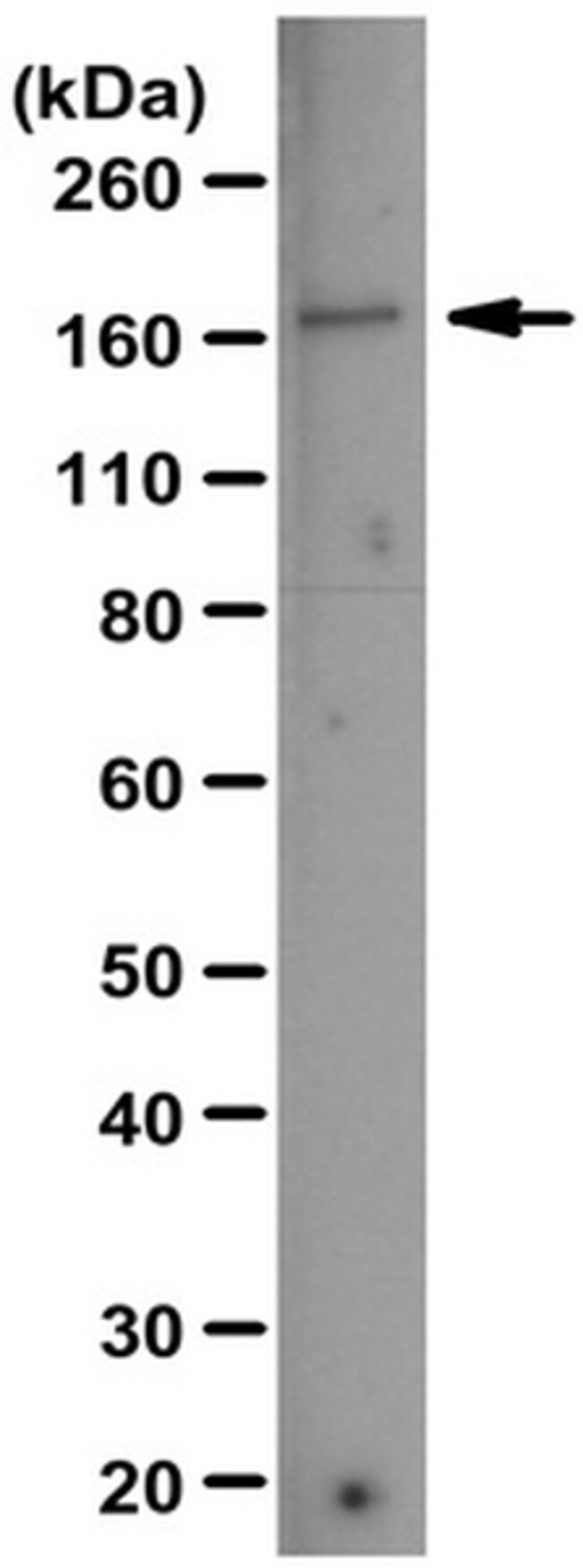
Contactin-associated protein-like 2 (UniProt Q9UHC6; also known as Cell recognition molecule Caspr2) is encoded by the CNTNAP2 (also known as AUTS15, CASPR2, CDFE, KIAA0868) gene (Gene ID 26047) in human. Caspr2 is a neurexin superfamily member that functions as a neuronal cell adhesion protein. Originally identified in myelinating nerves, Caspr2 serves to cluster voltage-gated potassium (Kv) channels at the juxtaparanode, a membrane domain adjacent to the node of Ranvier, where it forms a barrier holding nodal components in place. Caspr2 is found in axons, dendrites, dendritic spines and the soma of mature pyramidal neurons in the central nervous system (CNS). Caspr2 and its partner Contactin 2 are found in the synaptic plasma membranes fraction of the forebrain. In the absence of Caspr2, new synaptic spines are unable to stabilize, resulting in decreased spine density and altered spine morphology as well as downregulated AMPA receptor subunit on the spines in mice. CNTNAP2 gene mutations are linked to autism spectrum disorder (ASD) in human. Likewise, Cntnap2-knockout mice exhibit core autism-like deficits including abnormal social behavior and communication, and behavior inflexibility. Caspr2 is produced with a signal peptide (a.a. 1-27), the removal of which yields the mature transmembrane proein with a large extracellular region (a.a. 28-1262), followed by a transmembrane domain (a.a. 1263-1283) and a cytoplasmic tail (human a.a. 1284-1331 and mouse a.a. 1284-1332). The extracellular region contains an N-terminal Discoidin domain (a.k.a. F5/8 type C domain or C2-like domain; human a.a. 35-181), four Laminin G-like domains (human a.a. 216-368, 401-552, 799-963, 1055-1214), two EGF-like domains (human a.a. 554-591 and 963-1002), and a Fibrinogen C-terminal domain (human a.a. 592-798).

Specifications
Specifications
| Antigen | Caspr2 |
| Applications | Western Blot |
| Classification | Polyclonal |
| Concentration | Please refer to lot specific datasheet. |
| Conjugate | Unconjugated |
| Formulation | Rabbit polyclonal antibody serum with 0.05% Sodium Azide. |
| Gene | CNTNAP2, AUTS15, CASPR2, CDFE, KIAA0868 |
| Gene Accession No. | Q9UHC6 |
| Host Species | Rabbit |
| Immunogen | Human IgG1 Fc-tagged recombinant human Caspr2 extracellular domain fragment. |
| Show More |
For Research Use Only. Not for use in diagnostic procedures.
Product Title
By clicking Submit, you acknowledge that you may be contacted by Fisher Scientific in regards to the feedback you have provided in this form. We will not share your information for any other purposes. All contact information provided shall also be maintained in accordance with our Privacy Policy.
Spot an opportunity for improvement?