Promotional price valid on web orders only. Your contract pricing may differ. Interested in signing up for a dedicated account number?
Learn More
Learn More
Invitrogen™ Cathepsin F Polyclonal Antibody

Description
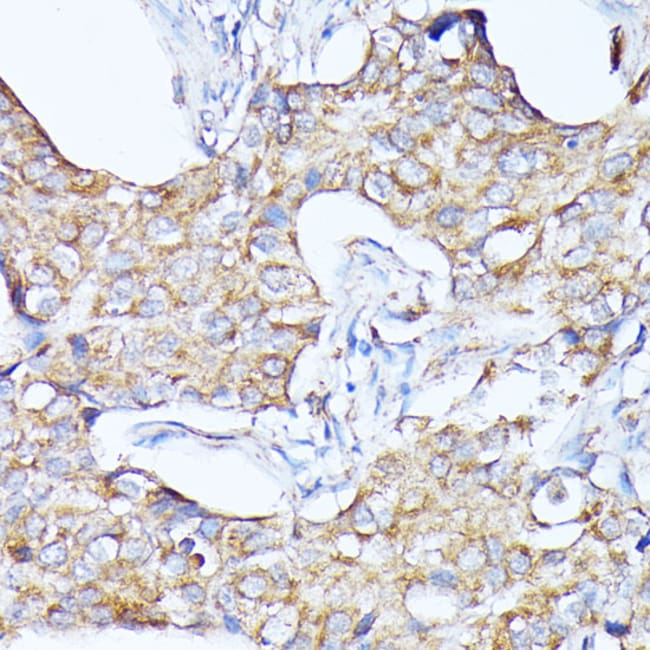
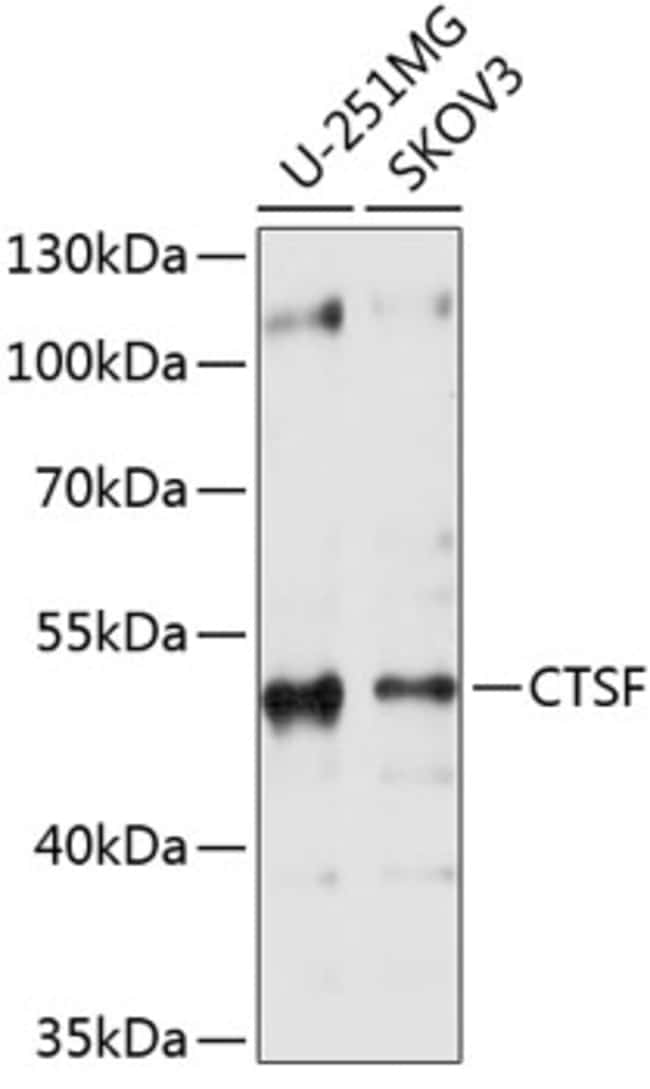
Immunogen sequence: LAPPEWDWRS KGAVTKVKDQ GMCGSCWAFS VTGNVEGQWF LNQGTLLSLS EQELLDCDKM DKACMGGLPS NAYSAIKNLG GLETEDDYSY QGHMQSCNFS AEKAKVYIND SVELSQNEQK LAAWLAKRGP ISVAINAFGM QFYRHGISRP LRPLCSPWLI DHAVLLVGYG NRSDVPFWAI KNSWGTDWGE KGYYYLHRGS GACGVNTMAS SAVVD; Positive Samples: U-251MG, SKOV3; Cellular Location: Lysosome.
Cathepsins are papain family cysteine proteinases that represent a major component of the lysosomal proteolytic system. Cathepsins generally contain a signal sequence, followed by a propeptide and then a catalytically active mature region. The very long (251 amino acid residues) proregion of the cathepsin F precursor contains a C-terminal domain similar to the pro-segment of cathepsin L-like enzymes, a 50-residue flexible linker peptide, and an N-terminal domain predicted to adopt a cystatin-like fold. The cathepsin F proregion is unique within the papain family cysteine proteases in that it contains this additional N-terminal segment predicted to share structural similarities with cysteine protease inhibitors of the cystatin superfamily. This cystatin-like domain contains some of the elements known to be important for inhibitory activity. CTSF encodes a predicted protein of 484 amino acids which contains a 19 residue signal peptide. Cathepsin F contains five potential N-glycosylation sites, and it may be targeted to the endosomal/lysosomal compartment via the mannose 6-phosphate receptor pathway. The cathepsin F gene is ubiquitously expressed, and it maps to chromosome 11q13, close to the gene encoding cathepsin W.

Specifications
Specifications
| Antigen | Cathepsin F |
| Applications | ELISA, Immunohistochemistry (Paraffin), Western Blot |
| Classification | Polyclonal |
| Concentration | 2.44 mg/mL |
| Conjugate | Unconjugated |
| Formulation | PBS with 50% glycerol and 0.01% thimerosal; pH 7.3 |
| Gene | Ctsf |
| Gene Accession No. | Q9UBX1 |
| Gene Alias | AI481912; Cathepsin F; CATSF; CLN13; CTSF; HGNC:2531 |
| Gene Symbols | Ctsf |
| Show More |
Product Title
By clicking Submit, you acknowledge that you may be contacted by Fisher Scientific in regards to the feedback you have provided in this form. We will not share your information for any other purposes. All contact information provided shall also be maintained in accordance with our Privacy Policy.
Spot an opportunity for improvement?