Promotional price valid on web orders only. Your contract pricing may differ. Interested in signing up for a dedicated account number?
Learn More
Learn More
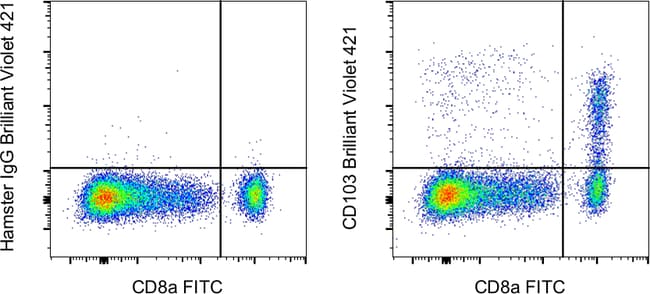
Invitrogen™ CD103 (Integrin alpha E) Monoclonal Antibody (2E7), Brilliant Violet™ 421, eBioscience™, Invitrogen™


Description
CD103, also known as ITGAE or Integrin alpha E, is a molecule that non-covalently associates with integrin beta 7 to form a heterodimeric integral membrane protein. This protein is part of the integrin family, characterized by an alpha chain and a beta chain. Specifically, CD103 includes a 150 kDa alpha chain and a 120 kDa beta chain, with the alpha integrin undergoing post-translational cleavage in the extracellular domain to yield disulfide-linked heavy and light chains. CD103 is primarily expressed on mucosa-associated T lymphocytes, intraepithelial lymphocytes (IELs), and activated cells, as well as a subset of TGF beta-1 cells. It is preferentially found in human intestinal IELs, where it plays a role in adhesion and may serve as an accessory molecule for IEL activation. CD103 binds to epithelial cell antigen E-cadherin, mediating the homing of lymphocytes to the intestinal epithelium. In peripheral blood and lymphoid organs, CD103 is expressed by 0.5 to 2% of resting lymphocytes, and its expression can be upregulated in vitro by stimulating human T cells with mitogens. CD103 is also expressed by hairy cell leukemia (HCL) and some chronic B cell lymphocytic leukemias. The CD103 antibody stains a few bone marrow cells and, rarely, peripheral blood lymphocytes. Diseases associated with CD103 dysfunction include hairy cell leukemia and splenic marginal zone lymphoma.

Specifications
Specifications
| Antigen | CD103 (Integrin alpha E) |
| Applications | Flow Cytometry |
| Classification | Monoclonal |
| Clone | 2E7 |
| Concentration | 0.2 mg/mL |
| Conjugate | Brilliant Violet 421 |
| Formulation | PBS with BSA and 0.09% sodium azide; pH 7.2 |
| Gene | Itgae |
| Gene Accession No. | Q60677 |
| Gene Alias | A530055J10; alpha-E1; alpha-M290; aM290; antigen CD103; antigen CD103, human mucosal lymphocyte antigen 1; alpha polypeptide; CD103; DC; DCs; HML-1 antigen; human mucosal lymphocyte antigen 1, alpha polypeptide; HUMINAE; integrin alpha E; integrin alpha E, epithelial-associated; integrin alpha E1, epithelial-associated; integrin alpha M290; Integrin alpha-E; Integrin alpha-E heavy chain; Integrin alpha-E light chain; Integrin alpha-IEL; integrin subunit alpha E; integrin, alpha E; integrin, alpha E (antigen CD103, human mucosal lymphocyte antigen 1; alpha polypeptide); integrin, alpha E, epithelial-associated; Intregrin alpha E2; Itgae; MGC141996; Mucosal lymphocyte 1 antigen |
| Show More |
Product Title
By clicking Submit, you acknowledge that you may be contacted by Fisher Scientific in regards to the feedback you have provided in this form. We will not share your information for any other purposes. All contact information provided shall also be maintained in accordance with our Privacy Policy.
Spot an opportunity for improvement?