Learn More
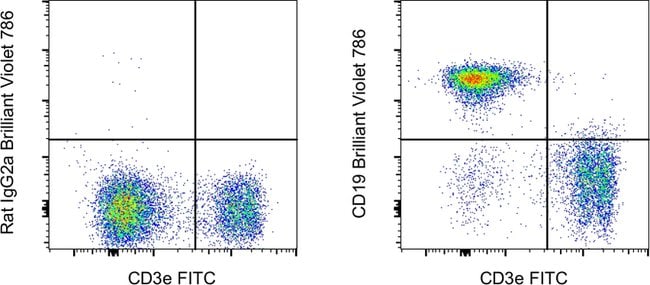
Invitrogen™ CD19 Monoclonal Antibody (eBio1D3 (1D3)), Brilliant Violet™ 786, eBioscience™, Invitrogen™


Description
The eBio1D3 mAb reacts with mouse CD19, a 95 kDa transmembrane glycoprotein. CD19 is expressed by B cells during all stages of development excluding the terminally differentiated plasma cells. Follicular dendritic cells also express CD19. Together CD21, CD81, MHC class II, and CD19 form a multimolecular complex that associates with the BCR. Signaling through CD19 induces tyrosine phosphorylation, calcium flux and proliferation of B cells. Applications Reported: This eBio1D3 (1D3) antibody has been reported for use in flow cytometric analysis. Applications Tested: This eBio1D3 (1D3) antibody has been tested by flow cytometric analysis of mouse splenocytes. This may be used at less than or equal to 1ug per test BV 786 is a tandem dye that emits at 786nm and is intended for use on cytometers equipped with a violet (405nm) laser. Please make sure that your instrument is capable of detecting this fluorochrome. When using two or more Super Bright, BV, BUV, or other polymer dye-conjugated antibodies in a staining panel, it is recommended to use Super Bright Complete Staining Buffer (SB-4401-42) or Brilliant Stain Buffer (00-4409-75) to minimize any non-specific polymer interactions. Light sensitivity: This tandem dye is sensitive to photo-induced oxidation. Excitation: 407nm; Emission: 786nm; Laser: Violet Laser. BV is a trademark or registered trademark of Becton, Dickinson and Company or its affiliates, and is used under license. Powered by Sirigen.

Specifications
Specifications
| Antigen | CD19 |
| Applications | Flow Cytometry |
| Classification | Monoclonal |
| Clone | eBio1D3 (1D3) |
| Concentration | 0.2 mg/mL |
| Conjugate | Brilliant Violet 786 |
| Formulation | PBS with BSA and 0.09% sodium azide; pH 7.2 |
| Gene | Cd19 |
| Gene Accession No. | P25918 |
| Gene Alias | AW495831; B4; B-lymphocyte antigen CD19; B-lymphocyte surface antigen B4; Cd19; CD19 antigen; CD19 molecule; CVID3; differentiation antigen CD19; Leu-12; T-cell surface antigen Leu-12 |
| Show More |
By clicking Submit, you acknowledge that you may be contacted by Fisher Scientific in regards to the feedback you have provided in this form. We will not share your information for any other purposes. All contact information provided shall also be maintained in accordance with our Privacy Policy.