Learn More
Description
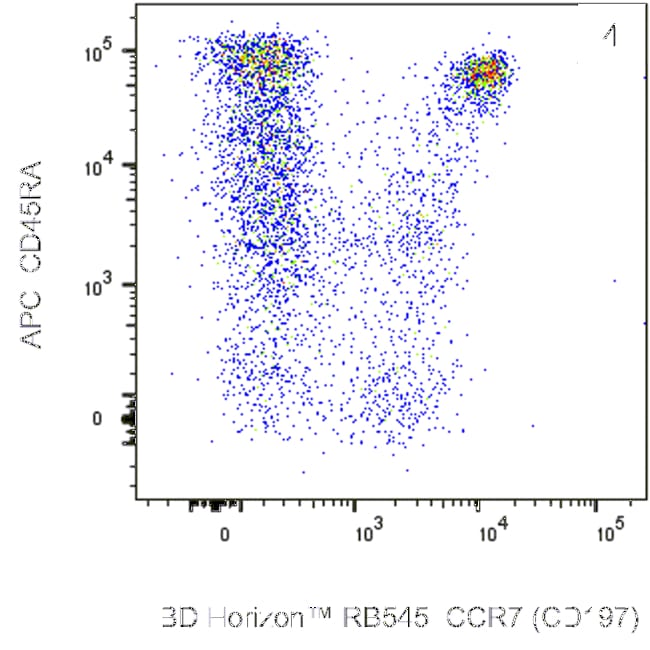
The 2-L1-A monoclonal antibody specifically binds to the human CC chemokine receptor CCR7, also known as CD197, on the cell surface. CCR7 (previously known as BLR2, EBI1 and CMKBR7) is a seven-transmembrane, G-protein-coupled receptor specific for two CC chemokines: CCL19 (also known as MIP-3β, Exodus-3, and ELC) and CCL21 (also known as 6Ckine, Exodus-2 SLC, TCA4, and SCYA21). CCR7 mRNA is expressed mainly in lymphoid tissues including the spleen, lymph nodes and tonsil, in bone marrow, and on peripheral T and B lymphocytes, cord blood CD34-positive cells, and mature dendritic cells. In response to its cognate chemokines, CCR7 (CD197) mediates homing of leucocytes to secondary lymphoid tissues. Differential CCR7 (CD197) expression can be used to distinguish naive, central memory, and effector memory T cell subsets. The human CCR7 gene, unlike other CC chemokine receptor genes, has been mapped to chromosome 17 (region 17q12). Because the extracellular region of CCR2 (CD192) has significant sequence homology with CCR7 (CD197), BD Biosciences has confirmed that mAb 2-L1-A does not cross-react with CCR2 on the surface of transfected cells.

Specifications
Specifications
| Antigen | CD197 (CCR7) |
| Applications | Flow Cytometry |
| Classification | Monoclonal |
| Clone | 2-L1-A |
| Conjugate | RB545 |
| Formulation | Aqueous buffered solution containing ≤0.09% sodium azide. |
| Gene Alias | BLR2; CC chemokine receptor 7; CMKBR7; EBI1; EVI1; Epstein-Barr virus induced gene 1; MIP-3 beta receptor |
| Host Species | Mouse |
| Immunogen | Human CCR7 Transfected Cell Line |
| Purification Method | Affinity Purified |
| Show More |
Safety and Handling
By clicking Submit, you acknowledge that you may be contacted by Fisher Scientific in regards to the feedback you have provided in this form. We will not share your information for any other purposes. All contact information provided shall also be maintained in accordance with our Privacy Policy.