Learn More
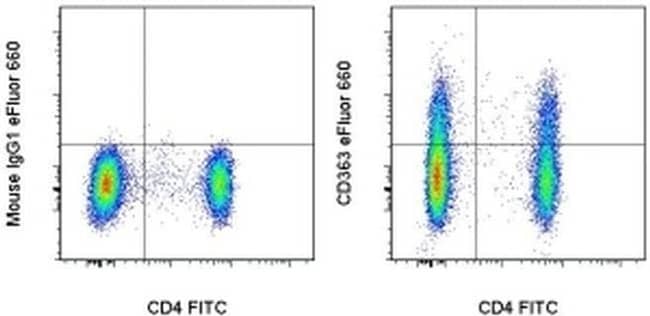
Invitrogen™ CD363 (S1PR1) Monoclonal Antibody (SW4GYPP), eFluor™ 660, eBioscience™, Invitrogen™


Description
Description: The SW4GYPP monoclonal antibody recognizes human CD363, also known as sphingosine-1-phosphate receptor 1 (S1PR1, S1P1), or endothelial differentiation G-protein coupled receptor 1 (EDG1). CD363 is a part of a family of five G-protein-coupled receptors that bind sphingosine-1-phosphate (S1P), a lysophospholipid mediator. It has been shown to be primarily expressed by lymphocytes but is also seen on endothelial cells, B cells, NK cells, monocytes/macrophages, neural progenitors, neurons, astrocytes, and oligodendrocytes. CD363 surface expression is dependent on the extracellular concentration of S1P and its signaling is important for lymphocyte egress from secondary lymphoid tissues and the thymus. CD363 plays a key role in many cellular processes like angiogenesis, vascular maturation, endothelial barrier function and trafficking of immune cells. Therapeutic CD363 modulators have been successful in the treatment of relapsing-remitting multiple sclerosis through sequestration of immune cells in secondary lymphoid organs and, therefore, away from sites of inflammation. Applications Reported: This SW4GYPP antibody has been reported for use in flow cytometric analysis. Applications Tested: This SW4GYPP antibody has been pre-titrated and tested by flow cytometric analysis of normal human peripheral blood cells. This can be used at 5 μL (0.5 μg) per test.

Specifications
Specifications
| Antigen | CD363 (S1PR1) |
| Applications | Flow Cytometry |
| Classification | Monoclonal |
| Clone | SW4GYPP |
| Concentration | 5 μL/Test |
| Conjugate | eFluor 660 |
| Formulation | PBS with BSA and 0.09% sodium azide; pH 7.2 |
| Gene | S1PR1 |
| Gene Accession No. | P21453 |
| Gene Alias | AI849002; CD antigen CD363; CD363; CD363 antigen; CHEDG1; D1S3362; ECGF1; EDG1; EDG-1; EDG1 (Edg1); Edg1; rhodopsin family G protein-coupled receptor; endothelial differentiation G-protein coupled receptor 1; endothelial differentiation sphingolipid G-protein-coupled receptor 1; endothelial differentiation, sphingolipid G-protein-coupled receptor, 1; etID43307.22; Lpb1; Lysophospholipid receptor B1; S1p; S1P receptor 1; S1P receptor Edg-1; s1p1; S1PR1; sphingosine 1-phosphate receptor; sphingosine 1-phosphate receptor 1; sphingosine 1-phosphate receptor EDG1; Sphingosine 1-phosphate receptor Edg-1; sphingosine-1-phosphate receptor 1; wu:fb98f05 |
| Show More |
Frequently Asked Questions (FAQs)
Our options will depend on the samples you are analyzing.
If cell viability is not critical, you can store your stained samples at 4 degrees C or on ice overnight in the dark and analyze the following day.
For samples stained with eFluor organic fluorochromes, we recommend that cells be suspended in 100 uL of Flow Cytometry Staining Buffer (Cat. No. 00-4222) and 100 uL of eBioscience IC Fixation Buffer (Cat. No. 00-8222); samples can be incubated for up to 3 days at 4 degrees C in the dark. Alternatively, the 1-step Fix/Lyse Solution (Cat. No. 00-5333) can be used. This is a great option when working with whole blood but also works for other cell types.
Yes, the eFluor Organic fluorochromes can be used for intracellular staining. The eFluor organic fluorochromes maintain bright signal and require minimal changes in compensation when fixed with eBioscience IC Fixation Buffer (Cat. No. 00-8222-49) and Permeabilization Buffer (Cat. No. 00-8333-56) or 1-step Fix/Lyse Solution (Cat. No. 00-5333-54, 00-5333-57) (as compared to live cells).
Yes, in-house studies have demonstrated that the eFluor 660 fluorochrome is recognized by Anti-Cy5/Alexa Fluor 647 beads. Side by side studies with Alexa Fluor 647 versus eFluor 660 conjugated antibodies have demonstrated comparable results.
The eFluor Organic fluorochromes and eVolve QDots can be used with flow staining buffers containing PBS and protein.
As with other fluorochromes, we recommend minimal exposure to light to maintain optimal signal.
Safety and Handling
For Research Use Only.
By clicking Submit, you acknowledge that you may be contacted by Fisher Scientific in regards to the feedback you have provided in this form. We will not share your information for any other purposes. All contact information provided shall also be maintained in accordance with our Privacy Policy.