Promotional price valid on web orders only. Your contract pricing may differ. Interested in signing up for a dedicated account number?
Learn More

Invitrogen™ CD38 Monoclonal Antibody (HB7), Super Bright™ 600, eBioscience™

Catalog No. 63038842
Encompass_Preferred
Change view
Click to view available options
Quantity:
100 Tests
1 product options available for selection
Product selection table with 1 available options. Use arrow keys to navigate and Enter or Space to select.
Catalog No. Quantity
63-038-842 100 Tests
Use arrow keys to navigate between rows. Press Enter or Space to select a product option. 1 options available.
1 options
Catalog No. 63-038-842 Supplier Invitrogen™ Supplier No. 63038842
Add to Cart
Edge
Add to Cart

Mouse Monoclonal Antibody

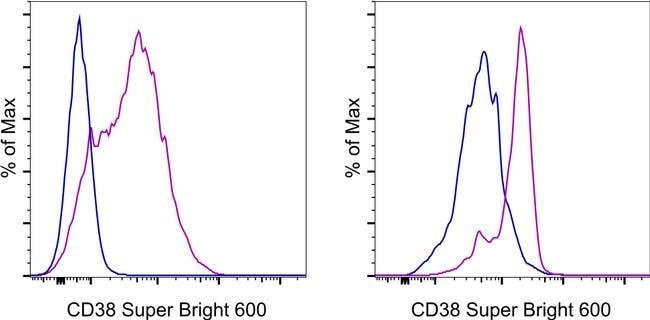
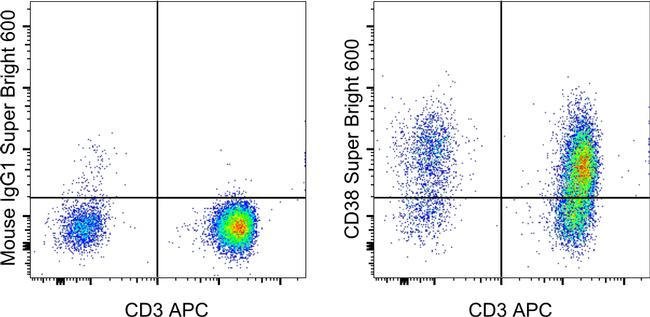
The HB7 monoclonal antibody reacts with the human CD38 molecule, an approximately 45 kDa type II transmembrane protein. CD38 is an ectoenzyme which catalyses NAD into nicotinic acid adenine dinucleotide phosphate (NAADP) and cyclic ADP-ribose (cADPR), both of which are secondary messengers. Expression of CD38 is bimodal during B cell development, modulating from high in immature cells to low in intermediate ones and back to high on mature B cells. Additionally CD38 is found in a variety of tissues and other hematopoietic cells (e.g. T cells, NK cells and monocytes) and can be used to phenotype leukemias and monitor HIV-1 progression. The CD34+CD38- population of hematopoietic stems cells is thought to define the most pluripotent cells (e.g. blast colony forming cells). In addition to surface expression, CD38 has recently been found in the nucleus where it may play a role in monitoring calcium levels. Applications Reported: This HB7 antibody has been reported for use in flow cytometric analysis. Applications Tested: This HB7 antibody has been pre-diluted and tested by flow cytometric analysis of normal human peripheral blood cells. This may be used at 5 μL (0.125 μg) per test. A test is defined as the amount (μg) of antibody that will stain a cell sample in a final volume of 100 μL. Cell number should be determined empirically but can range from 10^5 to 10^8 cells/test. Super Bright 600 is a tandem dye that can be excited with the violet laser line...

CD38 is a multifunctional ectoenzyme and type II transmembrane glycoprotein involved in various cellular processes. It catalyzes the conversion of NAD into secondary messengers such as nicotinic acid adenine dinucleotide phosphate (NAADP) and cyclic ADP-ribose (cADPR). CD38 plays a crucial role in B cell development, with expression levels fluctuating from high in immature cells to low in intermediate ones, and back to high in mature B cells. It is also present in a variety of tissues and hematopoietic cells, including T cells, NK cells, and monocytes, and is used to phenotype leukemias and monitor HIV-1 progression. The CD34+CD38- population is considered to define the most pluripotent hematopoietic stem cells. In addition to its surface expression, CD38 has been identified in the nucleus, where it may regulate calcium levels. It functions as a multi-catalytic ectoenzyme, serving roles as an ADP-ribosyl cyclase, cyclic ADP-ribose hydrolase, and possibly NAD+ glycohydrolase, or as a cell surface receptor. CD38 is involved in the activation, proliferation, and differentiation of mature lymphocytes and mediates apoptosis of myeloid and lymphoid progenitor cells. It also participates in cell adhesion, signal transduction, and calcium signaling. Antibodies to CD38 are valuable for subtyping lymphomas and leukemias, detecting plasma cells (such as in myelomas), and marking activated B and T cells. CD38 is expressed at high levels in the pancreas, liver, kidney, malignant lymphoma, and neuroblastoma. Dysfunctions in CD38 are associated with diseases like chronic lymphocytic leukemia and Richter's Syndrome.
TRUSTED_SUSTAINABILITY

Specifications

Antigen CD38
Applications Flow Cytometry
Classification Monoclonal
Clone HB7
Concentration 5 μL/Test
Conjugate Super Bright 600
Formulation PBS with BSA and 0.09% sodium azide; pH 7.2
Gene CD38
Gene Accession No. P28907
Gene Alias 2'-phospho-ADP-ribosyl cyclase; 2'-phospho-ADP-ribosyl cyclase/2'-phospho-cyclic-ADP-ribose transferase; 2'-phospho-cyclic-ADP-ribose transferase; ADPRC 1; ADPRC1; ADP-ribosyl cyclase 1; ADP-ribosyl cyclase/cyclic ADP-ribose hydrolase 1; cADPr hydrolase 1; Cd38; CD38 antigen; CD38 antigen (ADP-ribosyl cyclase / cyclic ADP-ribose hydrolase); CD38 antigen (p45); CD38 antigen p45; CD38 molecule; CD38H; Cd38-rs1; cluster of differentiation 38; cyclic ADP-ribose hydrolase 1; ecto-nicotinamide adenine dinucleotide glycohydrolase; I-19; NAD(+) nucleosidase; NAD+ nucleosidase; NIM-R5 antigen; T10
Gene Symbols CD38
Host Species Mouse
Purification Method Affinity chromatography
Quantity 100 Tests
Regulatory Status RUO
Primary or Secondary Primary
Gene ID (Entrez) 952
Target Species Human
Content And Storage 4°C, do not freeze
Product Type Antibody
Form Liquid
Isotype IgG1 κ
Show More Show Less
Can I use the OneComp and UltraComp eBeads microspheres with Super Bright-conjugated antibodies?

UltraComp eBeads microspheres (Cat. No. 01-2222) are recommended for use with Super Bright dyes.
Note: Super Bright Staining Buffer (Cat. No. SB-4400) is not compatible with UltraComp eBeads microspheres (Cat. No. 01-2222-41, 00-2222-42). If using UltraComp eBeads microspheres as a compensation tool, solely use Flow Cytometry Stain Buffer (Cat. No. 00-4222-26, 00-4222-57) for any antibody dilutions.

In some experiments, we have observed that compensation values for Super Bright 780- and Brilliant Violet 785- or Brilliant Violet 786-conjugated antibodies are higher in the violet 450/50 channel when using UltraComp eBeads microspheres as compared to single-color stained cells. In such circumstances, we would recommend setting compensation with cells. We have also observed this in some experiments using AbC Total Antibody Compensation beads, both with Super Bright 780 and Brilliant Violet 786. We have not tested Brilliant Violet 785 with the AbC beads.

Can I prepare an antibody cocktail containing Super Bright Staining Buffer and Super Bright-conjugated antibodies ahead of time?

We recommend that the antibody cocktails containing Super Bright-conjugated antibodies and Super Bright Staining Buffer are prepared fresh prior to staining. Discard any unused portions. We do not recommend overnight storage of prepared cocktails.

Can I fix my cells after staining with Super Bright-conjugated antibodies? How long can fixed cells be stored prior to analysis?

Samples that have been stained with antibodies conjugated to Super Bright dyes may be stored for up to three days, at 2-8°C, in the dark, using either IC Fixation Buffer (Cat. No. 00-8222) or 1-step Fix/Lyse Buffer (Cat. No. 00-5333) with no significant effect on brightness or compensation.

Are the Super Bright dyes sensitive to methanol fixation?

Super Bright dyes are stable in methanol-based fixation buffers.

Can Super Bright-conjugated antibodies be used in combination with intracellular (IC Fixation/Permeabilization) or intranuclear (Foxp3 fixation/permeabilization) staining?

Yes, Super Bright-conjugated antibodies are stable in formaldehyde-based fixation buffers and permeabilization buffers, such as the IC Fixation and Permeabilization Buffer Set (Cat. No. 88-8824) and the Foxp3/Transcription Factor Staining Buffer Set (Cat. No. 00-5523).

Which laser do I use to detect Super Bright-conjugated antibodies?

The violet laser (405 nm) should be used to excite Super Bright-conjugated antibodies.

Can the Super Bright Staining Buffer be used with other polymer dyes?

Yes, the Super Bright Staining Buffer (Cat. No. SB-4400) is compatible with other polymer dyes (i.e., Brilliant Violet dyes) and is useful for minimizing any non-specific polymer interactions when two or more of these dyes are used in combination.

Can Super Bright-conjugated antibodies be used in combination with other polymer dyes? What buffer should I use when using more than one Super Bright or polymer dye?

When using two or more Super Bright dyes, or when using Super Bright dyes in combination with other polymer dyes (i.e., Brilliant Violet dyes), we recommend using the Super Bright Staining Buffer (Cat. No. SB-4400) to minimize any non-specific polymer interactions between these fluorochromes. For specific instructions for use, please refer to the product technical data sheet.

Are there recommended tubes for staining with Super Bright-conjugated antibodies?

We recommend using polystyrene tubes (for example, FACS tubes) for staining with your Super Bright-conjugated antibodies. If using polypropylene (for example, Eppendorf tubes), protecting from light is critical.

Is there a specific buffer I should use when staining with Super Bright-conjugated antibodies?

No special buffer is required when using a single Super Bright-conjugated antibody in a panel.
When using more than one Super Bright dye, or when using Super Bright dyes in combination with other polymer dyes (i.e., Brilliant Violet dyes), we recommend using the Super Bright Staining Buffer (Cat. No. SB-4400) to minimize any non-specific polymer interactions between these fluorochromes. For specific instructions for use, please refer to the product technical data sheet.

How does the protocol for staining with Super Bright-conjugated antibodies differ from staining with conventional organic fluorochrome and eVolve conjugated antibodies?

Antibodies conjugated to Super Bright dyes can be used similarly to traditional fluorochromes. If multiple Super Bright dyes are used in combination with each other or in combination with other polymer dyes (i.e., Brilliant Violet dyes), then the use of Super Bright Staining Buffer (Cat. No. SB-4400) is recommended to minimize any non-specific polymer interactions between these fluorochromes. For specific instructions for use, please refer to the product technical data sheet.

Can the Super Bright dyes be used for non-flow applications?

Super Bright dyes have not been tested for applications other than flow cytometry.

What is the difference between the Super Bright and eVolve dyes?

Super Bright dyes are fluorochromes based on polymer technology and are excited by the violet laser. In contrast, eVolve dyes are based on Qdot nanocrystal technology and are maximally excited by the UV laser, although they may also be excited by violet, blue, yellow-green, and, depending on the eVolve, the red laser lines. The general shape of the emission spectra for Super Bright dyes will be more similar to traditional fluorochromes, while eVolve dyes have extremely narrow emission spectra. Please contact Tech Support (techsupport@thermofisher.com) for more information.

What are the Super Bright dyes?

eBioscience Super Bright dyes are a series of patent-pending fluorochromes that are based upon a fluorescent polymer and its tandems. Super Bright dyes have been developed for use in flow cytometry and can be excited by the violet laser (405 nm). The peak emission of each Super Bright dye is indicated by the number in the product description, e.g., "Super Bright 600" has a peak emission of 600 nm.

Are the Super Bright Dyes photo-labile?

As with other fluorochromes, we recommend minimal exposure to light to maintain optimal signal.


WARNING: Cancer - www.P65Warnings.ca.gov
Product Title
Select an issue

By clicking Submit, you acknowledge that you may be contacted by Fisher Scientific in regards to the feedback you have provided in this form. We will not share your information for any other purposes. All contact information provided shall also be maintained in accordance with our Privacy Policy.