Promotional price valid on web orders only. Your contract pricing may differ. Interested in signing up for a dedicated account number?
Learn More

Invitrogen™ CD3e/CD3g Recombinant Rabbit Monoclonal Antibody (4F5G4)
GREENER_CHOICE

Catalog No. PIMA542744
Change view
Click to view available options
Quantity:
100 μL
1 product options available for selection
Product selection table with 1 available options. Use arrow keys to navigate and Enter or Space to select.
Catalog No. Quantity
PIMA542744 100 μL
Use arrow keys to navigate between rows. Press Enter or Space to select a product option. 1 options available.
1 options
This item is not returnable. View return policy
Catalog No. PIMA542744 Supplier Invitrogen™ Supplier No. MA542744
Add to Cart
Add to Cart
This item is not returnable. View return policy

Rabbit Recombinant Monoclonal Antibody

The target is usually found in the following locations: Cell membrane, Single-pass type I membrane protein, Membrane, Single-pass type I membrane protein. Immunogen sequence: MQSGTHWRVL GLCLLSVGVW GQDGNEEMGG ITQTPYKVSI SGTTVILTCP QYPGSEILWQ HNDKNIGGDE DDKNIGSDED HLSLKEFSEL EQSGYYVCYP RGSKPEDANF YLYLRARVCE NCMEMDVMSV ATIVIVDICI TGGLLLLVYY WSKNRKAKAK PVTRGAGAGG RQRGQNKERP PPVPNPDYEP IRKGQRDLYS GLNQRRI(CD 3E)&MEQGKG LAVLILAIIL LQGTLAQSIK GNHLVKVYDY QEDGSVLLTC DAEAKNITWF KDGKMIGFLT EDKKKWNLGS NAKDPRGMYQ CKGSQNKSKP LQVYYRMCQN CIELNAATIS GFLFAEIVSI FVLAVGVYFI AGQDGVRQSR ASDKQTLLPN DQLYQPLKDR EDDQYSHLQG NQLRRN(CD3 G).

The CD3 subunit complex which is crucial in transducing antigen-recognition signals into the cytoplasm of T cells and in regulating the cell surface expression of the TCR complex. T cell activation through the antigen receptor (TCR) involves the cytoplasmic tails of the CD3 subunits CD3 gamma, CD3 delta, CD3 epsilon and CD3 zeta. These CD3 subunits are structurally related members of the immunoglobulins super family encoded by closely linked genes on human chromosome 11. The CD3 components have long cytoplasmic tails that associate with cytoplasmic signal transduction molecules and this association is mediated at least in part by a double tyrosine-based motif present in a single copy in the CD3 subunits. CD3 may play a role in TCR-induced growth arrest, cell survival and proliferation. The CD3 antigen is present on 68-82% of normal peripheral blood lymphocytes, 65-85% of thymocytes and Purkinje cells in the cerebellum. It is never expressed on B or NK cells. Decreased percentages of T lymphocytes may be observed in some autoimmune diseases. The genes encoding the CD3 epsilon, gamma and delta polypeptides are located on chromosome 11. Defects in the CD3 gene are associated with CD3 immunodeficiency.
TRUSTED_SUSTAINABILITY

Specifications

Antigen CD3e/CD3g
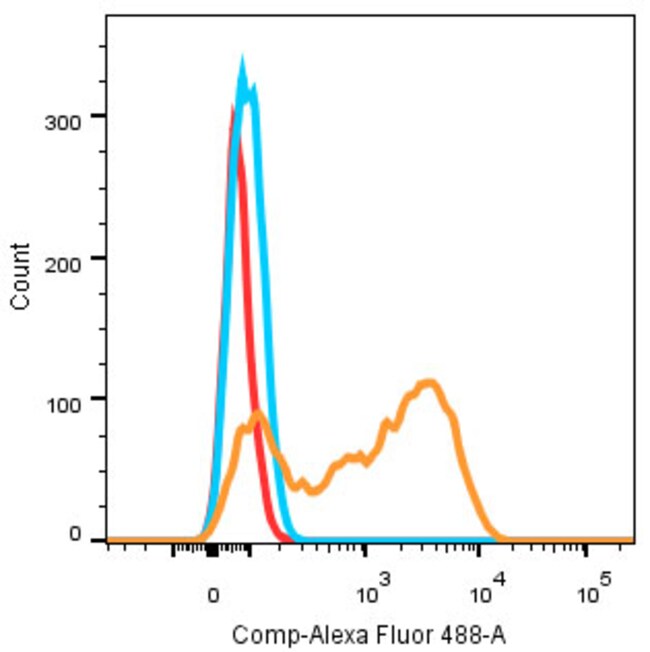
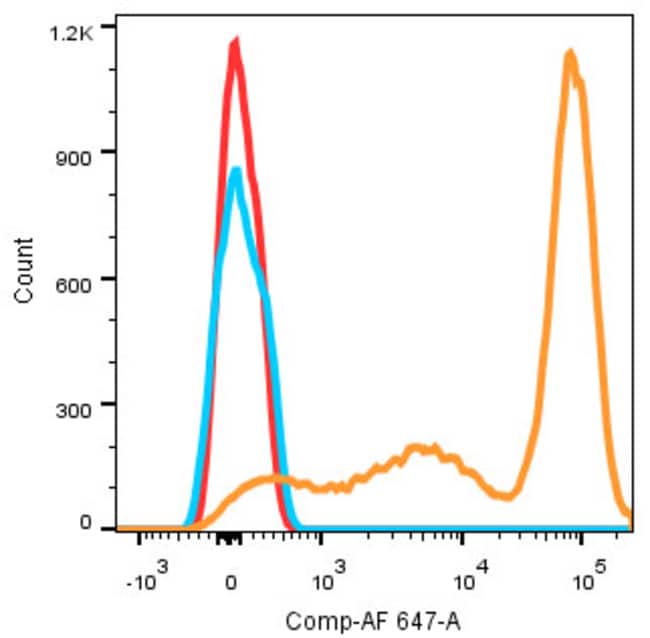
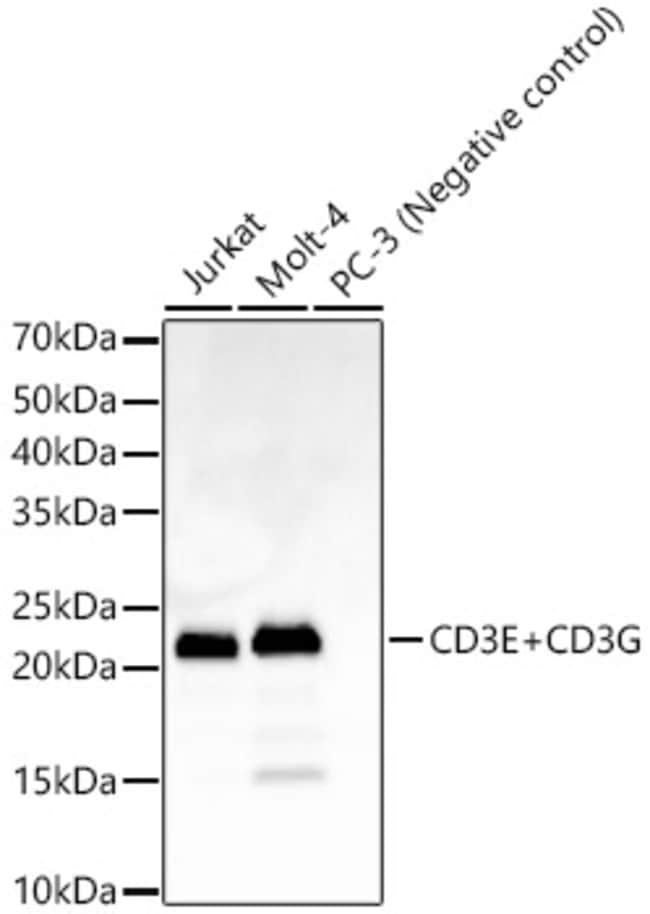
Applications ELISA, Flow Cytometry, Western Blot
Classification Recombinant Monoclonal
Clone 4F5G4
Concentration 0.94 mg/mL
Conjugate Unconjugated
Formulation PBS with 0.05% BSA, 50% glycerol and 0.05% ProClin 300; pH 7.3
Gene CD3G
Gene Accession No. P07766, P09693
Gene Symbols CD3E, CD3G
Host Species Rabbit
Immunogen Recombinant fusion protein containing a sequence corresponding to amino acids 1-207(CD3E)& 1-182(CD3G) of human CD3 epsilon&CD3 gamma Heterodimer.
Purification Method Affinity Chromatography
Quantity 100 μL
Regulatory Status RUO
Primary or Secondary Primary
Gene ID (Entrez) 916, 917
Target Species Human
Content And Storage -20°C, Avoid Freeze/Thaw Cycles
Product Type Antibody
Form Liquid
Isotype IgG
Show More Show Less
WARNING: Cancer - www.P65Warnings.ca.gov
Product Title
Select an issue

By clicking Submit, you acknowledge that you may be contacted by Fisher Scientific in regards to the feedback you have provided in this form. We will not share your information for any other purposes. All contact information provided shall also be maintained in accordance with our Privacy Policy.