Learn More
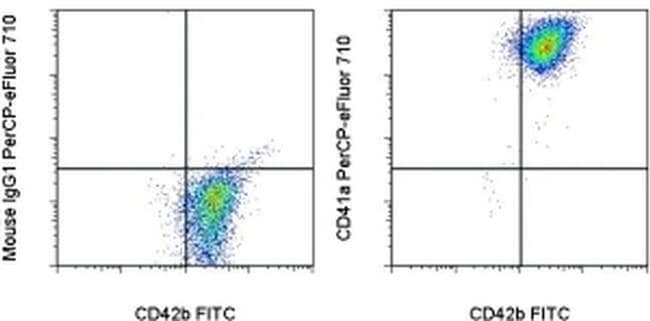
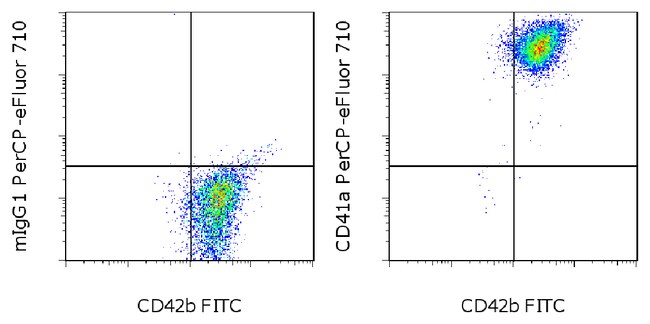
Invitrogen™ CD41a Monoclonal Antibody (HIP8), PerCP-eFluor™ 710, eBioscience™, Invitrogen™


Description
ITGA2B encodes integrin alpha chain 2b. Integrins are heterodimeric integral membrane proteins composed of an alpha chain and a beta chain. Alpha chain 2b undergoes post-translational cleavage to yield disulfide-linked light and heavy chains that join with beta 3 to form a fibronectin receptor expressed in platelets that plays a crucial role in coagulation. Mutations that interfere with this role result in thrombasthenia. In addition to adhesion, integrins are known to participate in cell-surface mediated signalling.

Specifications
Specifications
| Antigen | CD41a |
| Applications | Flow Cytometry |
| Classification | Monoclonal |
| Clone | HIP8 |
| Concentration | 5 μL/Test |
| Conjugate | PerCP-eFluor 710 |
| Formulation | PBS with BSA and 0.09% sodium azide; pH 7.2 |
| Gene | Itga2b |
| Gene Accession No. | P08514 |
| Gene Alias | AI172977; alpha IIb; alphaIIb; alphaIIb protein; BDPLT16; BDPLT2; CD41; CD41B; form 1; form 2; GP IIb; GP2B; GPalpha IIb; GPIIb; GT; GTA; HPA3; integrin alpha 2b; integrin alpha 2b (Cd41b); integrin alpha-IIb; Integrin alpha-IIb heavy chain; Integrin alpha-IIb light chain; Integrin alpha-IIb light chain, form 1; Integrin alpha-IIb light chain, form 2; integrin subunit alpha 2b; integrin subunit alpha IIb; integrin, alpha 2B; integrin, alpha 2b (platelet glycoprotein IIb of IIb/IIIa complex, antigen CD41); ITGA2B; ITGAB; platelet fibrinogen receptor, alpha subunit; platelet glycoprotein IIb; platelet glycoprotein IIb of IIb/II Ia complex; platelet glycoprotein IIb of IIb/IIIa complex; platelet membrane glycoprotein IIb; platelet-specific antigen BAK; PPP1R93; protein phosphatase 1, regulatory subunit 93 |
| Show More |
Frequently Asked Questions (FAQs)
Our options will depend on the samples you are analyzing.
If cell viability is not critical, you can store your stained samples at 4 degrees C or on ice overnight in the dark and analyze the following day.
For samples stained with eFluor organic fluorochromes, we recommend that cells be suspended in 100 uL of Flow Cytometry Staining Buffer (Cat. No. 00-4222) and 100 uL of eBioscience IC Fixation Buffer (Cat. No. 00-8222); samples can be incubated for up to 3 days at 4 degrees C in the dark. Alternatively, the 1-step Fix/Lyse Solution (Cat. No. 00-5333) can be used. This is a great option when working with whole blood but also works for other cell types.
Yes, the eFluor Organic fluorochromes can be used for intracellular staining. The eFluor organic fluorochromes maintain bright signal and require minimal changes in compensation when fixed with eBioscience IC Fixation Buffer (Cat. No. 00-8222-49) and Permeabilization Buffer (Cat. No. 00-8333-56) or 1-step Fix/Lyse Solution (Cat. No. 00-5333-54, 00-5333-57) (as compared to live cells).
The eFluor Organic fluorochromes and eVolve QDots can be used with flow staining buffers containing PBS and protein.
The eFluor Organic Dyes (eFluor 450, APC-eFluor 780, PerCP-eFluor 710, eFluor 710) are conventional fluorochromes. In contrast, the eVolve line of products are Quantum dots.
As with other fluorochromes, we recommend minimal exposure to light to maintain optimal signal.
For Research Use Only.
By clicking Submit, you acknowledge that you may be contacted by Fisher Scientific in regards to the feedback you have provided in this form. We will not share your information for any other purposes. All contact information provided shall also be maintained in accordance with our Privacy Policy.