Promotional price valid on web orders only. Your contract pricing may differ. Interested in signing up for a dedicated account number?
Learn More

Invitrogen™ CD43 Monoclonal Antibody (MEM-59), Alexa Fluor™ 700
GREENER_CHOICE

Catalog No. PIMA528597
Change view
Click to view available options
Quantity:
100 Tests
1 product options available for selection
Product selection table with 1 available options. Use arrow keys to navigate and Enter or Space to select.
Catalog No. Quantity
PIMA528597 100 Tests
Use arrow keys to navigate between rows. Press Enter or Space to select a product option. 1 options available.
1 options
Catalog No. PIMA528597 Supplier Invitrogen™ Supplier No. MA528597
Only null left
Add to Cart
Add to Cart

Mouse Monoclonal Antibody

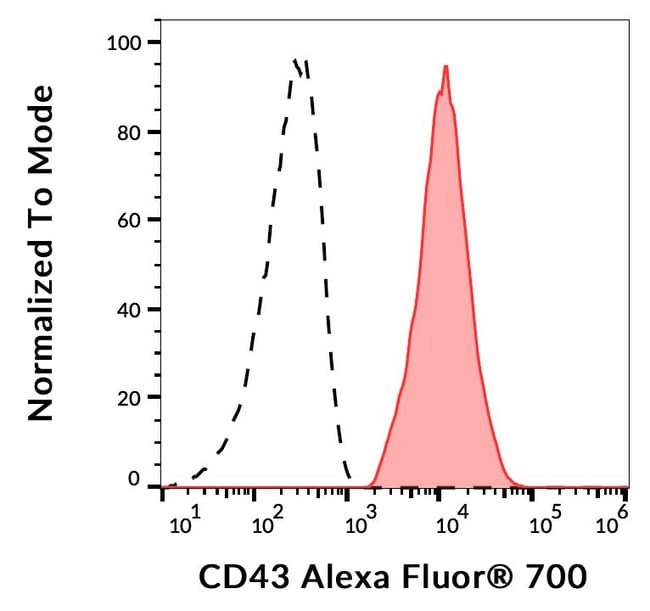
This antibody recognizes a neuraminidase-sensitive extracellular epitope on CD43 (Leukosialin), a 95-135 kDa type I transmembrane glycoprotein (mucin-type) which is involved in lymphocyte activation. CD43 is expressed by platelets and at high levels on the surface of all leukocytes; it is negative on resting B lymphocytes and erythrocytes. Recommended dilution is for 100 μL of whole blood or 1x10^6 cells in suspension.

CD43, also known as leukosialin or sialophorin, is a transmembrane mucin-like protein characterized by a high negative charge. It is expressed on the surface of most hematopoietic cells, excluding resting B lymphocytes. CD43 serves both adhesive and anti-adhesive functions, contributing to a repulsive barrier that can interfere with cellular adhesion while also promoting leukocyte aggregation in certain contexts. CD43 is involved in the activation of T cells, B cells, NK cells, and monocytes. Its expression decreases upon activation due to proteolytic processing. The counter-receptor for CD43 is CD169/SIGLEC-1, which is expressed on macrophages. CD43 interacts with actin-binding proteins ezrin and moesin, playing a regulatory role in remodeling T-cell morphology and regulating cell-cell interactions during lymphocyte traffic. It enhances LFA-1 adhesiveness while counteracting LFA-1 induction via other receptors. CD43 signaling induces the functionally active tumor suppressor p53 protein, but in cases of p53 and ARF deficiency, it can promote tumor proliferation and viability. CD43 is an important modulator of leukocyte functions, with dysfunctions associated with diseases such as Wiscott-Aldrich Syndrome and Adenoid Basal Cell Carcinoma.
TRUSTED_SUSTAINABILITY

Specifications

Antigen CD43
Applications Flow Cytometry
Classification Monoclonal
Clone MEM-59
Concentration 0.21 mg/mL
Conjugate Alexa Fluor 700
Formulation TBS with 0.2% BSA and 15mM sodium azide
Gene SPN
Gene Accession No. P16150
Gene Alias 3E8 antigen; A630014B01Rik; B-cell differentiation antigen LP-3; CD43; CD43 cytoplasmic tail; CD43-ct; Galactoglycoprotein; GALGP; gpL115; Leukocyte sialoglycoprotein; leukosialin; leukosianin; LOC101120462; LOW QUALITY PROTEIN: leukosialin; Lsn; Lsn1; Ly48; Ly-48; Lymphocyte antigen 48; sialophorin; sialophorin (gpL115, leukosialin, CD43); sialophorin gpL115; SPN; W3/13 antigen
Gene Symbols SPN
Host Species Mouse
Immunogen Human T lymphocytes.
Purification Method Size-exclusion chromatography
Quantity 100 Tests
Regulatory Status RUO
Primary or Secondary Primary
Gene ID (Entrez) 6693
Target Species Human
Content And Storage 4°C, store in dark, DO NOT FREEZE!
Product Type Antibody
Form Liquid
Isotype IgG1
Show More Show Less
Product Title
Select an issue

By clicking Submit, you acknowledge that you may be contacted by Fisher Scientific in regards to the feedback you have provided in this form. We will not share your information for any other purposes. All contact information provided shall also be maintained in accordance with our Privacy Policy.