Learn More
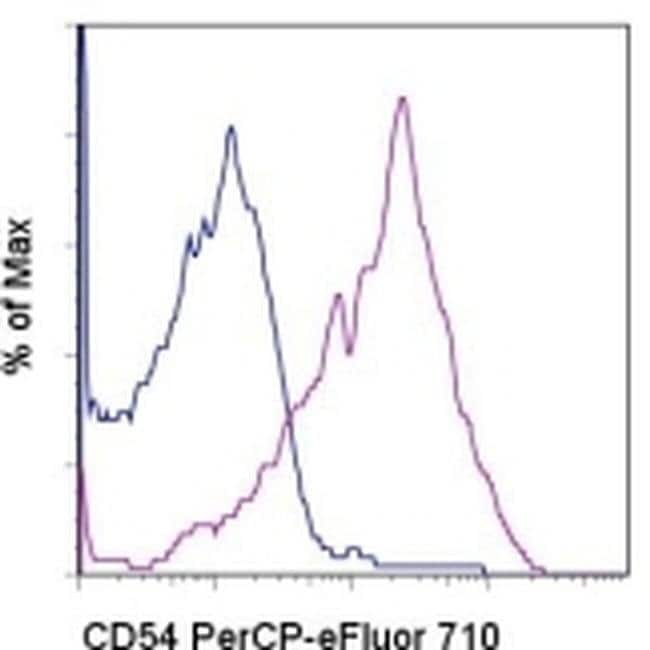
Invitrogen™ CD54 (ICAM-1) Monoclonal Antibody (1A29), PerCP-eFluor™ 710, eBioscience™


Description
Description: The 1A29 monoclonal antibody reacts with rat CD54, which is also known as intercellular adhesion molecule 1 (ICAM-1). In the immune system, this type I immunoglobulin (Ig)-like transmembrane protein is expressed on lymphocytes, macrophages, dendritic cells, monocytes, granulocytes, and thymic stromal cells. CD54 is also present on endothelial cells and such non-immune cells as hepatocytes, cardiomyocytes, and vascular smooth muscle cells. In addition, reports demonstrate that CD54 expression can be induced in vitro by proinflammatory cytokines, including IFN-gamma, IL-1, CCL2, or TNF-alpha. CD54 plays important roles in transendothelial migration of leukocytes to sites of inflammation and in T cell interactions with antigen presenting cells. Studies indicate that CD54 mediates these functions by binding to lymphocyte function-associated molecule (LFA-1; also known as CD11a/CD18). The 1A29 antibody has been reported to block interactions between CD54 and LFA-1. Applications Reported: This 1A29 antibody has been reported for use in flow cytometric analysis. Applications Tested: This 1A29 antibody has been tested by flow cytometric analysis of rat splenocytes. This can be used at less than or equal to 0.125 μg per test. A test is defined as the amount (μg) of antibody that will stain a cell sample in a final volume of 100 μL. Cell number should be determined empirically but can range from 10^5 to 10^8 cells/test. It is recommended that the antibody be ca...

Specifications
Specifications
| Antigen | CD54 (ICAM-1) |
| Applications | Flow Cytometry |
| Classification | Monoclonal |
| Clone | 1A29 |
| Concentration | 0.2 mg/mL |
| Conjugate | PerCP-eFluor 710 |
| Formulation | PBS with 0.09% sodium azide; pH 7.2 |
| Gene | ICAM1 |
| Gene Accession No. | Q00238 |
| Gene Alias | BB2; CD54; cell surface glycoprotein P3.58; Human rhinovirus receptor; ICAM; Icam1; ICAM-1; ICAM-1; CD54 homolog; Intercellular adhesion molecule 1; intercellular adhesion molecule 1 (CD54), human rhinovirus receptor; intercellular adhesion molecule-1; intercellular adhesion molecule-1 precursor; Ly 47; Ly-47; major group rhinovirus receptor; MALA2; MALA-2; MyD10; P3.58; sCD54; soluble CD54; Surface antigen of activated B cells |
| Show More |
Frequently Asked Questions (FAQs)
Our options will depend on the samples you are analyzing.
If cell viability is not critical, you can store your stained samples at 4 degrees C or on ice overnight in the dark and analyze the following day.
For samples stained with eFluor organic fluorochromes, we recommend that cells be suspended in 100 uL of Flow Cytometry Staining Buffer (Cat. No. 00-4222) and 100 uL of eBioscience IC Fixation Buffer (Cat. No. 00-8222); samples can be incubated for up to 3 days at 4 degrees C in the dark. Alternatively, the 1-step Fix/Lyse Solution (Cat. No. 00-5333) can be used. This is a great option when working with whole blood but also works for other cell types.
Yes, the eFluor Organic fluorochromes can be used for intracellular staining. The eFluor organic fluorochromes maintain bright signal and require minimal changes in compensation when fixed with eBioscience IC Fixation Buffer (Cat. No. 00-8222-49) and Permeabilization Buffer (Cat. No. 00-8333-56) or 1-step Fix/Lyse Solution (Cat. No. 00-5333-54, 00-5333-57) (as compared to live cells).
The eFluor Organic fluorochromes and eVolve QDots can be used with flow staining buffers containing PBS and protein.
As with other fluorochromes, we recommend minimal exposure to light to maintain optimal signal.
Safety and Handling
By clicking Submit, you acknowledge that you may be contacted by Fisher Scientific in regards to the feedback you have provided in this form. We will not share your information for any other purposes. All contact information provided shall also be maintained in accordance with our Privacy Policy.