Learn More
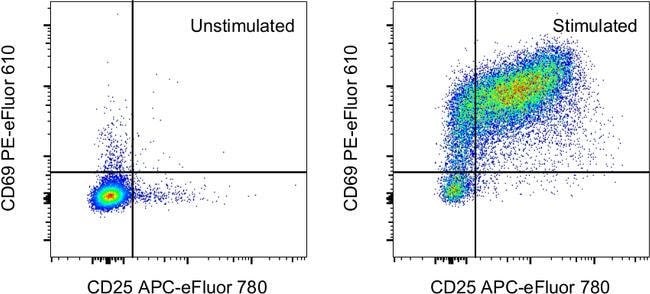
Invitrogen™ CD69 Monoclonal Antibody (H1.2F3), PE-eFluor™ 610, eBioscience™, Invitrogen™


Description
The H1.2F3 MAb reacts with mouse CD69, also known as very early activation antigen (VEA). CD69 is approximately 35 kDa and is expressed on the surface as a disulfide-linked dimer. While a small subset of lymphocytes in the thymus, spleen and lymph nodes express this antigen, activation of both T and B cells rapidly upregulates the surface expression of CD69, suggesting a role for CD69 in lymphocyte development and activation.

Specifications
Specifications
| Antigen | CD69 |
| Applications | Flow Cytometry |
| Classification | Monoclonal |
| Clone | H1.2F3 |
| Concentration | 0.2 mg/mL |
| Conjugate | PE-eFluor 610 |
| Formulation | PBS with 0.09% sodium azide; pH 7.2 |
| Gene | CD69 |
| Gene Accession No. | P37217 |
| Gene Alias | 5830438K24Rik; Activation inducer molecule; activation inducer molecule (AIM/CD69); AI452015; AIM; BL-AC/P26; CD69; CD69 antigen; CD69 antigen (p60, early T-cell activation antigen); CD69 molecule; CLEC2C; C-type lectin domain family 2 member C; C-type lectin domain family 2, member C; EA1; early activation antigen CD69; early lymphocyte activation antigen; early T-cell activation antigen p60; GP32/28; leukocyte surface antigen Leu-23; MLR-3; VEA; Very Early Activation Antigen |
| Show More |
By clicking Submit, you acknowledge that you may be contacted by Fisher Scientific in regards to the feedback you have provided in this form. We will not share your information for any other purposes. All contact information provided shall also be maintained in accordance with our Privacy Policy.