Promotional price valid on web orders only. Your contract pricing may differ. Interested in signing up for a dedicated account number?
Learn More
Learn More
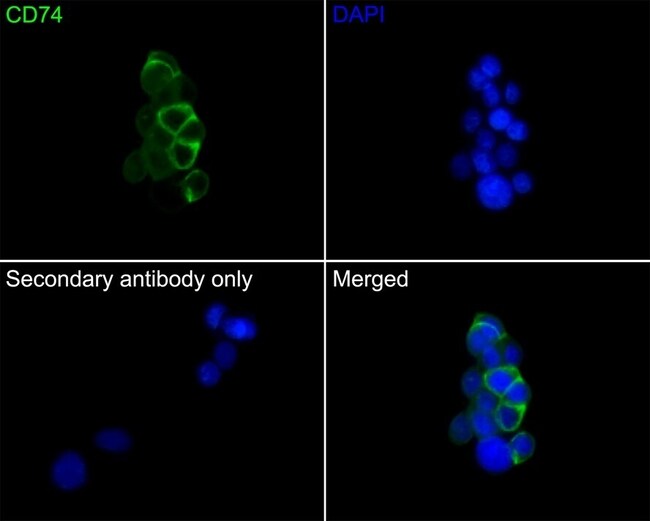
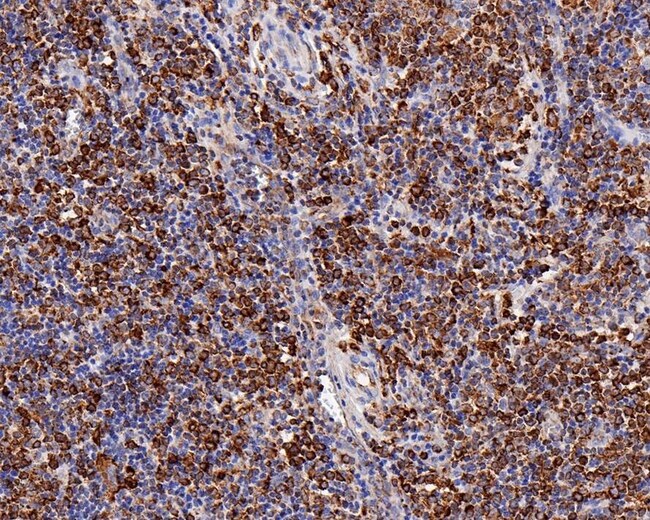
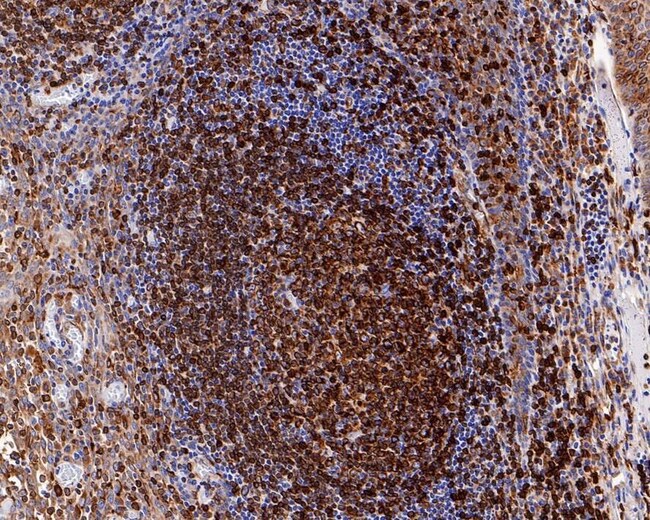

Invitrogen™ CD74 Recombinant Mouse Monoclonal Antibody (PDM0-22)

Description
Positive control: Human B-cell lymphoma tissue, human tonsil tissue, LOVO, Daudi cell lysate, Raji cell lysate. Predicted band size: 33 kDa Subcellular Location: Endoplasmic reticulum membrane, trans-Golgi network, cell membrane, lysosome, endosome.
HLA-DR, like other MHC class II molecules, is a transmembrane glycoprotein composed of a 36 kDa alpha chain (DRA) and 27 kDa beta chain (DRB). The alpha chain gene contains 5 exons. Exon 1 encodes the leader peptide, exons 2 and 3 encode the two extracellular domains, and exon 4 encodes the transmembrane domain and the cytoplasmic tail. DRA does not have polymorphisms in the peptide binding part and acts as the sole alpha chain for DRB1, DRB3, DRB4 and DRB5. Within the DR molecule the beta chain contains all the polymorphisms specifying the peptide binding specificities. Hundreds of DRB1 alleles have been described and typing for these polymorphisms is routinely done for bone marrow and kidney transplantation. HLA-DR is expressed primarily on antigen presenting cells such as B lymphocytes, monocytes, macrophages, thymic epithelial cells and activated T lymphocytes. Three loci, DR, DQ and DP, encode the major expressed products of the human class II region. The human MHC class II molecules bind intracellularly processed peptides, present them to T-helper cells, and have a critical role in the initiation of the immune response.

Specifications
Specifications
| Antigen | CD74 |
| Applications | Immunohistochemistry (Paraffin), Western Blot, Immunocytochemistry |
| Classification | Recombinant Monoclonal |
| Clone | PDM0-22 |
| Concentration | 2 mg/mL |
| Conjugate | Unconjugated |
| Formulation | PBS with 0.1% BSA, 40% glycerol and 0.05% sodium azide; pH 7.4 |
| Gene | CD74 |
| Gene Accession No. | P04233 |
| Gene Alias | CD74; CD74 antigen; CD74 antigen (invariant polypeptide of major histocompatibility complex, class II antigen-associated); CD74 molecule; Cd74 molecule, major histocompatibility complex, class II invariant chain; class II-associated invariant chain peptide; CLIP; DHLAG; dinucleotide microsatellite; gamma chain of class II antigens; H-2 class II histocompatibility antigen gamma chain; histocompatibility: class II antigens, gamma chain of; HLA class II histocompatibility antigen gamma chain; HLADG; HLA-DR antigens-associated invariant chain; HLA-DR-gamma; ia antigen-associated invariant chain; Ia-associated invariant chain; Ia-GAMMA; Ii; invariant polypeptide of major histocompatibility complex, class II antigen-associated; INVG34; MHC class II-associated invariant chain; MHC HLA-DR gamma chain; p33 |
| Show More |
Product Title
By clicking Submit, you acknowledge that you may be contacted by Fisher Scientific in regards to the feedback you have provided in this form. We will not share your information for any other purposes. All contact information provided shall also be maintained in accordance with our Privacy Policy.
Spot an opportunity for improvement?