Promotional price valid on web orders only. Your contract pricing may differ. Interested in signing up for a dedicated account number?
Learn More
Learn More
Invitrogen™ CHMP1A Polyclonal Antibody

Description
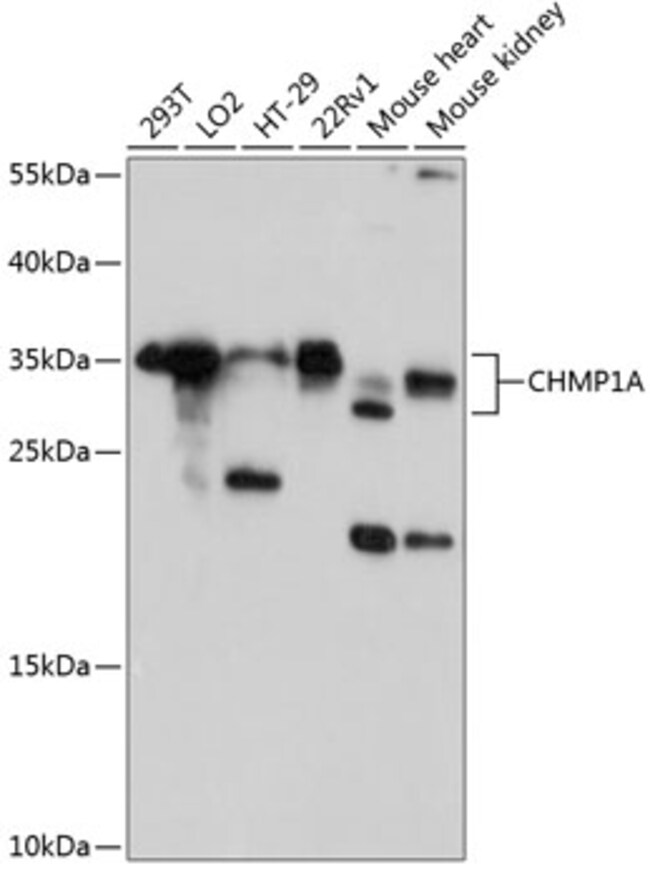
Immunogen sequence: MDDTLFQLKF TAKQLEKLAK KAEKDSKAEQ AKVKKALLQK NVECARVYAE NAIRKKNEGV NWLRMASRVD AVASKVQTAV TMKGVTKNMA QVTKALDKAL STMDLQKVSS VMDRFEQQVQ NLDVHTSVME DSMSSATTLT TPQEQVDSLI MQIAEENGLE VLDQLSQLPE GASAVGESSV RSQEDQLSRR LAALRN; Positive Samples: 293T, LO2, HT-29, 22RV1, Mouse heart, Mouse kidney; Cellular Location: Cytoplasm, Endosome membrane, Nucleus matrix, Peripheral membrane protein.
Probable peripherally associated component of the endosomal sorting required for transport complex III (ESCRT-III) which is involved in multivesicular bodies (MVBs) formation and sorting of endosomal cargo proteins into MVBs. MVBs contain intraluminal vesicles (ILVs) that are generated by invagination and scission from the limiting membrane of the endosome and mostly are delivered to lysosomes enabling degradation of membrane proteins, such as stimulated growth factor receptors, lysosomal enzymes and lipids. The MVB pathway appears to require the sequential function of ESCRT-O, -I, -II and -III complexes. ESCRT- III proteins mostly dissociate from the invaginating membrane before the ILV is released. The ESCRT machinery also functions in topologically equivalent membrane fission events, such as the terminal stages of cytokinesis and the budding of enveloped viruses (HIV-1 and other lentiviruses). ESCRT-III proteins are believed to mediate the necessary vesicle extrusion and/or membrane fission activities, possibly in conjunction with the AAA ATPase VPS4. Involved in cytokinesis. Involved in recruiting VPS4A and/or VPS4B to the midbody of dividing cells. May also be involved in chromosome condensation. Targets the Polycomb group (PcG) protein BMI1/PCGF4 to regions of condensed chromatin. May play a role in stable cell cycle progression and in PcG gene silencing.

Specifications
Specifications
| Antigen | CHMP1A |
| Applications | ELISA, Western Blot |
| Classification | Polyclonal |
| Concentration | 2.15 mg/mL |
| Conjugate | Unconjugated |
| Formulation | PBS with 50% glycerol and 0.01% thimerosal; pH 7.3 |
| Gene | CHMP1A |
| Gene Accession No. | Q921W0, Q9HD42 |
| Gene Alias | 2900018H07Rik; charged multivesicular body protein 1/chromatin modifying protein 1; charged multivesicular body protein 1a; CHMP1; CHMP1A; chromatin modifying protein 1A; chromatin-modifying protein 1a; hVps46-1; KIAA0047; PCH8; PCOLN3; procollagen (type III) N-endopeptidase; protease, metallo, 1, 33kD; PRSM1; Vacuolar protein sorting-associated protein 46-1; Vps46-1; VPS46A |
| Gene Symbols | CHMP1A |
| Show More |
Product Title
By clicking Submit, you acknowledge that you may be contacted by Fisher Scientific in regards to the feedback you have provided in this form. We will not share your information for any other purposes. All contact information provided shall also be maintained in accordance with our Privacy Policy.
Spot an opportunity for improvement?