Learn More
Invitrogen™ CHRNA9 Polyclonal Antibody

Description
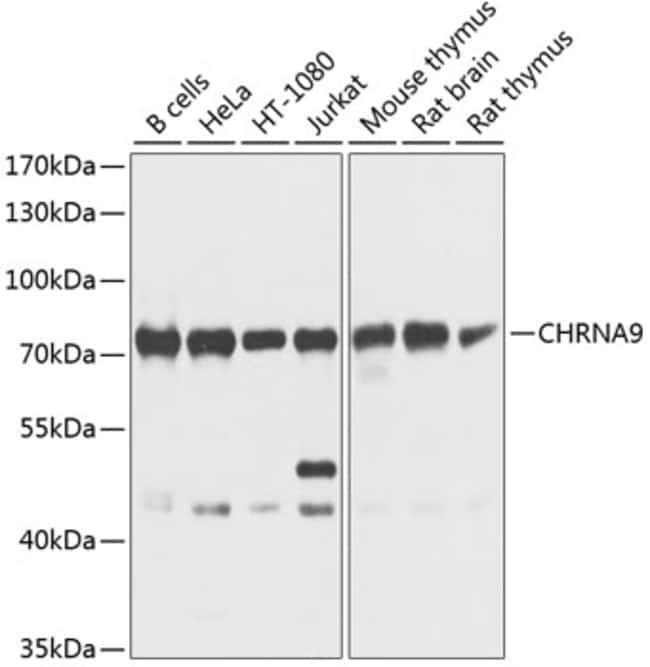
Positive test controls include: B cells, HeLa, HT-1080, Jurkat, Mouse thymus, Rat brain, Rat thymus. The target is usually found in the following locations: Cell junction, Cell membrane, Multi-pass membrane protein, postsynaptic cell membrane, synapse. Immunogen sequence: ADGKYAQKLF NDLFEDYSNA LRPVEDTDKV LNVTLQITLS QIKDMDERNQ ILTAYLWIRQ IWHDAYLTWD RDQYDGLDSI RIPSDLVWRP DIVLYNKADD ESSEPVNTNV VLRYDGLITW DAPAITKSSC VVDVTYFPFD NQQCNLTFGS WTYNGNQVDI FNALDSGDLS DFIEDVEWEV HGMPAVKNVI SYGCCSEPYP DVTFTLLLKR RSSFY.

Specifications
Specifications
| Antigen | CHRNA9 |
| Applications | ELISA, Western Blot |
| Classification | Polyclonal |
| Concentration | 0.78 mg/mL |
| Conjugate | Unconjugated |
| Formulation | PBS with 50% glycerol and 0.02% sodium azide; pH 7.3 |
| Gene | CHRNA9 |
| Gene Accession No. | P43144, Q9UGM1 |
| Gene Alias | 2410015I05Rik; acetylcholine receptor; acetylcholine receptor alpha 9 subunit (nAChR); acetylcholine receptor, neuronal nicotinic, alpha-9 subunit; Acra9; cholinergic receptor; cholinergic receptor nicotinic alpha 9 subunit; cholinergic receptor, nicotinic alpha 9; cholinergic receptor, nicotinic, alpha 9; cholinergic receptor, nicotinic, alpha 9 (neuronal); cholinergic receptor, nicotinic, alpha 9a; cholinergic receptor, nicotinic, alpha polypeptide 9; chrna9; chrna9a; EG666827; Gm8311; HSA243342; LOW QUALITY PROTEIN: neuronal acetylcholine receptor subunit alpha-9; NACHR alpha 9; NACHR alpha-9; NACHRA9; neuronal acetylcholine receptor protein, alpha-9 subunit; neuronal acetylcholine receptor subunit alpha-9; nicotinic acetylcholine receptor subunit alpha 9; nicotinic acetylcholine receptor subunit alpha-9; si:dkey-274k22.9 |
| Gene Symbols | CHRNA9 |
| Show More |
By clicking Submit, you acknowledge that you may be contacted by Fisher Scientific in regards to the feedback you have provided in this form. We will not share your information for any other purposes. All contact information provided shall also be maintained in accordance with our Privacy Policy.