Promotional price valid on web orders only. Your contract pricing may differ. Interested in signing up for a dedicated account number?
Learn More
Learn More
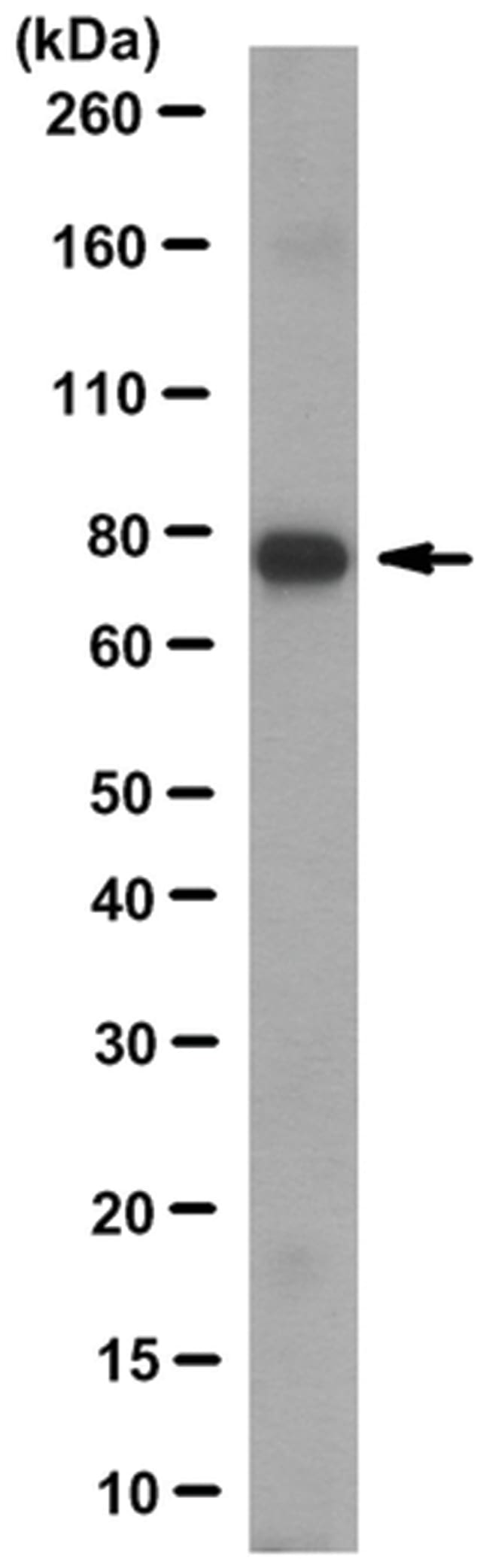
MilliporeSigma™ Cortactin (p80/85), Mouse, Unlabeled, Clone: 5G3.2,
Shop All MilliporeSigma ProductsDescription
Src substrate cortactin (UniProt Q14247; also known as Amplaxin, Oncogene EMS1) is encoded by the CTTN (also known as EMS1) gene (Gene ID 2017) in human. Cortactin is a cytosolic protein that promotes polymerization and rearrangement of the actin cytoskeleton, especially the actin cortex around the cellular periphery. Cortactin is activated via phosphorylation by upstream kinases in response to extracellular stimuli. Src is known to phosphorylate cortactin on Tyr421, Tyr466, and Tyr482, leading to cortactin interaction with F-actin and Arp2/3. Erk can also phosphorylate cortactin on Ser405 and Ser418, causing recruitment of additional actin nucleation-promoting factors (NPFs), most importantly N-WASP, to the Arp2/3/ complex. Phosphorylated cortactin thus recruits and stabilizes Arp2/3 complex on preexisting F-actin, providing a nucleation site for a new actin branch to form. Cortactin overexpression in tumor cells enhances invasiveness as a result of highly active lamellipodia formation, also known as invadopodia. Cortactin contains an N-terminal aspartic acid-aspartic acid-tryptophan (DDW) sequence (a.a. 29-31 in chicken; a.a. 20-22 in human and mouse) that mediates its interaction with Arp2/3, followed by six and a half repeat sequences (a.a. 80-125, 126-162, 163-199, 200-236, 237-273, 274-310, 311-333 in chicken; a.a. 80-116, 117-153, 154-190, 191-227, 228-264, 265-301, 302-324 in human and mouse) that mediates F-actin interaction, a proline-rich coiled coil domain (a.a. 349-410 in chicken; a.a. 348-401 in human and mouse) that mediates Src SH3 domain interaction, and a C-terminal SH3 domain (a.a. 505-563 in chicken; a.a. 492-550 in human a.a. 488-546 in mouse) that contains Erk phosphorylation sites and is important for cortactin interaction with NPFs other than Arp2/3.

Specifications
Specifications
| Antigen | Cortactin (p80/85) |
| Applications | Western Blot |
| Classification | Monoclonal |
| Clone | 5G3.2 |
| Concentration | Please refer to lot specific datasheet. |
| Conjugate | Unconjugated |
| Formulation | Purified mouse IgG2b in buffer containing 0.1M Tris-Glycine (pH 7.4), 150mM NaCl with 0.05% Sodium Azide. |
| Gene | CTTN, EMS1 |
| Gene Accession No. | Q14247 |
| Host Species | Mouse |
| Show More |
For Research Use Only. Not for use in diagnostic procedures.
Product Title
By clicking Submit, you acknowledge that you may be contacted by Fisher Scientific in regards to the feedback you have provided in this form. We will not share your information for any other purposes. All contact information provided shall also be maintained in accordance with our Privacy Policy.
Spot an opportunity for improvement?