Promotional price valid on web orders only. Your contract pricing may differ. Interested in signing up for a dedicated account number?
Learn More
Learn More
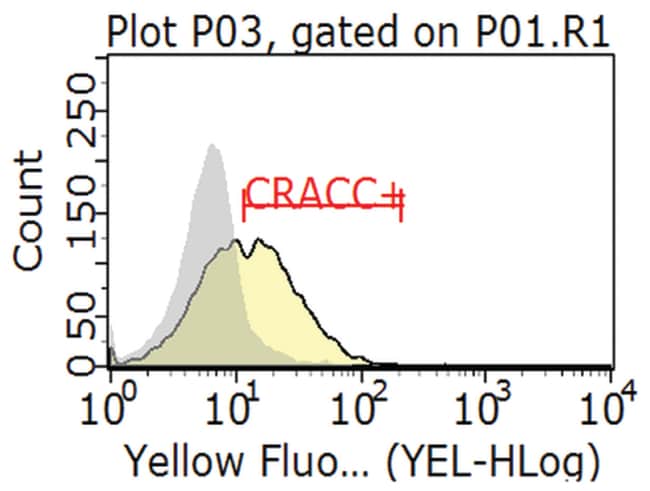
Description
SLAM family member 7 (UniProt Q8BHK6; also known as CD2-like receptor-activating cytotoxic cells, CRACC, Leukocyte cell-surface antigen, Novel Ly9, CD319) is encoded by the Slamf7 (also known as Cs1) gene (Gene ID 75345) in murine species. CRACC/CS1 belongs to the 6-member (SLAM/CD150, Ly-9/CD229, 2B4/CD244, CD84, NTB-A/CD352, CRACC) signaling lymphocytic activation molecule family (SLAMF) of receptors broadly expressed in hematopoietic cells. 2B4 and CD48 interact with each other, while rest of the family members act as self-ligands, where two identical molecules on the surface of two different cells can interact as receptor and ligand to each other. CRACC is synthesized with a signal peptide sequence (a.a. 1-22), the removal of which yields the mature CRACC with an extracellular region (a.a. 23-224) that contains a V-type and a C2-type Ig-like domain (a.a. 27-112 and 128-203), followed by a single transmembrane domain (a.a. 225-245) and a cytoplasmic tail (a.a. 246-333). CRACC cytoplasmic domain contains one immunoreceptor tyrosine-based switch motif (ITSM; 278-TFYSTV-283, numbering based on mature murine sequence), which upon phosphorylation (pY300) recruits SAP family adaptor EWS-Fli1-activated transcript-2 (EAT-2) for signaling transduction. CRACC can also be phosphorylated on Tyr280. Unlike pY300, pY280 mediates the inhibitory function of CRACC in NK cells. In addition to NK cells, evidence indicates that CRACC is also involved in regulating B- and T-cell functions.

Specifications
Specifications
| Antigen | CRACC |
| Applications | Functional Assay, Immunoprecipitation |
| Classification | Monoclonal |
| Clone | 4G2 |
| Concentration | Please refer to lot specific datasheet. |
| Conjugate | Unconjugated |
| Formulation | Purified rat monoclonal IgG1κ antibody in PBS without preservatives. |
| Gene | Slamf7, Cs1 |
| Gene Accession No. | Q8BHK6 |
| Host Species | Rat |
| Show More |
For Research Use Only. Not for use in diagnostic procedures.
Product Title
By clicking Submit, you acknowledge that you may be contacted by Fisher Scientific in regards to the feedback you have provided in this form. We will not share your information for any other purposes. All contact information provided shall also be maintained in accordance with our Privacy Policy.
Spot an opportunity for improvement?