Learn More
Invitrogen™ Cutaneous Lymphocyte Antigen (CLA) Monoclonal Antibody (HECA-452), eBioscience™

Description
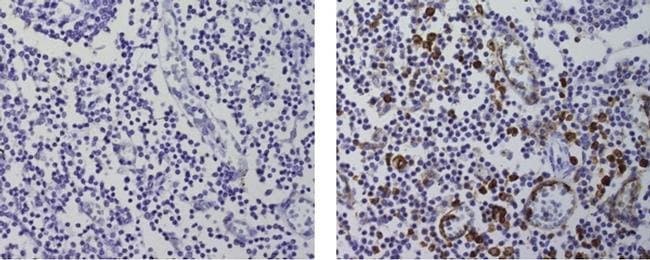
This HECA-452 monoclonal antibody reacts with human Cutaneous Lymphocyte Antigen (CLA). This cell surface glycoprotein is most highly expressed on T cells in the skin. Nevertheless, CLA can also be detected on some peripheral T and NK cells, as well as monocytes, neutrophils and CD1a+ dendritic cells. Studies have determined that this antibody recognizes sialofucosylated glycans and sialyl Lewis x (sLex). CLA, which binds E-selectin and endothelial cell-leukocyte adhesion molecule 1 (ELAM-1), is involved in T lymphocyte infiltration and adhesion at cutaneous sites of inflammation. The HECA-452 antibody has been reported to inhibit sLex binding to E-selectin; however, this property is still under debate in the literature. Applications Reported: This HECA-452 antibody has been reported for use in flow cytometric analysis, western blotting, functional assays, and immunohistochemical staining of formalin-fixed paraffin embedded tissue sections. Applications Tested: This HECA-452 antibody has been tested by flow cytometric analysis on human PBMCs and by immunohistochemistry on FFPE human tissue. The HECA-452 antibody can be used at less than or equal to 0.125 μg/test for flow cytometry and at less than or equal to 10 μg/mL. The antibody performs optimally with low pH antigen retrieval but high pH antigen retrieval can also be used. It is recommended that the antibody be carefully titrated for optimal performance in the assay of interest. Purity: Greater than...

Specifications
Specifications
| Antigen | Cutaneous Lymphocyte Antigen (CLA) |
| Applications | Flow Cytometry, Functional Assay, Immunohistochemistry (Paraffin), Western Blot |
| Classification | Monoclonal |
| Clone | HECA-452 |
| Concentration | 0.5 mg/mL |
| Conjugate | Unconjugated |
| Formulation | PBS with 0.09% sodium azide; pH 7.2 |
| Gene Alias | CLA |
| Host Species | Rat |
| Purification Method | Affinity chromatography |
| Show More |
By clicking Submit, you acknowledge that you may be contacted by Fisher Scientific in regards to the feedback you have provided in this form. We will not share your information for any other purposes. All contact information provided shall also be maintained in accordance with our Privacy Policy.