Learn More
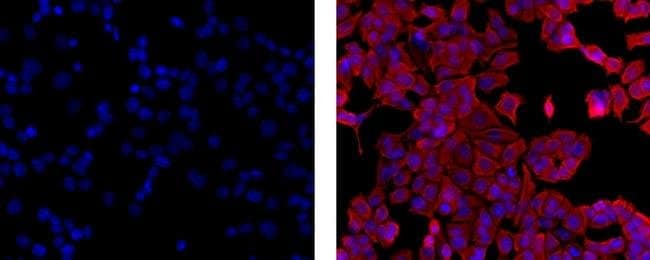
Invitrogen™ Cytokeratin 18 Monoclonal Antibody (LDK18), eFluor™ 570, eBioscience™


Description
The monoclonal antibody LDK18 recognizes human Cytokeratin 18. Cytokeratin 18 is member of the large family of intermediate filaments found within epithelial cells. The family of cytokeratins is made up of type I (acidic) and type II (basic) members which form heterodimers by pairing an acidic with a basic member to compose the keratin filament. Cytokeratin 18 (type I) is most commonly found associated with cytokeratin 8 (type II). Because many tumors of epithelial origin retain expression of keratin proteins, cytokeratin 18 has been used as a tumor marker to identify both tumors and metastases. In addition, cytokeratin 18 has been shown to be expressed in highly proliferative retinal pigment epithelium cells. Applications Reported: This LDK18 antibody has been reported for use in microscopy, immunohistochemical staining, and immunocytochemistry. Applications Tested: This LDK18 antibody has been tested by immunocytochemistry of MeOH-fixed human cells and can be used at less than or equal to 1 μg/mL. It is recommended that the antibody be carefully titrated for optimal performance in the assay of interest. Filter Recommendation: When using this eFluor 570 antibody conjugate, we recommend a filter that will capture the 570 emission wavelength (for example, Excitation 545/25, 565LP, Emission 605/70). A standard Alexa Fluor 555 or TRITC filter is acceptable. Excitation: 555 nm; Emission: 570 nm.

Specifications
Specifications
| Antigen | Cytokeratin 18 |
| Applications | Immunohistochemistry, Immunocytochemistry |
| Classification | Monoclonal |
| Clone | LDK18 |
| Concentration | 0.2 mg/mL |
| Conjugate | eFluor 570 |
| Formulation | PBS with 0.09% sodium azide; pH 7.2 |
| Gene | KRT18 |
| Gene Accession No. | P05783 |
| Gene Alias | cb83; Cell proliferation-inducing gene 46 protein; CK 18; CK18; CK-18; CYK18; cytokeratin 18; cytokeratin endo B; cytokeratin type -1; DAPK-1; Cytokeratin18; cytokeratin-18; dapk1; dorsal aorta proneprin kinesin-1; DreK18; Endo B; I79_023185; K 18; K18; keratin 18; keratin 18, type I; keratin 18a, tandem duplicate 1; keratin complex 1, acidic, gene 18; keratin D; Keratin, type I cytoskeletal 18; Keratin18; keratin-18; Kerd; KRT 18; Krt1-18; KRT18; krt18 {ECO:0000250; krt18a.1; LOC100008885; PIG46; sb:cb83; type I cytoskeletal 18; UniProtKB:P05783}; wu:fa13f02; wu:fb36b04 |
| Show More |
Frequently Asked Questions (FAQs)
Yes, the eFluor Organic fluorochromes can be used for intracellular staining. The eFluor organic fluorochromes maintain bright signal and require minimal changes in compensation when fixed with eBioscience IC Fixation Buffer (Cat. No. 00-8222-49) and Permeabilization Buffer (Cat. No. 00-8333-56) or 1-step Fix/Lyse Solution (Cat. No. 00-5333-54, 00-5333-57) (as compared to live cells).
The eFluor Organic fluorochromes and eVolve QDots can be used with flow staining buffers containing PBS and protein.
The eFluor Organic Dyes (eFluor 450, APC-eFluor 780, PerCP-eFluor 710, eFluor 710) are conventional fluorochromes. In contrast, the eVolve line of products are Quantum dots.
As with other fluorochromes, we recommend minimal exposure to light to maintain optimal signal.
Safety and Handling
By clicking Submit, you acknowledge that you may be contacted by Fisher Scientific in regards to the feedback you have provided in this form. We will not share your information for any other purposes. All contact information provided shall also be maintained in accordance with our Privacy Policy.