Promotional price valid on web orders only. Your contract pricing may differ. Interested in signing up for a dedicated account number?
Learn More

DbpB Polyclonal Antibody, Rockland™
SDP

Catalog No. 501990897
Encompass
Encompass_Preferred
Change view
Click to view available options
Quantity:
100 μg
25 μL
2 product options available for selection
Product selection table with 2 available options. Use arrow keys to navigate and Enter or Space to select.
Catalog No. Quantity
50-199-0897 25 μL
50-199-0896 100 μg
Use arrow keys to navigate between rows. Press Enter or Space to select a product option. 2 options available.
2 options
Catalog No. 50-199-0897 Supplier Rockland Immunochemicals Supplier No. 200401C16S
Add to Cart
Add to Cart

Rabbit Polyclonal Antibody

Store vial at 4°C prior to restoration. For extended storage aliquot contents and freeze at -20°C or below. Avoid cycles of freezing and thawing. Centrifuge product if not completely clear after standing at room temperature. This product is stable for several weeks at 4°C as an undiluted liquid. Dilute only prior to immediate use. This antibody is specific for Borrelia burgdorferi DbpB protein. A BLAST analysis was used to suggest cross-reactivity with DbpB from B. burgdorferi and B. garinii sources based on 100% homology with the immunizing sequence. Cross-reactivity with DbpB from other sources has not been determined.

Decorin-binding protein B, or DbpB, binds to decorin, which may mediate the adherence of B.burgdorferi to collagen fibers in skin and other tissues. Spirochetal surface adhesions mediate attachment to decorin, a major component of the host extracellular matrix enabling bacteria to colonize in mammalian tissues. The spirochete migrates from the tick midgut during feeding to its salivary glands and are thus transmitted to the mammal host. This transition may be facilitated by changes in expression of some B. burgdorferi genes. It is believed that expression of the various proteins associated with the spirochete may be regulated by the changes in tick life cycle, changes in conditions during tick feeding (such as temperature, pH, and nutrients) and/or in coordination with the course of infection of the mammal host. Borrelia burgdorferi can colonize multiple tissues, and is capable of attachment to diverse cell types. The expression of decorin-binding protein (Dbp) A and/or DbpB, two B. burgdorferi surface proteins that bind GAGs, is sufficient to convert a high-passage nonadherent B. burgdorferi strain into one that efficiently binds 293 epithelial cells.

Specifications

Antigen DbpB
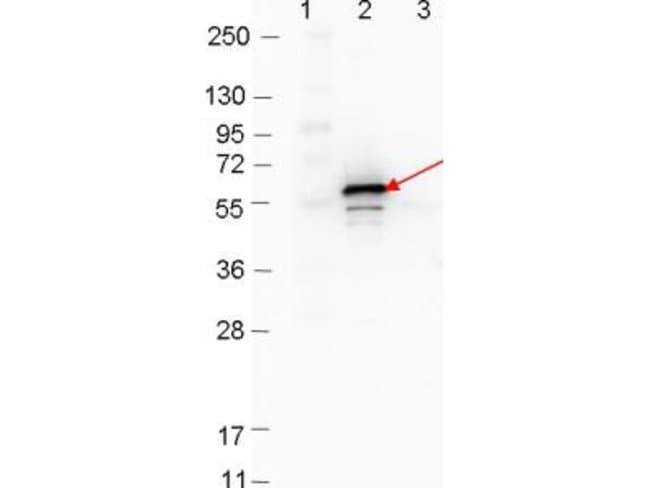
Applications Immunoprecipitation, Western Blot
Classification Polyclonal
Concentration 1 mg/mL
Conjugate Unconjugated
Formulation 0.02M potassium phosphate with 0.15M NaCl and 0.01% sodium azide; pH 7.2
Host Species Rabbit
Immunogen MBP-fusion protein corresponding to Borrelia burgdorferi Dbp-B protein.
Quantity 25 μL
Regulatory Status RUO
Primary or Secondary Primary
Target Species Bacteria
Content And Storage Store at 4°C short term. For long term storage, store at -20°C, avoiding freeze/thaw cycles.
Product Type Antibody
Form Lyophilized
Show More Show Less
Product Title
Select an issue

By clicking Submit, you acknowledge that you may be contacted by Fisher Scientific in regards to the feedback you have provided in this form. We will not share your information for any other purposes. All contact information provided shall also be maintained in accordance with our Privacy Policy.