Promotional price valid on web orders only. Your contract pricing may differ. Interested in signing up for a dedicated account number?
Learn More

Invitrogen™ DCP1A Polyclonal Antibody
GREENER_CHOICE

Catalog No. PIPA5121093
Change view
Click to view available options
Quantity:
100 μL
1 product options available for selection
Product selection table with 1 available options. Use arrow keys to navigate and Enter or Space to select.
Catalog No. Quantity
PIPA5121093 100 μL
Use arrow keys to navigate between rows. Press Enter or Space to select a product option. 1 options available.
1 options
This item is not returnable. View return policy
Catalog No. PIPA5121093 Supplier Invitrogen™ Supplier No. PA5121093
Add to Cart
Add to Cart
This item is not returnable. View return policy

Rabbit Polyclonal Antibody

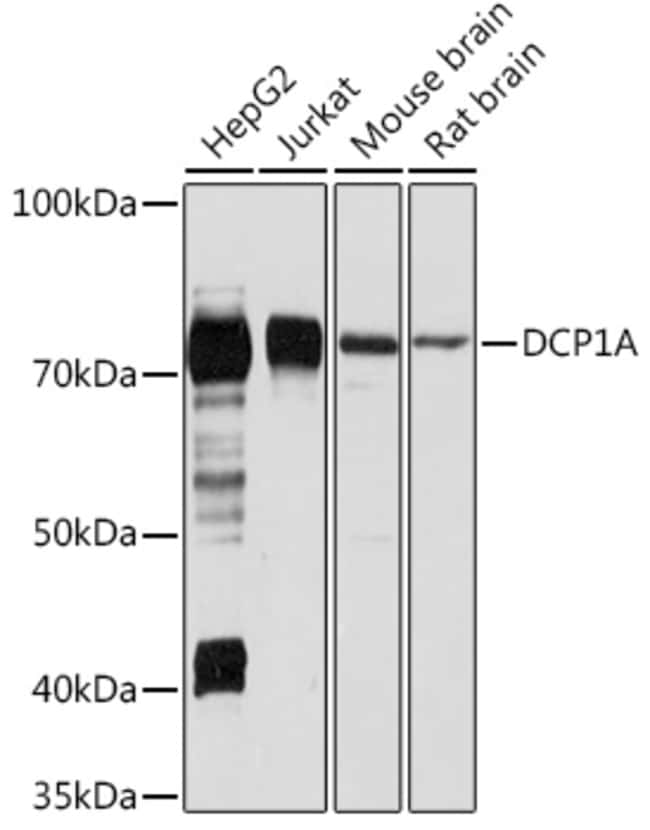
Positive test controls include: HepG2, Jurkat, Mouse brain, Rat brain. The target is usually found in the following locations: Cytoplasm, Nucleus, P-body. Immunogen sequence: NEKHAPTYTI PLSPVLSPTL PAEAPTAQVP PSLPRNSTMM QAVKTTPRQR SPLLNQPVPE LSHASLIANQ SPFRAPLNVT NTAGTSLPSV DLLQKLRLTP QHDQIQTQPL GKGAMVASFS PAAGQLATPE SFIEPPSKTA AARVAASASL SNMVLAPLQS MQQNQDPEVF VQPKVLSSAI PVAGAPLVTA TTTAVSSVLL APSVFQQTVT RSSDLERKAS SPSPLTIGTP ESQRKPSIIL SKSQLQDTLI HLIKNDSSFL STLHEVYLQV LTKNKDNHNL.

Signal transduction of TGF-beta superfamily members is regulated by Smad proteins. In particular, Smads influence specific gene transcription by relaying signals from the cell membrane to the nucleus. Smad4 plays an essential role in TGF-beta-induced transcriptional activation wherein phosphorylated receptor-associated Smads associate with Smad4. Furthermore, SMIF (Smad4-intereacting protein) and Smad4 complex with TGF-beta and BMP4. An increase in Smad4 concentration increases the translocation of this complex to the nucleus. SMIF and Smad4 interact directly through a EVH1/WH1 domain on SMIF and a proline-rich activation domain on Smad4. Smad4 is essential to nuclear translocation of SMIF as deletion of the Smad4-interacting domain (located in the N-terminal 100 amino acids) of SMIF eliminates TGF-beta-induced nuclear translocation of SMIF. The human SMIF gene is ubiquitously expressed and encodes a protein with a relative molecular mass of 70 kDa.
TRUSTED_SUSTAINABILITY

Specifications

Antigen DCP1A
Applications ELISA, Western Blot
Classification Polyclonal
Concentration 1.23 mg/mL
Conjugate Unconjugated
Formulation PBS with 50% glycerol and 0.09% sodium azide; pH 7.3
Gene Dcp1a
Gene Accession No. Q91YD3, Q9NPI6
Gene Alias 1110066A22Rik; 4930568L04Rik; AU019772; D14Ertd817e; DCP1 decapping enzyme homolog A; DCP1 decapping enzyme homolog A (S. cerevisiae); DCP1 decapping enzyme-like protein A; DCP1A; decapping enzyme; decapping enzyme hDcp1a; decapping mRNA 1A; FLJ21691; HSA275986; MAD homolog 4 interacting transcription coactivator 1; MAD homolog 4-interacting transcription coactivator 1; Mitc1; mRNA-decapping enzyme 1A; Nbla00360; putative protein product of Nbla00360; RGD1561298; Smad4-interacting transcriptional co-activator; SMAD4IP1; SMIF; test2; transcription factor SMIF
Gene Symbols Dcp1a
Host Species Rabbit
Immunogen Recombinant fusion protein containing a sequence corresponding to amino acids 303-582 of human DCP1A (NP_060873.4).
Purification Method Affinity Chromatography
Quantity 100 μL
Regulatory Status RUO
Primary or Secondary Primary
Gene ID (Entrez) 361109, 55802, 75901
Target Species Human, Mouse, Rat
Content And Storage -20°C, Avoid Freeze/Thaw Cycles
Product Type Antibody
Form Liquid
Isotype IgG
Show More Show Less
WARNING: Cancer - www.P65Warnings.ca.gov
Product Title
Select an issue

By clicking Submit, you acknowledge that you may be contacted by Fisher Scientific in regards to the feedback you have provided in this form. We will not share your information for any other purposes. All contact information provided shall also be maintained in accordance with our Privacy Policy.