Promotional price valid on web orders only. Your contract pricing may differ. Interested in signing up for a dedicated account number?
Learn More
Learn More
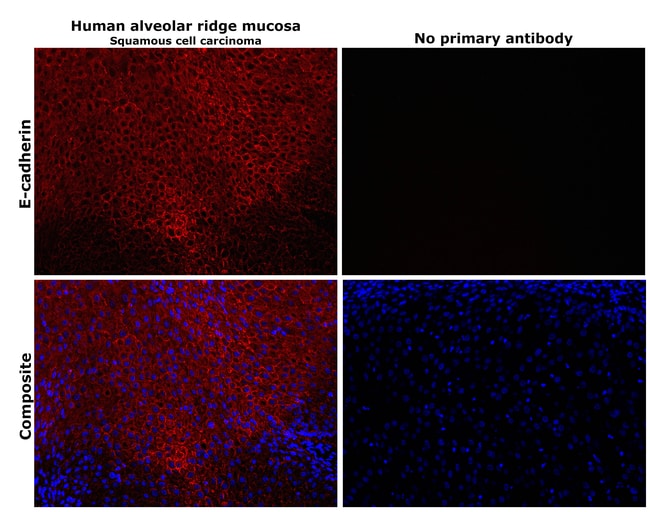
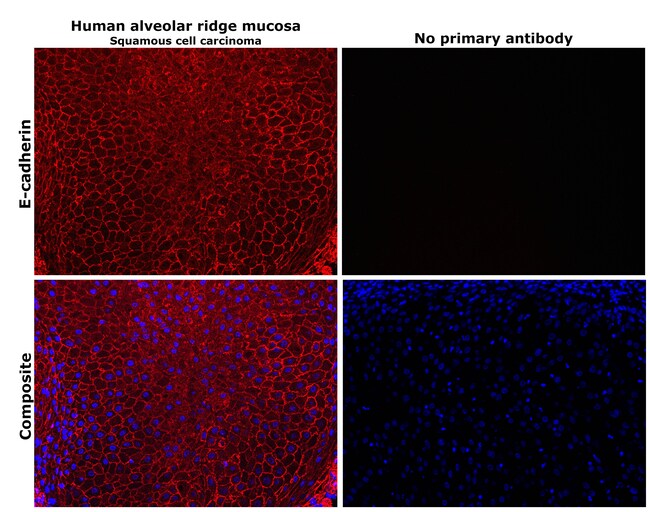
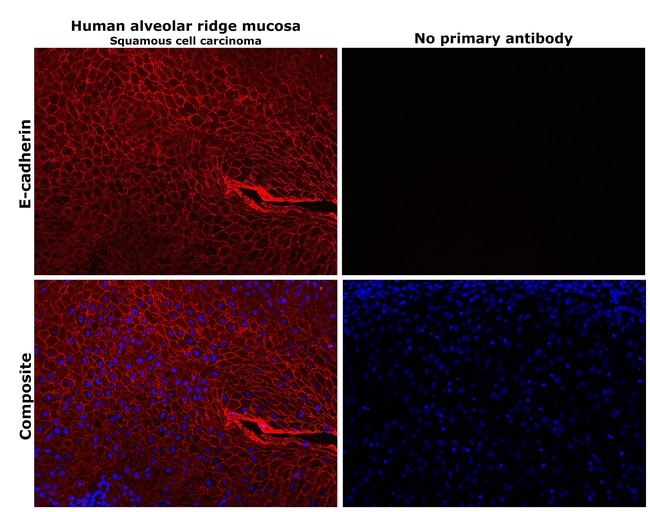
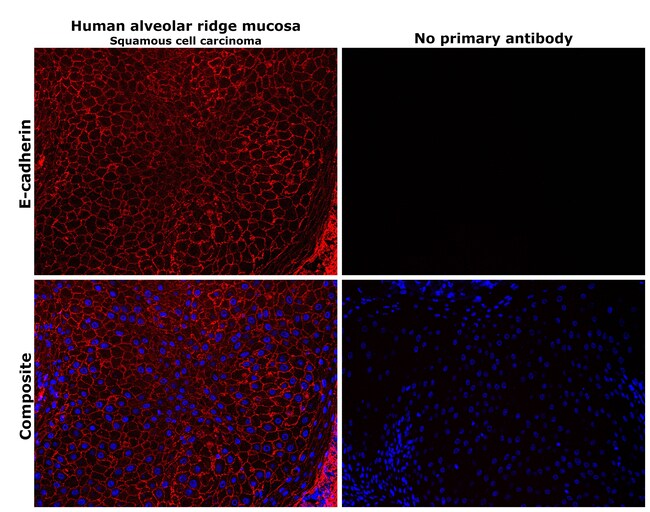
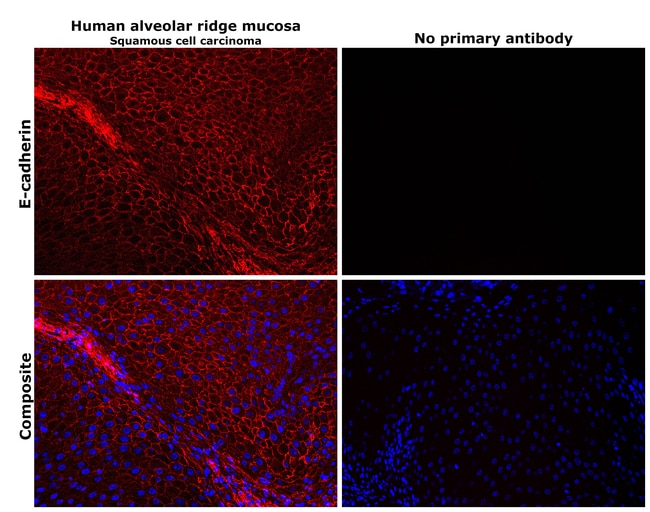
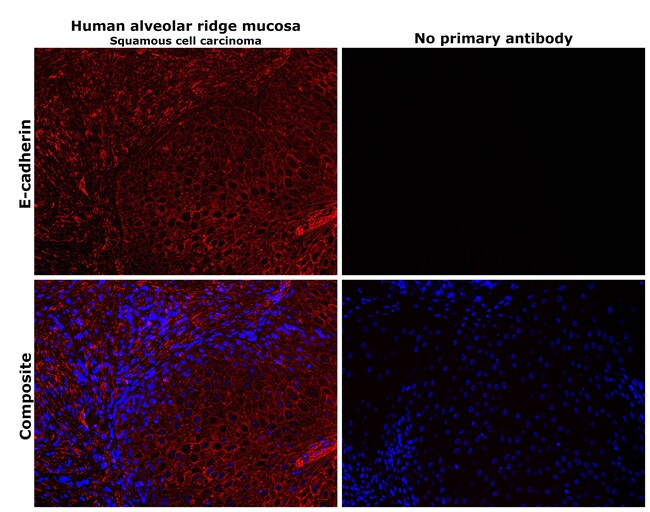


Invitrogen™ E-cadherin Polyclonal Antibody

Description
A diffuse signal may be seen at higher concentrations (5-10 μg/mL) in ICC/IF. For Western Blot, this antibody has non-specific bands at 40 kDa,65 kDa,75 kDa and 90 kDa. This antibody is predicted to react with chicken, cow and Xenopus laevis based on sequence homology. This antibody may not perform well in ICC/IF using mouse cells.
E-Cadherin (epithelial cadherin) is a classical cadherin from the cadherin (alcium dependent adhesion protein) superfamily. The encoded protein is a calcium dependent cell-cell adhesion glycoprotein comprised of five extracellular cadherin repeats, a transmembrane region and a highly conserved cytoplasmic tail. Mutations in this gene are correlated with gastric, breast, colorectal, thyroid and ovarian cancer. Loss of function is thought to contribute to progression in cancer by increasing proliferation, invasion, and/or metastasis. The ectodomain of this protein mediates bacterial adhesion to mammalian cells and the cytoplasmic domain is required for internalization. Identified transcript variants arise from mutation at consensus splice sites. E-cadherin plays a central role in the growth and development of cells by controlling tissue architecture, and maintenance of tissue integrity. In humans, E-cadherin is encoded by the CDH1 gene present on chromosome 16. Studies have demonstrated that reduction and/or loss of E-cadherin expression in carcinomas correlates positively with the potential of these tumors for invasion and metastasis.

Specifications
Specifications
| Antigen | E-cadherin |
| Applications | Immunohistochemistry (Paraffin), Western Blot, Immunocytochemistry |
| Classification | Polyclonal |
| Concentration | 1 mg/mL |
| Conjugate | Unconjugated |
| Formulation | PBS with 1% BSA and 0.02% sodium azide; pH 7.4 |
| Gene | CDH1 |
| Gene Accession No. | P09803, P12830, Q9R0T4 |
| Gene Alias | AA960649; ARC-1; cadherin 1; cadherin 1, E-cadherin (epithelial); cadherin 1, epithelial; cadherin 1, type 1; cadherin 1, type 1, E-cadherin (epithelial); cadherin e; cadherin-1; cadherin-E; calcium-dependent adhesion protein, epithelial; CAM 120/80; CD324; CDH1; CDHE; cell adhesion molecule; cell-CAM 120/80; ECAD; E-cad; E-Cad/CTF1; E-Cad/CTF2; E-Cad/CTF3; Ecadherin; E-cadherin; E-cadherin 1; E-cadherin precursor; Epithelial cadherin; hab; half baked; LCAM; L-CAM; Um; UVO; Uvomorulin |
| Gene Symbols | CDH1 |
| Show More |
Safety and Handling
WARNING: Cancer - www.P65Warnings.ca.gov
Product Title
By clicking Submit, you acknowledge that you may be contacted by Fisher Scientific in regards to the feedback you have provided in this form. We will not share your information for any other purposes. All contact information provided shall also be maintained in accordance with our Privacy Policy.
Spot an opportunity for improvement?