Learn More
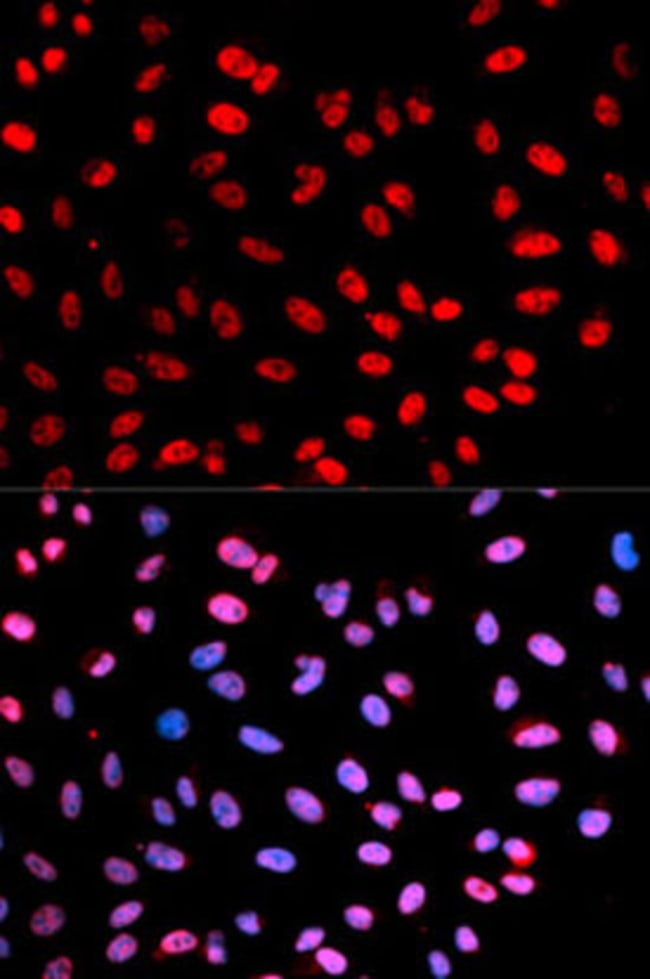
Description
Stable cohesion between sister chromatids before anaphase and their timely separation during anaphase are critical for chromosome inheritance. In vertebrates, sister chromatid cohesion is released in 2 steps via distinct mechanisms. The first step involves phosphorylation of STAG1 (MIM 604358) or STAG2 (MIM 604359) in the cohesin complex. The second step involves cleavage of the cohesin subunit SCC1 (RAD21; MIM 606462) by ESPL1, or separase, which initiates the final separation of sister chromatids (Sun et al., 2009 [PubMed 19345191]).[supplied by OMIM]
Specifications
Specifications
| Antigen | ESPL1 (phospho S1126) |
| Applications | Immunofluorescence, Western Blot |
| Classification | Polyclonal |
| Conjugate | Unconjugated |
| Description | Rabbit polyclonal antibody raised against synthetic phosphopeptide of human ESPL1. |
| Dilution | Immunofluorescence (1:20-1:100) Western Blot (1:500-1:2000) The optimal working dilution should be determined by the end user. |
| Formulation | In PBS (without Mg2+ and Ca2+), 150 mM NaCl, pH 7.4 (50% glycerol, 0.02% sodium azide) |
| Gene Alias | ESP1/FLJ46492/KIAA0165/SEPARASE/SEPARIN |
| Gene Symbols | ESPL1 |
| Host Species | Rabbit |
| Show More |
By clicking Submit, you acknowledge that you may be contacted by Fisher Scientific in regards to the feedback you have provided in this form. We will not share your information for any other purposes. All contact information provided shall also be maintained in accordance with our Privacy Policy.