Promotional price valid on web orders only. Your contract pricing may differ. Interested in signing up for a dedicated account number?
Learn More
Learn More
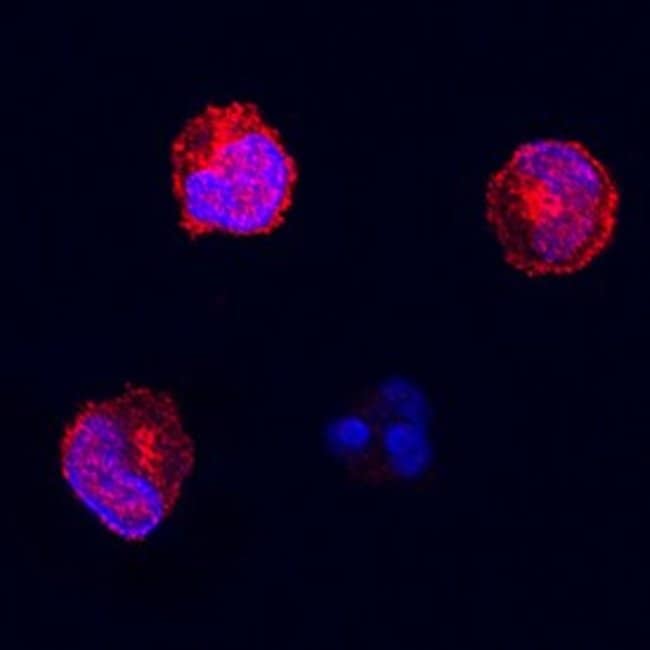
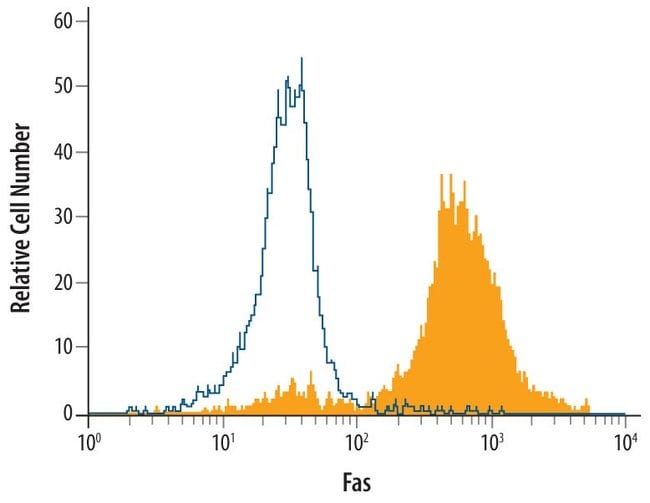
Invitrogen™ FAS Polyclonal Antibody

Description
In direct ELISAs and Western blots, less than 1% cross-reactivity with recombinant human Fas is observed. Reconstitute at 0.2 mg/mL in sterile PBS.
CD95, also known as Fas or APO-1, is a 46 kDa transmembrane glycoprotein that functions as a cell death receptor in the tumor necrosis factor receptor (TNFR) superfamily. It is expressed by a wide range of hematopoietic and non-hematopoietic cells, including monocytes, neutrophils, lymphocytes, and fibroblasts. CD95 also exists in a soluble form weighing approximately 26 kDa. The interaction of CD95 with its ligand, FasL, induces apoptosis, playing a crucial role in peripheral tolerance and anti-viral immune responses. Upon stimulation, CD95 leads to the aggregation of its intracellular Fas-associated death domains (FADD), formation of the death-inducing signaling complex (DISC), and activation of caspases. This cascade results in apoptosis. CD95 is also involved in activating NF-kappaB, MAPK3/ERK1, and MAPK8/JNK, and transduces proliferative signals in normal diploid fibroblasts and T cells. There are at least eight alternatively spliced transcript variants encoding seven distinct isoforms of CD95. Isoforms lacking the transmembrane domain may negatively regulate apoptosis mediated by the full-length isoform. The Fas/Fas ligand system is implicated in several human diseases, including AIDS, hepatitis, and cancer, highlighting its importance in immune regulation and disease pathology.

Specifications
Specifications
| Antigen | FAS |
| Applications | Flow Cytometry, Western Blot, Immunocytochemistry |
| Classification | Polyclonal |
| Concentration | 0.2 mg/mL |
| Conjugate | Unconjugated |
| Formulation | PBS with 5% trehalose and No Preservative |
| Gene | FAS |
| Gene Accession No. | 0 |
| Gene Alias | AI196731; ALPS1A; APO1; APO-1; Apo1 antigen; Apo-1 antigen; APO-1 cell surface antigen; Apo-1 Fas; apoptosis antigen 1; apoptosis signaling receptor FAS; apoptosis-mediating surface antigen FAS; APT1; CD95; CD95 antigen; FAS; Fas (TNF receptor superfamily member 6); Fas (TNF receptor superfamily member); Fas (TNF receptor superfamily, member 6); Fas AMA; Fas antigen; Fas antigen (ATP1); Fas cell surface death receptor; Fas receptor; FAS1; FASLG receptor; FASTM; lpr; lymphoproliferation; OTTHUMP00000020045; OTTHUMP00000020046; OTTHUMP00000020051; OTTHUMP00000059646; TNF receptor superfamily member 6; TNFR6; Tnfrsf6; tumor necrosis factor receptor superfamily member 6; tumor necrosis factor receptor superfamily member 6; tumor necrosis factor receptor superfamily member 26; Tumor necrosis factor receptor superfamily, member 6 |
| Gene Symbols | FAS |
| Show More |
Product Title
By clicking Submit, you acknowledge that you may be contacted by Fisher Scientific in regards to the feedback you have provided in this form. We will not share your information for any other purposes. All contact information provided shall also be maintained in accordance with our Privacy Policy.
Spot an opportunity for improvement?