Promotional price valid on web orders only. Your contract pricing may differ. Interested in signing up for a dedicated account number?
Learn More

PeproTech FGF2 Polyclonal Antibody, PeproTech®, Invitrogen™

Catalog No. 500P181MG
Encompass_Preferred
Change view
Click to view available options
Quantity:
1 mg
100 μg
2 product options available for selection
Product selection table with 2 available options. Use arrow keys to navigate and Enter or Space to select.
Catalog No. Quantity
500-P18-1MG 1 mg
500P18100UG 100 μg
Use arrow keys to navigate between rows. Press Enter or Space to select a product option. 2 options available.
2 options
This item is not returnable. View return policy
Catalog No. 500-P18-1MG Supplier PeproTech Supplier No. 500P181MG
Only null left
Add to Cart
Add to Cart
This item is not returnable. View return policy

Rabbit Polyclonal Antibody

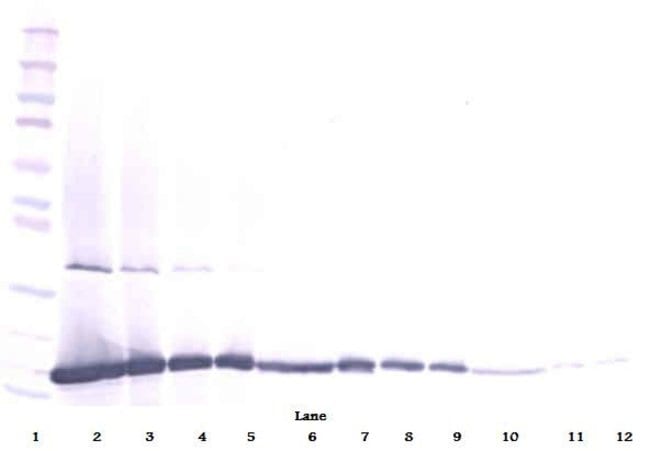
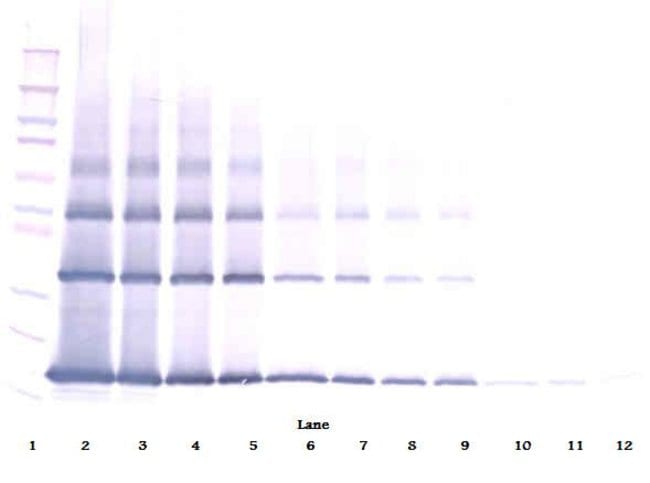
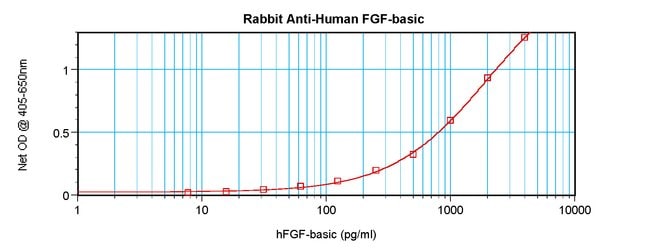
AA Sequence of recombinant protein: AAGSITTLPA LPEDGGSGAF PPGHFKDPKR LYCKNGGFFL RIHPDGRVDG VREKSDPHIK LQLQAEERGV VSIKGVCANR YLAMKEDGRL LASKCVTDEC FFFERLESNN YNTYRSRKYT SWYVALKRTG QYKLGSKTGP GQKAILFLPM SAKS. Preparation: Produced from sera of rabbits immunized with highly pure Recombinant Human FGF-basic. Anti-Human FGF-basic-specific antibody was purified by affinity chromatography employing an immobilized Human FGF-basic matrix. Sandwich ELISA: To detect Human FGF-basic by sandwich ELISA (using 100 μL/well antibody solution) a concentration of 0.5-2.0 μg/mL of this antibody is required. This antigen affinity purified antibody, in conjunction with PeproTech Biotinylated Anti-Human FGF-basic (500-P18Bt) as a detection antibody, allows the detection of at least 0.2-0.4 ng/well of Recombinant Human FGF-basic. Western Blot: To detect Human FGF-basic by Western Blot analysis this antibody can be used at a concentration of 0.1-0.2 μg/mL. Used in conjunction with compatible secondary reagents the detection limit for Recombinant Human FGF-basic is 1.5-3.0 ng/lane, under either reducing or non-reducing conditions.

FGF2 (FGFb, fibroblast growth factor basic) belongs to the fibroblast growth factor (FGF) family, and interacts with high-affinity transmembrane receptors to influence cell proliferation and tissue neovascularization. FGF2 exists as five isoforms with distinct intracellular localizations and functions. The 18 kDa isoform is predominantly cytosolic and acts through cell surface receptors, whereas the 22, 22.5, 24 and 34 kDa isoforms are nuclear and may signal independent of transmembrane receptor pathways. In humans, the gene is located on the q arm of chromosome 4. FGF2 has been implicated in diverse biological processes, such as limb and nervous system development, wound healing, and tumor growth. The mRNA for FGF2 contains multiple polyadenylation sites, and is alternatively translated from non-AUG and AUG initiation codons, resulting in five different isoforms with distinct properties. The CUG-initiated isoforms are localized in the nucleus and are responsible for the intracrine effect, whereas, the AUG-initiated form is mostly cytosolic and is responsible for the paracrine and autocrine effects of this FGF. Diseases associated with FGF2 dysfunction include Kaposi Sarcoma and corneal neovascularization.
TRUSTED_SUSTAINABILITY

Specifications

Antigen FGF2
Applications ELISA, Western Blot
Classification Polyclonal
Concentration 0.1-1.0 mg/mL
Conjugate Unconjugated
Formulation PBS with no preservative
Gene FGF2
Gene Accession No. P09038
Gene Alias Basic fibroblast growth factor; basic fibroblast growth factor bFGF; bFGF; FGF; fgf basic; Fgf2; Fgf-2; Fgfb; FGF-b; Fibroblast growth factor; fibroblast growth factor 2; fibroblast growth factor 2 (basic); Fibroblast growth factor basic; HBGF-2; Heparin-binding growth factor 2; H-FGF-b-147; H-FGF-b-154; M-FGF-b; Prostatic growth factor; prostatropin
Gene Symbols FGF2
Host Species Rabbit
Immunogen E.coli-derived Recombinant Human FGF-basic (154 a.a.).
Purification Method Antigen affinity chromatography
Quantity 1 mg
Regulatory Status RUO
Primary or Secondary Primary
Gene ID (Entrez) 2247
Target Species Human
Content And Storage -20°C
Product Type Antibody
Form Lyophilized
Show More Show Less
Product Title
Select an issue

By clicking Submit, you acknowledge that you may be contacted by Fisher Scientific in regards to the feedback you have provided in this form. We will not share your information for any other purposes. All contact information provided shall also be maintained in accordance with our Privacy Policy.