Learn More
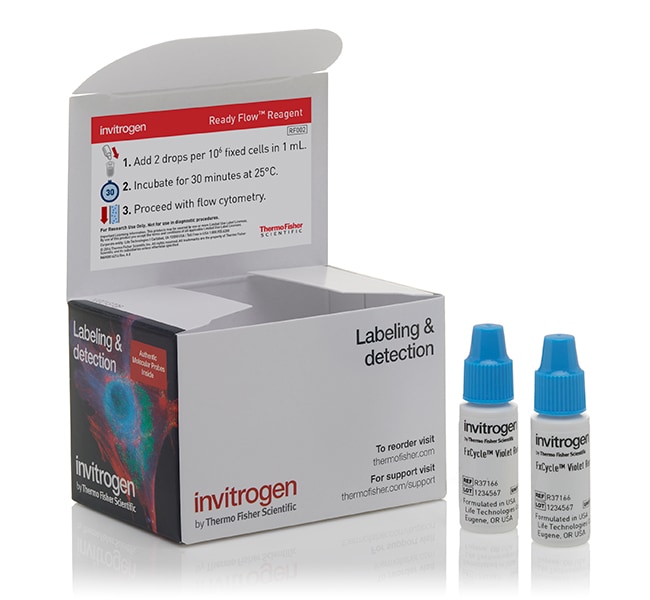
Invitrogen™ FxCycle™ Violet Ready Flow™ Reagent


Description
It is excitable by both UV and 405 nm lasers with an emission peak at 461 nm.
• Stable at room temperature
• Convenient, ready-to-use format—no need to dilute, weigh, or pipette
• Rapid staining of DNA in fixed cells
• No RNase treatment required
FxCycle Violet Ready Flow Reagent is a ready-to-use, direct-to-sample DNA stain. Add 2 drops from the dropper bottle directly into 1 x 10⁶ fixed cells, incubate, and analyze.
As a cell-impermeant dye, FxCycle Violet Ready Flow Reagent enters the cell after fixation and binds double-stranded DNA specifically, eliminating the need for RNase treatment. The dye can be detected when excited with a UV or 405 nm laser, and the emission captured at a peak of 461 nm. FxCycle Violet Ready Flow Reagent is an ideal choice for DNA content analysis and can be included in multi-color cell-cycle studies.

Specifications
Specifications
| Color | Blue |
| Content And Storage | 2 dropper bottles, store at room temperature |
| Product Type | Reagent |
| Dye Type | Cell-Impermeant |
| Product Line | FxCycle Ready Flow |
| Quantity | 120 assays |
| Sub Cellular Localization | Nucleus |
| Emission Wavelength | 358/461 |
Frequently Asked Questions (FAQs)
Yes, you may scale up or down as needed, but we recommend keeping the cell density the same. There are 41 µL per drop, so 2 drops is 82 µL (for the 1 mL of sample). You need to only scale down for this 100 µL volume, which would be 8.2 µL.
The amount of dye or reagent in the Ready Flow products is proprietary. If you need to consider the exact amount of dye or reagent for your experiment, each of the Ready Flow reagents is available as a standalone product.
This is not recommended. The ReadyProbes reagents were developed for imaging applications whereas the Ready Flow reagents were optimized for flow cytometry.
-Calcium flux: Each of the Oregon Green calcium indicators binds intracellular calcium with increasing affinity, providing a sensitivity range to match many applications. Oregon Green probes emit green fluorescence at resting levels of Ca2+ and increase their fluorescence intensity 14-fold with increasing Ca2+ concentration. The cell-permeant formulation (Cat. No. O6807) can be loaded in cell media and is compatible with flow cytometry.
-Rhodamine-based calcium indicators comprise a range of probes for large or small changes in Ca2+ concentration. They exhibit a 50-fold increase in fluorescence upon calcium binding and offer a range of wavelengths that can be used in conjunction with GFP or green-fluorescent dyes for multiplexing. Rhod-2, AM (Cat. No. R1245MP), in particular, localizes to mitochondria and can be used with flow cytometry.
-Membrane potential: A distinctive feature of the early stages of apoptosis is the disruption of the mitochondria, including changes in membrane and redox potential. We offer a range of products specifically designed to assay mitochondrial membrane potential in live cells by flow cytometry, with minimal disruption of cellular function. The MitoProbe family of mitochondrial stains (Cat. Nos. M34150, M34151, and M34152) provide quick, easy, and reliable flow cytometric detection of the loss of mitochondrial membrane potential that occurs during apoptosis. MitoTracker dyes (Cat. Nos. M7510 and M7512) are membrane potential-dependent probes for staining mitochondria in live cells. The staining pattern of MitoTracker dyes is retained throughout subsequent flow cytometry immunocytochemistry, DNA end labeling, in situ hybridization, or counterstaining steps. The Mitochondrial Permeability Transition Pore Assay (Cat. No. M34153) provides a more direct method of measuring mitochondrial permeability transition pore opening than assays relying on mitochondrial membrane potential alone. The mitochondrial permeability transition pore (MPTP) is a non-specific channel formed by components from the inner and outer mitochondrial membranes, and appears to be involved in the release of mitochondrial components during cell death.
-Phagocytosis: In phagocytosis, cells internalize particulate matter such as microorganisms, and this process is important for immune responses and during the clearance of apoptotic cells. Probes for studying phagocytosis include BioParticles indicators—bacteria and yeast labeled with fluorescent dyes.
-Tracking phagocytosis using a quench/wash-based assay can report on simple uptake, or a pH indicator can be used to monitor stages in the pathway. We have no-wash assays labeled with pHrodo Red or Green (Cat. Nos. A10010, P35361, P35364, P35365, P35366, and P35367) and no-wash assays for whole blood (Cat. Nos. A10025, A10026, P35381, and P35382), all suitable for flow cytometry.
-pH changes: Sensitive pH determinations can be made in a physiological range using either fluorescent intensity or ratiometric measurements. pHrodo dyes (Cat. Nos. P35373 and P35372) provide signal intensity modulation from pH 2 to pH 9 and with a choice of fluorescent wavelengths. Tracking internalization of fluorescent dextran is a routine method for analyzing pH changes in cellular compartments. Dextran conjugates of pHrodo dyes (Cat. Nos. P35368 and P10361) provide the most complete solution by allowing discrimination of vesicles from early endosomes to lysosomes, with no quench or wash required.
-Reactive oxygen species: Cells that are environmentally stressed usually contain greatly increased levels of reactive oxygen species (ROS). CellROX reagents are fluorogenic probes developed for the detection and quantitation of ROS in live cells. These cell-permeant reagents are non-fluorescent or very weakly fluorescent in the reduced state; however, when oxidized, they become brightly fluorescent and remain localized within the cell. We offer CellROX Green (Cat. No. C10492), CellROX Orange (Cat. No. C10493), and CellROX Deep Red (Cat. No. C10491) Assay Kits validated for flow cytometry.
By clicking Submit, you acknowledge that you may be contacted by Fisher Scientific in regards to the feedback you have provided in this form. We will not share your information for any other purposes. All contact information provided shall also be maintained in accordance with our Privacy Policy.