Promotional price valid on web orders only. Your contract pricing may differ. Interested in signing up for a dedicated account number?
Learn More

Invitrogen™ GNB1 Monoclonal Antibody (11F9)
GREENER_CHOICE

Catalog No. PIMA549277
Change view
Click to view available options
Quantity:
100 μg
1 product options available for selection
Product selection table with 1 available options. Use arrow keys to navigate and Enter or Space to select.
Catalog No. Quantity
PIMA549277 100 μg
Use arrow keys to navigate between rows. Press Enter or Space to select a product option. 1 options available.
1 options
Catalog No. PIMA549277 Supplier Invitrogen™ Supplier No. MA549277
Add to Cart
Add to Cart

Mouse Monoclonal Antibody

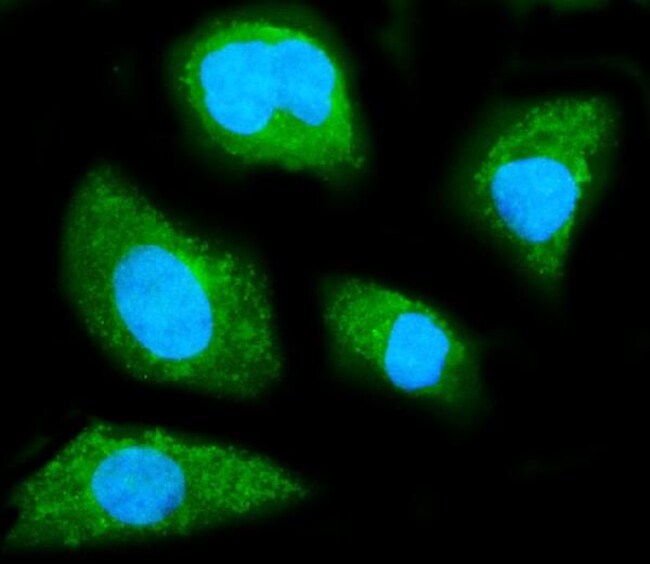
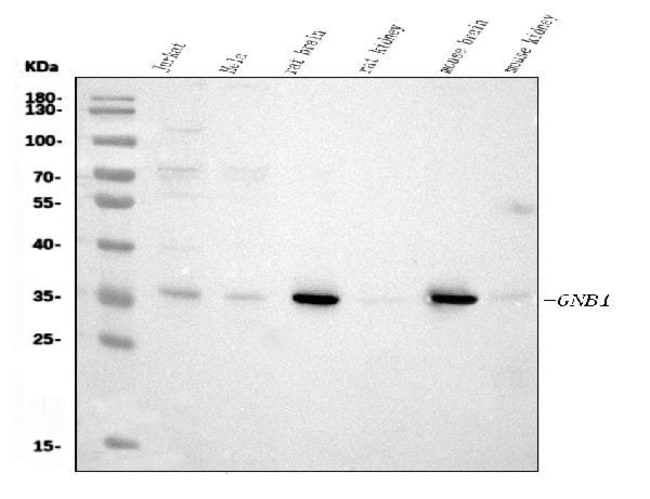
Adding 0.2 mL of distilled water will yield a concentration of 500 μg/mL. Immunogen sequence is identical to the related mouse and rat sequences. Positive Control - WB: human Jurkat whole cell, human Hela whole cell, rat brain tissue, rat kidney tissue, mouse brain tissue, mouse kidney tissue. ICC/IF: SiHa cell. Store at -20°C for one year from date of receipt. After reconstitution, at 4°C for one month. It can also be aliquotted and stored frozen at -20°C for six months. Avoid repeated freeze-thaw cycles.

Vision involves the conversion of light into electrochemical signals that are processed by the retina and subsequently sent to and interpreted by the brain. The process of converting light into an electrochemical signal begins when the membrane-bound protein, rhodopsin, absorbs light within the retina. Photoexcitation of rhodopsin causes the cytoplasmic surface of the protein to become catalytically active. In the active state, rhodopsin activates transducin, a GTP binding protein. Once activated, transducin promotes the hydrolysis of cGMP by phosphodiesterase (PDE). The decrease of intracellular cGMP concentration causes the ion channels within the outer segment of the rod or cone to close, thus causing membrane hyperpolarization and, eventually, signal transmission. Rhodopsin activity is believed to be shut off by phosphorylation followed by binding of the soluble protein, arrestin. Transducin, once activated by rhodopsin, promotes the hydrolysis of cGMP by PDE. The subunit composition of transducin differs between different photoreceptor cells. Rod transducin consists of rod transducin alpha (Tr alpha), T beta, and T gamma. Cone transducin is composed of cone transducin alpha (Tc alpha), T beta and T gamma. Differential transducin subunit composition of transducin is believed to be responsible for the different light sensitivities between photoreceptive cells.
TRUSTED_SUSTAINABILITY

Specifications

Antigen GNB1
Applications Western Blot, Immunocytochemistry
Classification Monoclonal
Clone 11F9
Concentration 500 μg/mL
Conjugate Unconjugated
Formulation PBS with 4mg trehalose and no preservative
Gene GNB1
Gene Accession No. P54311, P62873, P62874
Gene Alias AA409223; beta subunit, signal-transducing proteins GS/GI; C77571; G protein subunit beta 1; gbb1; GNB1; Gnb-1; gnb1 protein; gnb1a; guanine nucleotide binding protein (G protein), beta 1; guanine nucleotide binding protein (G protein), beta polypeptide 1; guanine nucleotide binding protein (G protein), beta polypeptide 1a; guanine nucleotide binding protein, beta 1; Guanine nucleotide-binding protein beta 1; guanine nucleotide-binding protein G(I)/G(S)/G(T) subunit beta-1; guanine nucleotide-binding protein, beta-1 subunit; MRD42; T beta; testicular tissue protein Li 72; transducin beta chain 1; transducin beta subunit; unnamed protein product; wu:fb50b09; wu:fj94h04
Gene Symbols GNB1
Host Species Mouse
Immunogen A synthetic peptide corresponding to a sequence at the N-terminus of human GNB1 (2-42aa SELDQLRQEAEQLKNQIRDARKACADATLSQITNNIDPVGR).
Purification Method Antigen affinity chromatography
Quantity 100 μg
Regulatory Status RUO
Primary or Secondary Primary
Gene ID (Entrez) 14688, 24400, 2782
Target Species Human, Mouse, Rat
Content And Storage -20°C
Product Type Antibody
Form Lyophilized
Isotype IgG2b
Show More Show Less
Product Title
Select an issue

By clicking Submit, you acknowledge that you may be contacted by Fisher Scientific in regards to the feedback you have provided in this form. We will not share your information for any other purposes. All contact information provided shall also be maintained in accordance with our Privacy Policy.