Learn More
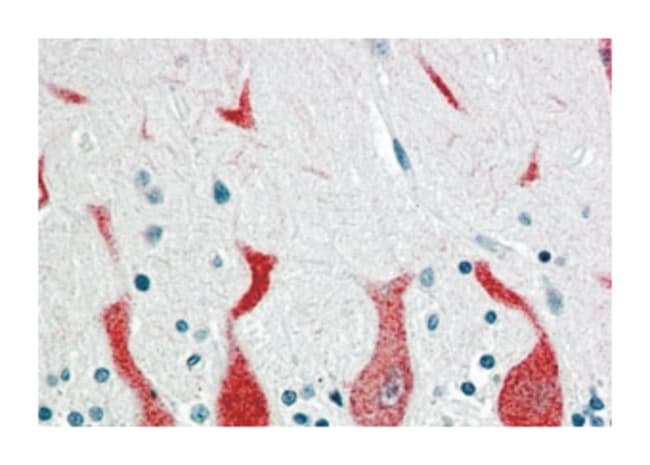

Description
Retinoid signaling is transduced by 2 families of nuclear receptors, retinoic acid receptor (RAR) and retinoid X receptor (RXR; see MIM 180245), which form RXR/RAR heterodimers. In the absence of ligand, DNA-bound RXR/RARA represses transcription by recruiting the corepressors NCOR1 (MIM 600849), SMRT (NCOR2; MIM 600848), and histone deacetylase (see MIM 601241). When ligand binds to the complex, it induces a conformational change allowing the recruitment of coactivators, histone acetyltransferases (see MIM 603053), and the basic transcription machinery. Translocations that always involve rearrangement of the RARA gene are a cardinal feature of acute promyelocytic leukemia (APL; MIM 612376). The most frequent translocation is t(15,17)(q21;q22), which fuses the RARA gene with the PML gene (MIM 102578) (Vitoux et al., 2007 [PubMed 17468032]).[supplied by OMIM
Specifications
Specifications
| Antigen | RARA |
| Applications | ELISA, Immunohistochemistry (PFA fixed), Western Blot |
| Classification | Polyclonal |
| Concentration | 0.5 mg/mL |
| Conjugate | Unconjugated |
| Description | Goat polyclonal antibody raised against synthetic peptide of RARA. |
| Dilution | ELISA (1:8000) Western blot (1-3 ug/mL) Immunohistochemistry (Formalin/PFA-fixed paraffin-embedded sections) (4-6 ug/mL) The optimal working dilution should be determined by the end user. |
| Formulation | In Tris saline, pH 7.3 (0.5% BSA, 0.02% sodium azide) |
| Gene | RARA |
| Gene Alias | NR1B1/RAR |
| Show More |
For Research Use Only
By clicking Submit, you acknowledge that you may be contacted by Fisher Scientific in regards to the feedback you have provided in this form. We will not share your information for any other purposes. All contact information provided shall also be maintained in accordance with our Privacy Policy.