Promotional price valid on web orders only. Your contract pricing may differ. Interested in signing up for a dedicated account number?
Learn More
Learn More
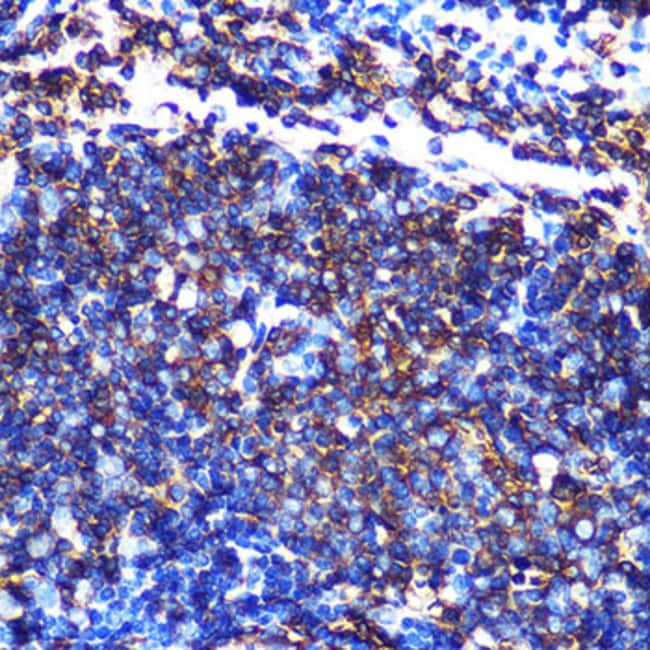
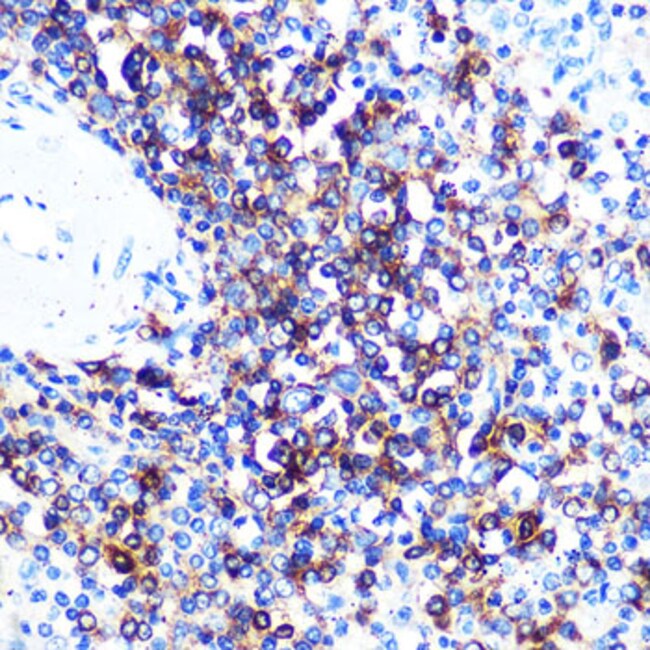
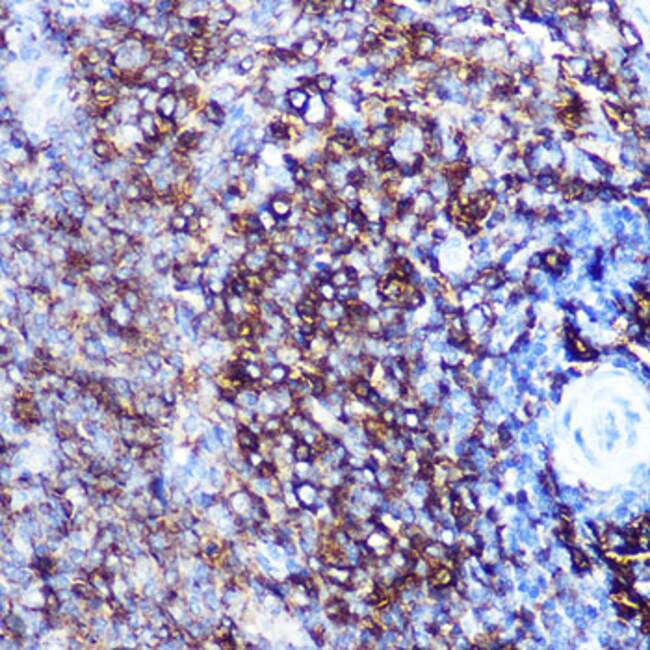
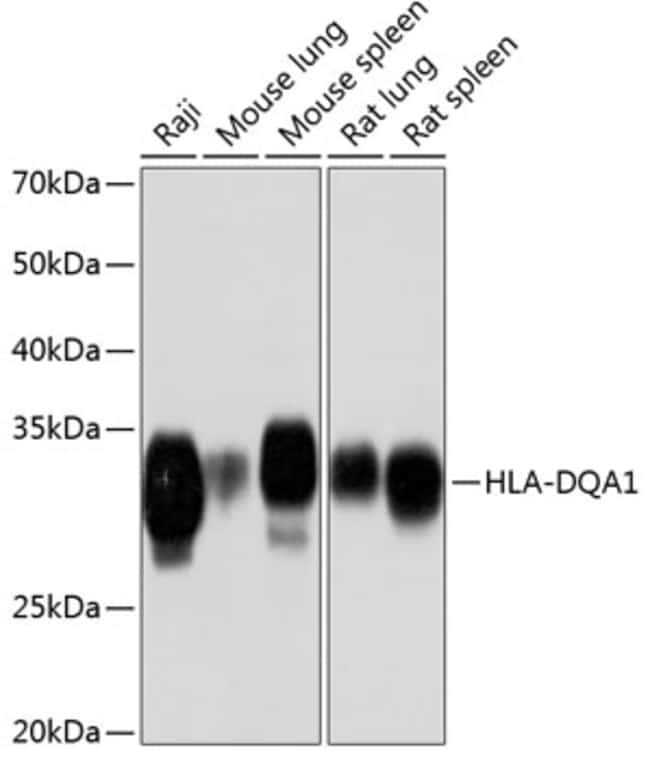
Invitrogen™ HLA-DQA1 Recombinant Rabbit Monoclonal Antibody (7W0M7)

Description
Immunogen sequence: EGVSETSFLS KSDHSFFKIS YLTLLPSAEE SYDCKVEHWG LDKPLLKHWE PEIPAPMSEL TETVVCALGL SVGLVGIVVG TVFIIRGLRS VGASRHQGPL.
Binds peptides derived from antigens that access the endocytic route of antigen presenting cells (APC) and presents them on the cell surface for recognition by the CD4 T-cells. The peptide binding cleft accommodates peptides of 10-30 residues. The peptides presented by MHC class II molecules are generated mostly by degradation of proteins that access the endocytic route, where they are processed by lysosomal proteases and other hydrolases. Exogenous antigens that have been endocytosed by the APC are thus readily available for presentation via MHC II molecules, and for this reason this antigen presentation pathway is usually referred to as exogenous. As membrane proteins on their way to degradation in lysosomes as part of their normal turn-over are also contained in the endosomal/lysosomal compartments, exogenous antigens must compete with those derived from endogenous components. Autophagy is also a source of endogenous peptides, autophagosomes constitutively fuse with MHC class II loading compartments. In addition to APCs, other cells of the gastrointestinal tract, such as epithelial cells, express MHC class II molecules and CD74 and act as APCs, which is an unusual trait of the GI tract. To produce a MHC class II molecule that presents an antigen, three MHC class II molecules (heterodimers of an alpha and a beta chain) associate with a CD74 trimer in the ER to form a heterononamer. Soon after the entry of this complex into the endosomal/lysosomal system where antigen processing occurs, CD74 undergoes a sequential degradation by various proteases, including CTSS and CTSL, leaving a small fragment termed CLIP (class-II-associated invariant chain peptide). The removal of CLIP is facilitated by HLA-DM via direct binding to the alpha-beta-CLIP complex so that CLIP is released. HLA-DM stabilizes MHC class II molecules until primary high affinity antigenic peptides are bound. The MHC II molecule bound to a peptide is then transported to the cell membrane surface. In B-cells, the interaction between HLA-DM and MHC class II molecules is regulated by HLA-DO. Primary dendritic cells (DCs) also to express HLA-DO. Lysosomal microenvironment has been implicated in the regulation of antigen loading into MHC II molecules, increased acidification produces increased proteolysis and efficient peptide loading. HLA and MHC antibodies play a significant role in Immunopeptidomics, facilitating the identification and characterization of neoantigens through high-performance liquid chromatography coupled to tandem Mass Spectrometry.

Specifications
Specifications
| Antigen | HLA-DQA1 |
| Applications | ELISA, Immunohistochemistry (Paraffin), Western Blot |
| Classification | Recombinant Monoclonal |
| Clone | 7W0M7 |
| Concentration | 0.18 mg/mL |
| Conjugate | Unconjugated |
| Formulation | PBS with 0.05% BSA, 50% glycerol and 0.02% sodium azide; pH 7.3 |
| Gene | HLA-DQA1 |
| Gene Accession No. | P01909 |
| Gene Alias | CD; CELIAC1; DC-1 alpha chain; DC-alpha; DQ-A1; DX alpha chain; DX-ALPHA; GSE; HLA class II antigen; HLA class II histocompatibility antigen, DQ alpha 1 chain; HLA class II histocompatibility antigen, DQ alpha 2 chain; HLA class II histocompatibility antigen, DQ beta 1 chain; HLA class II histocompatibility antigen, DQ(6) alpha chain; HLA class II histocompatibility antigen, DQ(W3) alpha chain; HLA-DCA; HLA-DQA; HLA-DQA1; HLA-DQA2; HLA-DQB; HLA-DQB1; HLA-DRB1; HLA-DXA; IDDM1; leucocyte antigen DQA1; leukocyte antigen alpha chain; lymphocyte antigen; major histocompatibility complex, class II, DQ alpha 1; major histocompatibility complex, class II, DQ alpha 2; major histocompatibility complex, class II, DQ beta 1; MHC class II antigen; MHC class II antigen DQB1; MHC class II antigen HLA-DQ-beta-1; MHC class II DQ beta chain; MHC class II DQA1; MHC class II DQA2; MHC class II HLA-D alpha glycoprotein; MHC class II HLA-DQ beta glycoprotein; MHC class II HLA-DQ-alpha-1; MHC class II surface glycoprotein; MHC class2 antigen; MHC DQ beta; MHC HLA-DQ alpha |
| Show More |
Safety and Handling
WARNING: Cancer - www.P65Warnings.ca.gov
Product Title
By clicking Submit, you acknowledge that you may be contacted by Fisher Scientific in regards to the feedback you have provided in this form. We will not share your information for any other purposes. All contact information provided shall also be maintained in accordance with our Privacy Policy.
Spot an opportunity for improvement?