Promotional price valid on web orders only. Your contract pricing may differ. Interested in signing up for a dedicated account number?
Learn More
Learn More
Invitrogen™ HSF1 Monoclonal Antibody (10H4), PerCP

Description
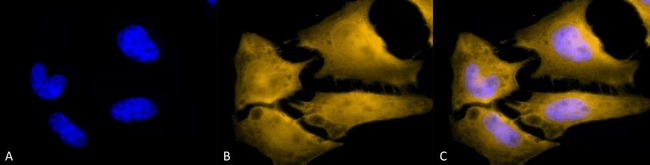
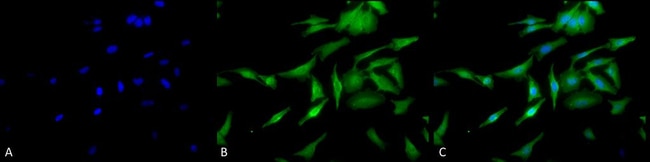
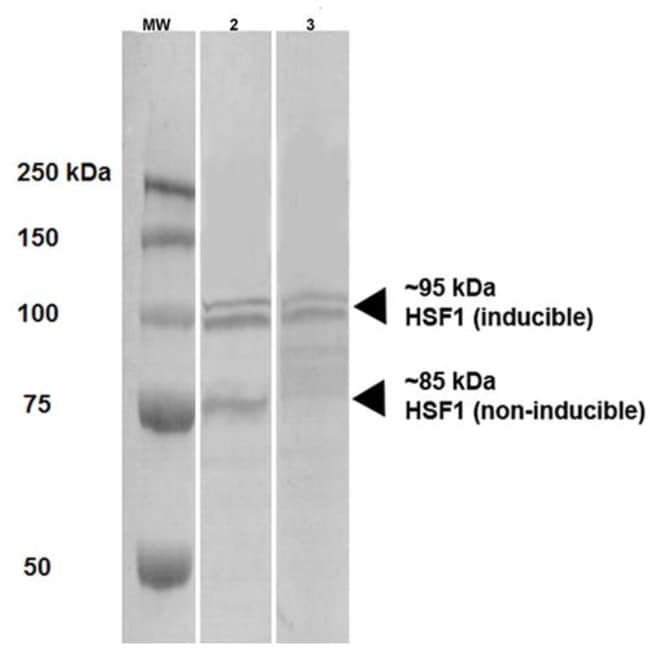
1 μg/mL of MA5-45711 was sufficient for detection of HSF1 in 20 μg of heat shocked HeLa cell lysate by colorimetric immunoblot analysis using Rabbit anti-rat IgG: AP as the secondary antibody. Detects approximately 85kDa (unstressed cell lysates) and approximately 95kDa (heat shocked cell lysates).
All organisms respond to elevated temperatures and a variety of environmental stresses by rapid synthesis of heat shock RNAs and proteins. The regulation of heat shock gene transcription is mediated by the transcriptional activator, heat shock factor (HSF), which binds to heat shock response elements (HSEs). These HSEs are found as three repeats of a 5-nucleotide {nGAAn} module, arranged in alternating orientation and present upstream of all heat shock genes. The HSEs are highly conserved among species yet HSF purified from yeast, Drosophila and human have different molecular weights and the proteins do not show significant immunological cross reaction. Two HSFs have been identified in human cells, HSF1 and HSF2, which bind to the same HSEs and have 38% sequence identity. These factors are activated by distinct stimuli, HSF1 is responsive to classical stress signals such as heat, heavy metals and oxidative reagents, whereas HSF2 is activated during hemin-mediated differentiation of human erythroleukemia cells. HSF1 exists constitutively in the cytoplasm and the nucleus of unstressed cells as a monomer which lacks DNA binding activity. Through an unknown signal generated during stress, HSF1 becomes activated to a nuclear localized, trimeric state which binds to DNA. The phosphorylation of HSF1 is necessary for maximal transcription of heat shock genes.

Specifications
Specifications
| Antigen | HSF1 |
| Applications | ELISA, Gel Shift, Immunohistochemistry (PFA fixed), Immunoprecipitation, Western Blot, Immunocytochemistry |
| Classification | Monoclonal |
| Clone | 10H4 |
| Concentration | 1 mg/mL |
| Conjugate | PerCP |
| Formulation | 2.48mM MES, 95.64mM phosphate with 0.5M EDTA and no preservative; pH 7.4 |
| Gene | Hsf1 |
| Gene Accession No. | P38532, Q00613, Q08DJ8 |
| Gene Alias | AA960185; heat shock factor 1; heat shock factor 2; Heat shock factor protein 1; Heat shock transcription factor 1; heat shock transcription factor 1 alpha isoform; heat shock transcription factor 1 beta isoform; heat shock transcription factor 1 gammaalpha isoform; heat shock transcription factor 1 gammabeta isoform; HSF; HSF 1; Hsf1; Hsf1alpha; Hsf1beta; Hsf1gammaalpha; Hsf1gammabeta; HSTF 1; HSTF1 |
| Show More |
Product Title
By clicking Submit, you acknowledge that you may be contacted by Fisher Scientific in regards to the feedback you have provided in this form. We will not share your information for any other purposes. All contact information provided shall also be maintained in accordance with our Privacy Policy.
Spot an opportunity for improvement?