Promotional price valid on web orders only. Your contract pricing may differ. Interested in signing up for a dedicated account number?
Learn More

HSF1 Polyclonal Antibody, Rockland™
SDP

Catalog No. 501992114
Encompass
Encompass_Preferred
Change view
Click to view available options
Quantity:
100 μg
25 μg
2 product options available for selection
Product selection table with 2 available options. Use arrow keys to navigate and Enter or Space to select.
Catalog No. Quantity
50-199-2114 25 μg
50-199-2113 100 μg
Use arrow keys to navigate between rows. Press Enter or Space to select a product option. 2 options available.
2 options
Catalog No. 50-199-2114 Supplier Rockland Immunochemicals Supplier No. 600401GV3S
Add to Cart
Add to Cart

Rabbit Polyclonal Antibody

Store vial at -20°C prior to opening. Aliquot contents and freeze at -20°C or below for extended storage. Avoid cycles of freezing and thawing. Centrifuge product if not completely clear after standing at room temperature. This product is stable for several weeks at 4°C as an undiluted liquid. Dilute only prior to immediate use. Anti-HSF1 is directed against human HSF1 at a n-terminus position. A BLAST analysis was used to suggest reactivity with this protein in mouse and bovine species based on 100% homology for the immunogen sequence.

All organisms respond to elevated temperatures and a variety of environmental stresses by rapid synthesis of heat shock RNAs and proteins. The regulation of heat shock gene transcription is mediated by the transcriptional activator, heat shock factor (HSF), which binds to heat shock response elements (HSEs). These HSEs are found as three repeats of a 5-nucleotide {nGAAn} module, arranged in alternating orientation and present upstream of all heat shock genes. The HSEs are highly conserved among species yet HSF purified from yeast, Drosophila and human have different molecular weights and the proteins do not show significant immunological cross reaction. Two HSFs have been identified in human cells, HSF1 and HSF2, which bind to the same HSEs and have 38% sequence identity. These factors are activated by distinct stimuli, HSF1 is responsive to classical stress signals such as heat, heavy metals and oxidative reagents, whereas HSF2 is activated during hemin-mediated differentiation of human erythroleukemia cells. HSF1 exists constitutively in the cytoplasm and the nucleus of unstressed cells as a monomer which lacks DNA binding activity. Through an unknown signal generated during stress, HSF1 becomes activated to a nuclear localized, trimeric state which binds to DNA. The phosphorylation of HSF1 is necessary for maximal transcription of heat shock genes.

Specifications

Antigen HSF1
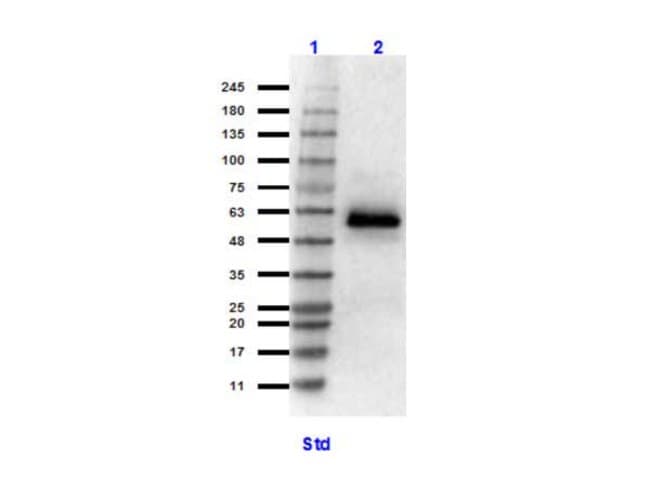
Applications ELISA, Western Blot
Classification Polyclonal
Concentration 1 mg/mL
Conjugate Unconjugated
Formulation 0.02M potassium phosphate with 0.15M NaCl and 0.01% sodium azide; pH 7.2
Gene Hsf1
Gene Accession No. Q00613
Gene Alias AA960185; BOS_13649; heat shock factor 1; Heat shock factor protein 1; Heat shock transcription factor 1; heat shock transcription factor 1 alpha isoform; heat shock transcription factor 1 beta isoform; heat shock transcription factor 1 gammaalpha isoform; heat shock transcription factor 1 gammabeta isoform; HSF 1; Hsf1; Hsf1alpha; Hsf1beta; Hsf1gammaalpha; Hsf1gammabeta; HSTF 1; HSTF1
Gene Symbols Hsf1
Host Species Rabbit
Quantity 25 μg
Regulatory Status RUO
Primary or Secondary Primary
Gene ID (Entrez) 3297
Target Species Human
Content And Storage -20°C, Avoid Freeze/Thaw Cycles
Product Type Antibody
Form Liquid
Show More Show Less
Product Title
Select an issue

By clicking Submit, you acknowledge that you may be contacted by Fisher Scientific in regards to the feedback you have provided in this form. We will not share your information for any other purposes. All contact information provided shall also be maintained in accordance with our Privacy Policy.