Promotional price valid on web orders only. Your contract pricing may differ. Interested in signing up for a dedicated account number?
Learn More

Invitrogen™ IL-22 Monoclonal Antibody (7F2)
GREENER_CHOICE

Catalog No. PIMA533008
Change view
Click to view available options
Quantity:
100 μg
1 product options available for selection
Product selection table with 1 available options. Use arrow keys to navigate and Enter or Space to select.
Catalog No. Quantity
PIMA533008 100 μg
Use arrow keys to navigate between rows. Press Enter or Space to select a product option. 1 options available.
1 options
Catalog No. PIMA533008 Supplier Invitrogen™ Supplier No. MA533008
Add to Cart
Add to Cart

Mouse Monoclonal Antibody

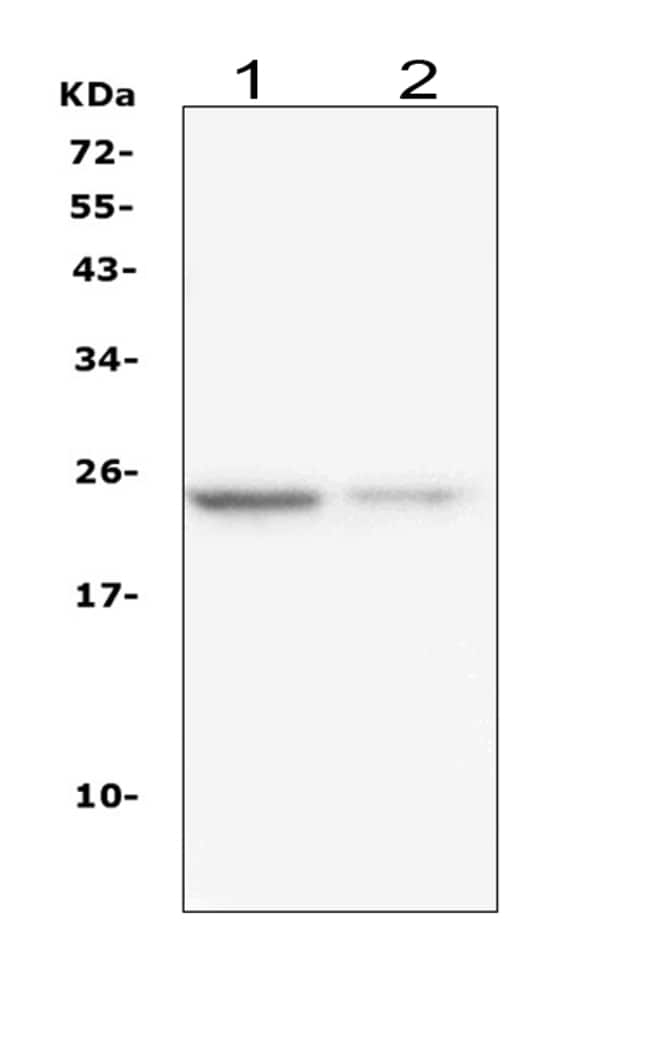
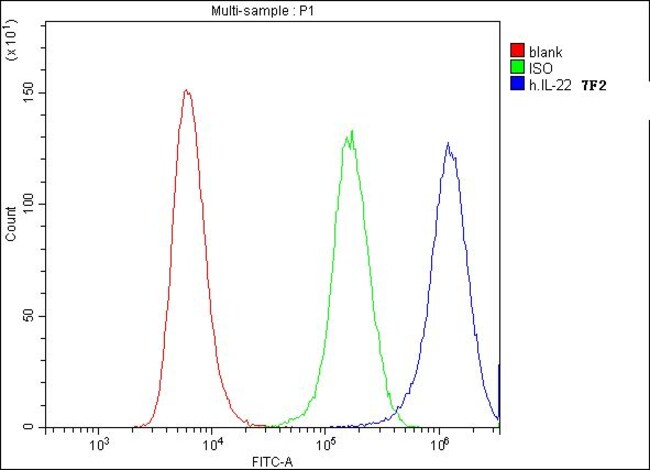
Human IL-22 shares 81.4% amino acid (aa) sequence identity with mouse IL-22. Reconstitute with 0.2 mL of distilled water to yield a concentration of 500 μg/mL. Positive Control - WB: human U-87MG whole cell, human A375 whole cell. Flow: HL-60 cell. Store at -20°C for one year from date of receipt. After reconstitution, at 4°C for one month. It can also be aliquotted and stored frozen at -20°C for six months. Avoid repeated freeze-thaw cycles.

IL-22 also known as IL-10-related T-cell derived inducible factor, is an alpha helical cytokine and is considered a member of the IFN-IL-10 family, which includes IL-19, IL-20, IL-24, IL-26, IL-28, IL-29, and the type I and II interferons. IL-22 is produced mainly by activated T cells and NK cells. In humans, the IL-22 gene is located on the q arm of chromosome 12, and is structurally related to IL10. IL-22 acts by engaging the heterodimeric receptor complex consisting of primary receptor IL-22R1 and accessory receptor IL-10R2. IL-22R1 also binds IL-20 and IL-24; IL-10R2 also binds IL-10, IL-27, IL-28, and IL-29. Binding of IL-22 to its receptor complex induces signal transduction, particularly via the JAK-STAT pathway. In addition to the membrane-bound IL-22R1/IL-10R2 complex, a soluble single-chain IL-22 receptor termed IL-22BP has been found to antagonize IL-22 binding and signaling. IL-22 appears not to directly influence immune cells, and major targets of the cytokine appear to be nonimmune cells, such as cells of the skin, digestive and respiratory system, as well as hepatocytes, and keratinocytes. IL-22 has been described as an effector cytokine of the Th17 lineage. Along with IL-17A and IL-17F, IL-22 regulates genes associated with innate immunity of the skin. IL-17A, IL-17F and IL-22 are all co-expressed by Th17 cells, however, they are differentially regulated. The effects of IL-22 include induction of acute phase reactants and antimicrobial proteins, as well as increasing the mobility of keratinocytes. IL-22 is highly expressed during chronic inflammation, and found to activate intracellular kinases and transcription factors. IL-22 is critical for host defense against infections of extracellular pathogens, and promotes wound-healing responses. IL-22 is upregulated in activated T cells. IL-22 has been reported to mediate IL-23-induced acanthosis and dermal inflammation through activation of STAT3.
TRUSTED_SUSTAINABILITY

Specifications

Antigen IL-22
Applications Flow Cytometry, Western Blot
Classification Monoclonal
Clone 7F2
Concentration 500 μg/mL
Conjugate Unconjugated
Formulation PBS with 4mg trehalose and 0.05mg sodium azide
Gene IL22
Gene Accession No. Q9GZX6
Gene Alias Cytokine Zcyto18; EGK_03903; il 22; IL-10-related T-cell-derived inducible factor; IL-10-related T-cell-derived-inducible factor; IL-21; IL22; IL-22; Il22a; IL-22a; IL-D110; ILN; ILTIF; IL-TIF; ILTIF alpha; IL-TIF alpha; ILTIFa; Interleukin; interleukin 10-related T cell-derived inducible factor; interleukin 22; Interleukin22; interleukin-22; Interleukin-22a; RGD1561292; TIFa; TIFIL-23; UNQ3099/PRO10096; ZCYTO18
Gene Symbols IL22
Host Species Mouse
Immunogen E.coli-derived human IL-22 recombinant protein (Position: A34-I179).
Purification Method Affinity chromatography
Quantity 100 μg
Regulatory Status RUO
Primary or Secondary Primary
Gene ID (Entrez) 50616
Target Species Human
Content And Storage -20°C
Product Type Antibody
Form Lyophilized
Isotype IgG1
Show More Show Less
Product Title
Select an issue

By clicking Submit, you acknowledge that you may be contacted by Fisher Scientific in regards to the feedback you have provided in this form. We will not share your information for any other purposes. All contact information provided shall also be maintained in accordance with our Privacy Policy.