Learn More
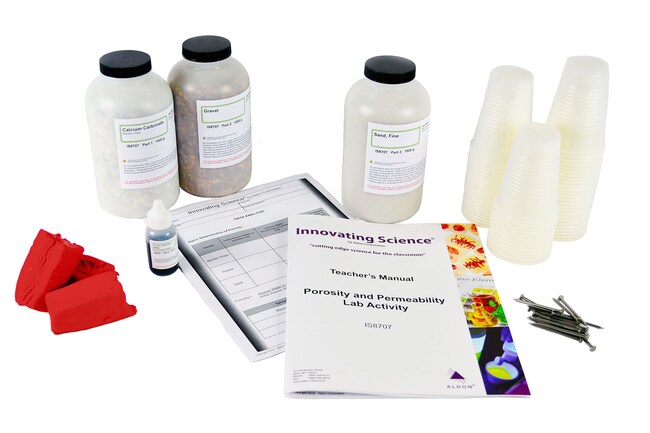


Description
While sources of fresh water are usually associated with visible bodies of water such as lakes, rivers, ponds, and streams, the majority of fresh water on Earth is actually underground, collectively referred to as groundwater. Like fresh water found on the surface, groundwater can flow beneath the surface of the planet. Porosity and permeability are two factors that affect both how much groundwater may be found in a given area and the ability of this water to move beneath the surface as well as affect the degree in which certain environmental issues, such as water pollution, may impact different areas.
- Kit contains enough materials for 15 groups
- Teacher's Manual and Student Study Guide copymasters are included
- Aligned to the Next Generation Science Standards (NGSS)
- Disciplinary Core Ideas: ESS3.A; ESS2.A
- Performance Expectations: MS- ESS3-1; HS-ESS2-2; HS- ESS3-1
- Cross Cutting Concepts: Influence of Science, Engineering and Technology on Society and the Natural World; Stability and Change, Cause and Effect
- Engineering Practices: Constructing Explanations and Designing Solutions; Developing and Using Models
Specifications
Specifications
| Certifications/Compliance | Next Gen Aligned |
| Color | White |
| Grade | 7 to 14 |
| Age | 13 to 20 |
| For Use With (Application) | Earth Science |
| Includes | Marble chips; Medium gravel; Coarse sand; 60 Plastic cups; 15 Nails; Modeling clay; 25 mL Food coloring |
| Material | Cardboard Box Kit |
| Quantity | 1 |
| Dimensions (L x W x H) | 10 x 10 x 10 in. |
| Class Size | 15 Lab Groups |
| Show More |
Next Generation Science Standards is a registered trademark of Achieve. Neither Achieve nor the lead states and partners that developed the Next Generation Science Standards was involved in the production of, and does not endorse, this product.
By clicking Submit, you acknowledge that you may be contacted by Fisher Scientific in regards to the feedback you have provided in this form. We will not share your information for any other purposes. All contact information provided shall also be maintained in accordance with our Privacy Policy.