Promotional price valid on web orders only. Your contract pricing may differ. Interested in signing up for a dedicated account number?
Learn More

Invitrogen™ JPH4 Polyclonal Antibody
GREENER_CHOICE

Catalog No. PIPA587818
Change view
Click to view available options
Quantity:
100 μL
1 product options available for selection
Product selection table with 1 available options. Use arrow keys to navigate and Enter or Space to select.
Catalog No. Quantity
PIPA587818 100 μL
Use arrow keys to navigate between rows. Press Enter or Space to select a product option. 1 options available.
1 options
Catalog No. PIPA587818 Supplier Invitrogen™ Supplier No. PA587818
Add to Cart
Add to Cart

Rabbit Polyclonal Antibody

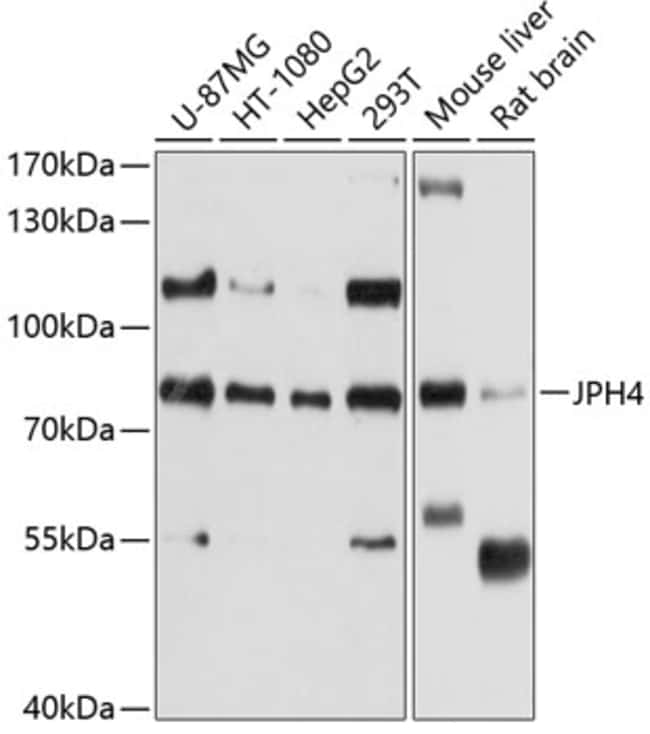
Immunogen sequence: AARMAKLIAQ DLQPMLEAPG RRPRQDSEGS DTEPLDEDSP GVYENGLTPS EGSPELPSSP ASSRQPWRPP ACRSPLPPGG DQGPFSSPKA WPEEWGGAGA QAEELAGYEA EDEAGMQGPG PRDGSPLLGG CSDSSGSLRE EEGEDEEPLP PLRAPAGTEP EPIAMLVLRG SSSRGPDAGC LTEELGEPAA TERPAQPGAA N; Positive Samples: U-87MG, HT-1080, HepG2, 293T, Mouse liver, Rat brain; Cellular Location: Cell membrane, Endoplasmic reticulum membrane, Peripheral membrane protein, Single-pass type IV membrane protein.

Junctional complexes between the plasma membrane (PM) and endoplasmic/sarcoplasmic reticulum (ER/SR) are a common feature of all excitable cell types and mediate cross talk between cell surface and intracellular ion channels. Junctophilins (JPs) are important components of the junctional complexes. JPs are composed of a carboxy-terminal hydrophobic segment spanning the ER/SR membrane and a remaining cytoplasmic domain that shows specific affinity for the PM. Four JPs have been identified as tissue-specific subtypes derived from different genes: JPH1 is expressed in skeletal muscle, JPH2 is detected throughout all muscle cell types, and JPH3 and JPH4 are predominantly expressed in the brain. In the CNS, both JPH3 and JPH4 are expressed throughout neural sites and contribute to the subsurface cistern formation in neurons. Mice lacking both JPH3 and JPH4 subtypes exhibit serious symptoms such as impaired learning and memory and are accompanied by abnormal nervous functions.
TRUSTED_SUSTAINABILITY

Specifications

Antigen JPH4
Applications ELISA, Western Blot
Classification Polyclonal
Concentration 2.77 mg/mL
Conjugate Unconjugated
Formulation PBS with 50% glycerol and 0.02% sodium azide; pH 7.3
Gene JPH4
Gene Accession No. Q69FB3, Q80WT0, Q96JJ6
Gene Alias 9330157P13Rik; JP4; JP-4; Jph4; jph4 {ECO:0000312; JPHL1; junctophilin 4; junctophilin like 1; junctophilin-4; Junctophilin-like 1 protein; KIAA1831; RGD:1303170}
Gene Symbols JPH4
Host Species Rabbit
Immunogen Recombinant fusion protein containing a sequence corresponding to amino acids 405-605 of human JPH4 (NP_1158282).
Purification Method Affinity Chromatography
Quantity 100 μL
Regulatory Status RUO
Primary or Secondary Primary
Gene ID (Entrez) 319984, 445271, 84502
Target Species Human, Mouse, Rat
Content And Storage -20°C, Avoid Freeze/Thaw Cycles
Product Type Antibody
Form Liquid
Isotype IgG
Show More Show Less
Product Title
Select an issue

By clicking Submit, you acknowledge that you may be contacted by Fisher Scientific in regards to the feedback you have provided in this form. We will not share your information for any other purposes. All contact information provided shall also be maintained in accordance with our Privacy Policy.