Promotional price valid on web orders only. Your contract pricing may differ. Interested in signing up for a dedicated account number?
Learn More
Learn More
Invitrogen™ KIR3DL1 Polyclonal Antibody

Description
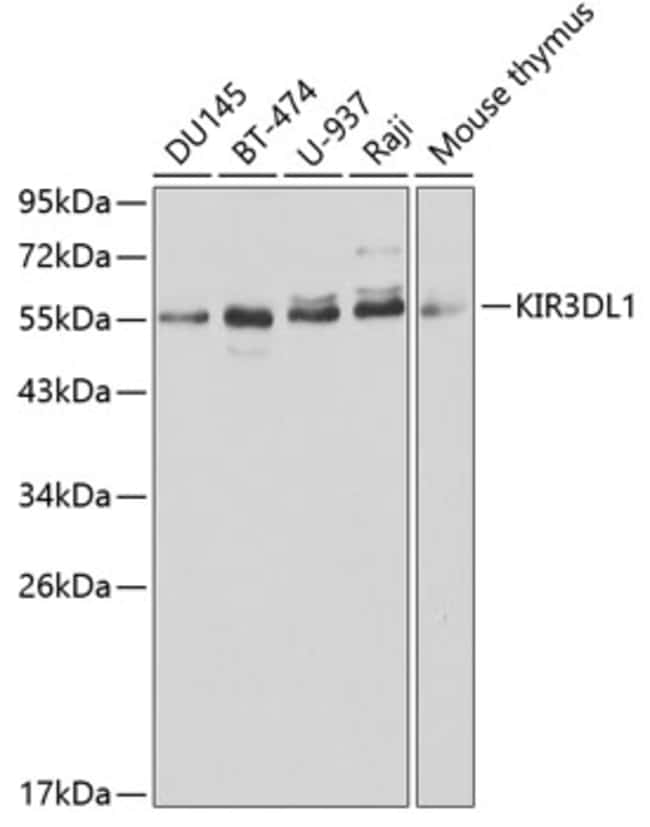
Immunogen sequence: HMGGQDKPFL SAWPSAVVPR GGHVTLRCHY RHRFNNFMLY KEDRIHIPIF HGRIFQESFN MSPVTTAHAG NYTCRGSHPH SPTGWSAPSN PVVIMVTGNH RKPSLLAHPG PLVKSGERVI LQCWSDIMFE HFFLHKEGIS KDPSRLVGQI HDGVSKANFS IGPMMLALAG TYRCYGSVTH TPYQLSAPSD PLDIVVTGPY E; Positive Samples: DU145, BT-474, U-937, Raji, Mouse thymus; Cellular Location: Cell membrane, Single-pass type I membrane protein.
KIR3DL1 are Killer cell immunoglobulin-like receptors (KIRs) are transmembrane glycoproteins expressed by natural killer cells and subsets of T cells. The KIR genes are polymorphic and highly homologous and they are found in a cluster on chromosome 19q13. 4 within the 1 Mb leukocyte receptor complex (LRC). The gene content of the KIR gene cluster varies among haplotypes, although several framework genes are found in all haplotypes (KIR3DL3, KIR3DP1, KIR3DL4, KIR3DL2). The KIR proteins are classified by the number of extracellular immunoglobulin domains (2D or 3D) and by whether they have a long (L) or short (S) cytoplasmic domain. KIR proteins with the long cytoplasmic domain transduce inhibitory signals upon ligand binding via an immune tyrosine-based inhibitory motif (ITIM), while KIR proteins with the short cytoplasmic domain lack the ITIM motif and instead associate with the TYRO protein tyrosine kinase binding protein to transduce activating signals. The ligands for several KIR proteins are subsets of HLA class I molecules; thus, KIR proteins are thought to play an important role in regulation of the immune response.

Specifications
Specifications
| Antigen | KIR3DL1 |
| Applications | ELISA, Western Blot |
| Classification | Polyclonal |
| Concentration | 0.69 mg/mL |
| Conjugate | Unconjugated |
| Formulation | PBS with 50% glycerol and 0.02% sodium azide; pH 7.3 |
| Gene | KIR3DL1 |
| Gene Accession No. | P43629, P83555 |
| Gene Alias | 3DL1; AMB11; CD158 antigen-like family member E; CD158E; CD158e antigen; CD158E1; CD158E1/2; CD158E2; CL11; CL2; HLA-BW4-specific inhibitory NK cell receptor; killer cell immunoglobulin like receptor, three Ig domains and long cytoplasmic tail 1; killer cell immunoglobulin-like receptor 3DL1; killer cell immunoglobulin-like receptor Kir3dl1; killer cell immunoglobulin-like receptor three domains long cytoplasmic tail 2; killer cell immunoglobulin-like receptor three domains short cytoplasmic tail 1; killer cell immunoglobulin-like receptor, three domains, long cytoplasmic tail, 1; killer Ig receptor; killer immunoglobulin receptor-like protein 1; KIR; KIR antigen 3DL1; KIR G1; KIR3D; KIR3DL1; KIR3DL1/S1; KIR3DL2; KIR3DS1; Kirl1; Kirl2; KIR-like receptor 1; Krl1; MGC119726; MGC119728; MGC126589; MGC126591; MHC class I NK cell receptor; natural killer cell receptor; natural killer-associated transcript 3; NK receptor; NKAT10; NKAT3; NKAT-3; NKB1; NKB1B; NK-receptor; p70; p70 killer cell inhibitory receptor; p70 natural killer cell receptor clones CL-2/CL-11; p70 NK; p70 NK receptor CL-2/CL-11 |
| Gene Symbols | KIR3DL1 |
| Show More |
Product Title
By clicking Submit, you acknowledge that you may be contacted by Fisher Scientific in regards to the feedback you have provided in this form. We will not share your information for any other purposes. All contact information provided shall also be maintained in accordance with our Privacy Policy.
Spot an opportunity for improvement?