Promotional price valid on web orders only. Your contract pricing may differ. Interested in signing up for a dedicated account number?
Learn More

Invitrogen™ M-CSF Polyclonal Antibody
GREENER_CHOICE

Catalog No. PIPA595279
Change view
Click to view available options
Quantity:
100 μg
1 product options available for selection
Product selection table with 1 available options. Use arrow keys to navigate and Enter or Space to select.
Catalog No. Quantity
PIPA595279 100 μg
Use arrow keys to navigate between rows. Press Enter or Space to select a product option. 1 options available.
1 options
Catalog No. PIPA595279 Supplier Invitrogen™ Supplier No. PA595279
Only null left
Add to Cart
Add to Cart

Rabbit Polyclonal Antibody

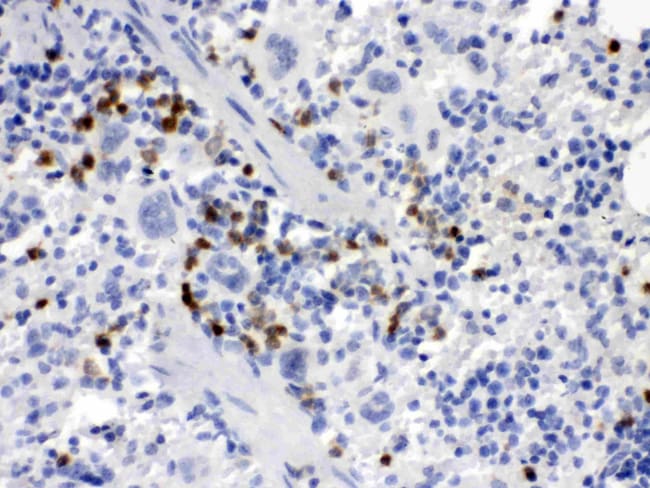
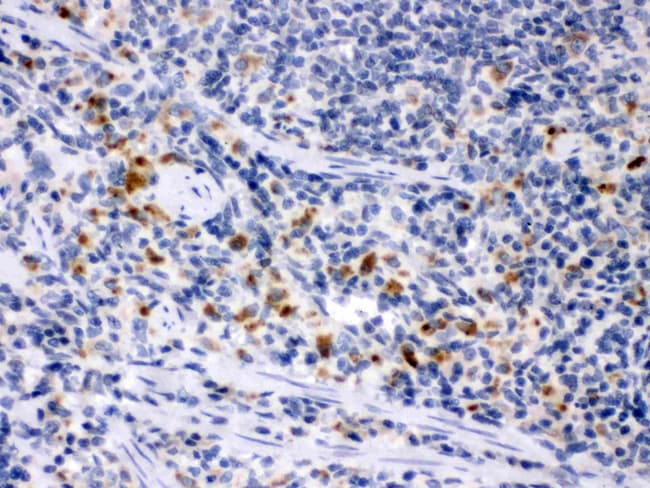
Mouse MCSF shares 80.9 % and 88.6% amino acid (aa) sequence identity with human and rat MCSF, respectively. Reconstitute with 0.2 mL of distilled water to yield a concentration of 500 μg/mL. Positive Control - IHC: mouse spleen tissue, rat spleen tissue. Store at -20°C for one year from date of receipt. After reconstitution, at 4°C for one month. It can also be aliquotted and stored frozen at -20°C for six months. Avoid repeated freeze-thaw cycles.

M-CSF (Macrophage colony-stimulating factor, CSF-1) is a survival factor essential for the proliferation and development of monocytes, macrophages, and osteoclast progenitor cells. M-CSF also induces VEGF (vascular endothelial growth factor) secretion by macrophages, thereby mediating mobilization of endothelial progenitor cells and neovascularization. M-CSF is present as several bioactive isoforms that differ in potency and stability. The full-length protein is synthesized as a membrane-spanning protein that can be expressed on the cell surface or further cleaved and modified in the secretory vesicle. Further, M-CSF is a disulfide-bonded homodimer which is processed into one of two isoforms, a glycoprotein or a proteoglycan that has been modified by the addition of chondroitin sulfate to each subunit. Binding of M-CSF to its receptor, c-Fms (CSF-1R or CD115) induces dimerization of the receptor followed by internalization and degradation of the complex. Functionally, M-CSF is known to stimulate differentiation of hematopoietic stem cells to monocyte-macrophage cell populations in culture. M-CSF acts through the CSF receptor 1. Although human M-CSF shows activity on mouse cells, mouse CSF shows no activity on human cells.
TRUSTED_SUSTAINABILITY

Specifications

Antigen M-CSF
Applications ELISA, Immunohistochemistry (Paraffin)
Classification Polyclonal
Concentration 500 μg/mL
Conjugate Unconjugated
Formulation PBS with 5mg BSA and 0.05mg sodium azide
Gene Csf1
Gene Accession No. P07141, Q8JZQ0
Gene Alias C87615; colony stimulating factor 1; colony stimulating factor 1 (macrophage); colony-stimulating factor-1 splice variant; CSF1; CSF-1; Csfm; H-MCSF; lanimostim; macrophage colony stimulating factor 1; macrophage colony stimulating factor alpha; macrophage colony stimulating factor beta; macrophage colony-stimulating factor; macrophage colony-stimulating factor 1; macrophage colony-stimulating factor beta; macrophage-colony stimulating factor alpha; MCSF; MCSF alpha; MCSFBETA; MGC31930; M-MCSF; op; osteopetrosis; Processed macrophage colony-stimulating factor 1
Gene Symbols Csf1
Host Species Rabbit
Immunogen E.coli-derived mouse MCSF recombinant protein (Position: K33-E262).
Purification Method Affinity chromatography
Quantity 100 μg
Regulatory Status RUO
Primary or Secondary Primary
Gene ID (Entrez) 12977, 78965
Target Species Mouse, Rat
Content And Storage -20°C
Product Type Antibody
Form Lyophilized
Isotype IgG
Show More Show Less
WARNING: Cancer - www.P65Warnings.ca.gov
Product Title
Select an issue

By clicking Submit, you acknowledge that you may be contacted by Fisher Scientific in regards to the feedback you have provided in this form. We will not share your information for any other purposes. All contact information provided shall also be maintained in accordance with our Privacy Policy.