Promotional price valid on web orders only. Your contract pricing may differ. Interested in signing up for a dedicated account number?
Learn More
Learn More
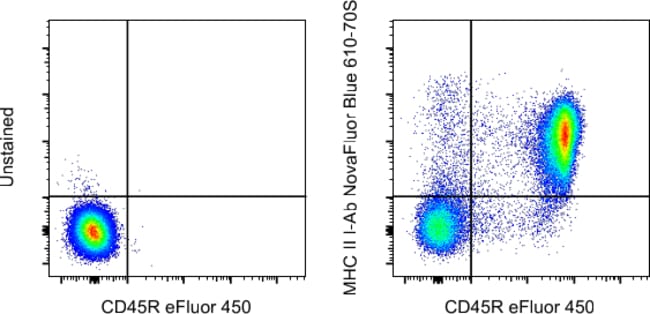

Invitrogen™ MHC Class II I-Ab Monoclonal Antibody (AF6-120.1), NovaFluor™ Blue 610-70S, eBioscience™, Invitrogen™

Description
I-Ab (H2-Ab1, histocompatibility 2, class II antigen A, beta 1) is an MHC class II heterodimer molecule of non-covalently associated alpha (31-34 kDa) and beta (26-29 kDa) chains. Major histocompatibility complex class II antigen presentation requires the participation of lysosomal proteases in two convergent processes. First, the antigens endocytosed by the antigen presenting cells must be broken down into antigenic peptides. Second, class II molecules are synthesized with their peptide-binding site blocked by invariant chain (Ii), and they aquire the capacity to bind antigens only after Ii has been degraded in the compartments where peptides reside. MHC class II molecules present exogenously derived antigen to CD4+ T lymphocytes, which are usually T helper cells. CD4 interacts with non-polymorphic residues of MHC class II. H2-Ab1 heterodimer chains alpha (DQA) and beta (DQB) are both anchored in the membrane. H2-Ab1 plays a central role in the immune system by presenting peptides derived from extracellular proteins. Class II molecules are expressed in antigen presenting cells (APC: B lymphocytes, dendritic cells, macrophages). The beta chain contains 6 exons. Exon one encodes the leader peptide, exons 2 and 3 encode the two extracellular domains, exon 4 encodes the transmembrane domain and exon 5 encodes the cytoplasmic tail. Within the DQ molecule both the alpha chain and the beta chain contain the polymorphisms specifying the peptide binding specificities, resulting in up to 4 different molecules. Typing for polymorphisms is routinely done for bone marrow transplantation. HLA and MHC antibodies play a significant role in Immunopeptidomics, facilitating the identification and characterization of neoantigens through high-performance liquid chromatography coupled to tandem Mass Spectrometry.

Specifications
Specifications
| Antigen | MHC Class II I-Ab |
| Applications | Flow Cytometry |
| Classification | Monoclonal |
| Clone | AF6-120.1 |
| Concentration | 0.1 mg/mL |
| Conjugate | NovaFluor Blue 610-70S |
| Formulation | PBS with 0.09% sodium azide; pH 7.2 |
| Gene | H2-Ab1 |
| Gene Accession No. | P01921, P06342, P06343, P06344, P06345, P06346, P14483 |
| Gene Alias | Abeta; AI845868; CELIAC1; DADB-249P12.2; H-2 class II histocompatibility antigen, A beta chain; H-2Ab; H2-Ab; H2-Ab1; H2Eb; H-2Eb; H2-iabeta; histocompatibility 2, class II antigen A, beta 1; HLA-DQB; Ia2; Ia-2; Ia4; Ia-4; IAb; I-Abeta; IDDM1; major histocompatibility complex class II beta chain; MGC163794; MGC163796; MHC class II antigen A beta; MHC class II H2-IA-beta-psi; response to metastatic cancers 1; Rmcs1 |
| Show More |
Product Title
By clicking Submit, you acknowledge that you may be contacted by Fisher Scientific in regards to the feedback you have provided in this form. We will not share your information for any other purposes. All contact information provided shall also be maintained in accordance with our Privacy Policy.
Spot an opportunity for improvement?