Promotional price valid on web orders only. Your contract pricing may differ. Interested in signing up for a dedicated account number?
Learn More
Learn More
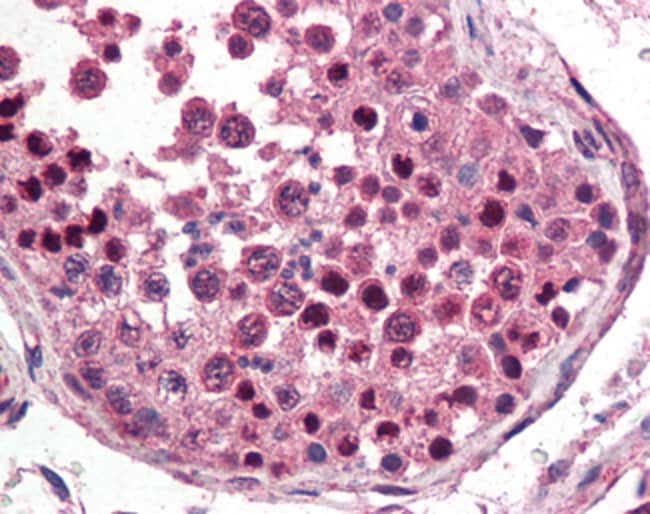
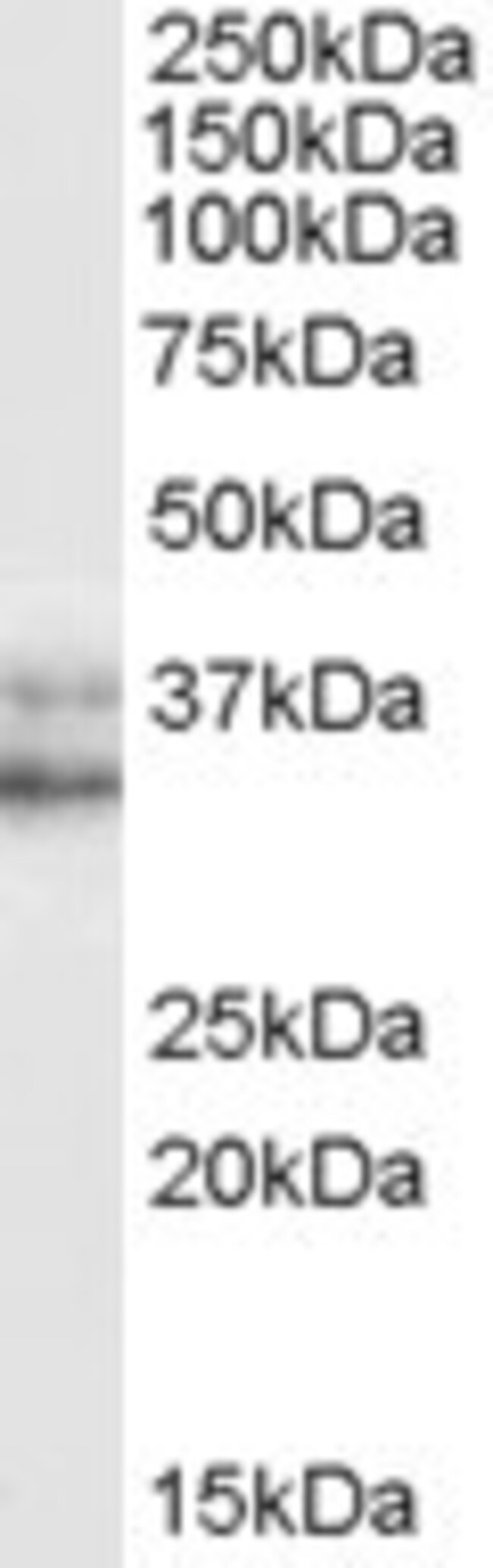
Invitrogen™ Nanog Polyclonal Antibody

Description
This antibody has been successfully tested in a Sandwhich ELISA as both a capture and a detection antibody in combination with PA5-18406.
NANOG (Nanog homeobox) is a divergent homeodomain protein that directs pluripotency and differentiation of undifferentiated embryonic stem cells. NANOG mRNA is present in pluripotent mouse and human cell lines, and absent from differentiated cells. Human NANOG protein shares 52% overall amino acid identity with the mouse protein, and 85% identity in the homeodomain. Human NANOG maps to gene locus 12p13.31, while the mouse NANOG maps to gene loci 6 F2. Murine embryonic NANOG expression is detected in the inner cell mass of the blastocyst. Research studies have shown that high levels of human NANOG expression in the undifferentiated N-Tera embryonal carcinoma cell line. Further, NANOG is a transcription regulator involved in inner cell mass and embryonic stem (ES) cells proliferation and self-renewal. The role of NANOG in embryonic development suggested that it might be useful in the creation of stem cells that might be useful in cell replacement therapies in the treatment of several degenerative diseases. Artificial stem cells, termed induced pluripotent stem (iPS) cells, can be created by expressing POU5F1 (also known as Oct-4), another germline-specific transcription factor, and the transcription factors Sox2, Klf4 and Lin28 along with c-Myc in mouse fibroblasts. Experiments have demonstrated that iPS cells could be generated using expression plasmids expressing NANOG, Sox2, KlfF4 and c-Myc, eliminating the need for virus introduction, thereby addressing a safety concern for potential use of iPS cells in regenerative medicine. When overexpressed, NANOG promotes cells to enter into S phase and proliferation. Diseases associated with dysfunction in the NANOG protein include tetracarcinoma and germ cell/embryonal cancer.

Specifications
Specifications
| Antigen | Nanog |
| Applications | Immunohistochemistry (Paraffin), Western Blot, Western Blot |
| Classification | Polyclonal |
| Concentration | 0.5 mg/mL |
| Conjugate | Unconjugated |
| Formulation | TBS with 0.5% BSA and 0.02% sodium azide; pH 7.3 |
| Gene | NANOG |
| Gene Accession No. | Q9H9S0 |
| Gene Alias | 2410002E02Rik; early embryo specific expression NK family; early embryo specific expression NK-type homeobox protein; Ecat4; ENK; ES cell-associated protein 4; FLJ12581; HGNC:20857; hNanog; Homeobox protein NANOG; homeobox transcription factor Nanog; homeobox transcription factor Nanog-delta 48; Nanog; Nanog homeobox |
| Gene Symbols | NANOG |
| Show More |
Safety and Handling
WARNING: Cancer - www.P65Warnings.ca.gov
Product Title
By clicking Submit, you acknowledge that you may be contacted by Fisher Scientific in regards to the feedback you have provided in this form. We will not share your information for any other purposes. All contact information provided shall also be maintained in accordance with our Privacy Policy.
Spot an opportunity for improvement?