Promotional price valid on web orders only. Your contract pricing may differ. Interested in signing up for a dedicated account number?
Learn More

Invitrogen™ NGF Recombinant Rabbit Monoclonal Antibody (R711)
GREENER_CHOICE

Catalog No. PIMA529443
Change view
Click to view available options
Quantity:
200 μg
1 product options available for selection
Product selection table with 1 available options. Use arrow keys to navigate and Enter or Space to select.
Catalog No. Quantity
PIMA529443 200 μg
Use arrow keys to navigate between rows. Press Enter or Space to select a product option. 1 options available.
1 options
Catalog No. PIMA529443 Supplier Invitrogen™ Supplier No. MA529443
Add to Cart
Add to Cart

Rabbit Recombinant Monoclonal Antibody

This product is preservative free. It is recommended to add sodium azide to avoid contamination (final concentration 0.05%-0.1%). Recombinant rabbit monoclonal antibodies are produced using in vitro expression systems. The expression systems are developed by cloning in the specific antibody DNA sequences from immunoreactive rabbits. Then, individual clones are screened to select the best candidates for production. The advantages of using recombinant rabbit monoclonal antibodies include: better specificity and sensitivity, lot-to-lot consistency, animal origin-free formulations, and broader immunoreactivity to diverse targets due to larger rabbit immune repertoire. This antibody has specificity for Human NGF/NGFB.

Nerve growth factor (NGF) influences the survival and differentiation of a variety of neuronal and nonneuronal cells. The actions of this polypeptide result from binding to specific cell surface receptors which are present as both high and low affinity sites. Although both types of receptor bind NGF only the high affinity form is capable of signal transduction. Cross-linking studies with 125I-NGF have shown that the high affinity receptor of rat PC12 cells forms an Mr 158,000 complex with NGF while the low affinity receptor forms an Mr 100,000 complex. Full length cDNA clones for both the human and rat NGF receptor genes have been produced and sequenced, revealing greater than 90% homology between the two species. NGF exhibits nerve growth stimulating activity and is involved in the regulation of growth and the differentiation of sympathetic and certain sensory neurons. Further, NGF stimulates division and differentiation of sympathetic and embryonic sensory neurons. Mutations in the NGF gene have been associated with hereditary sensory and autonomic neuropathy, type 5 (HSAN5), and dysregulation of NGF gene expression is associated with allergic rhinitis.
TRUSTED_SUSTAINABILITY

Specifications

Antigen NGF
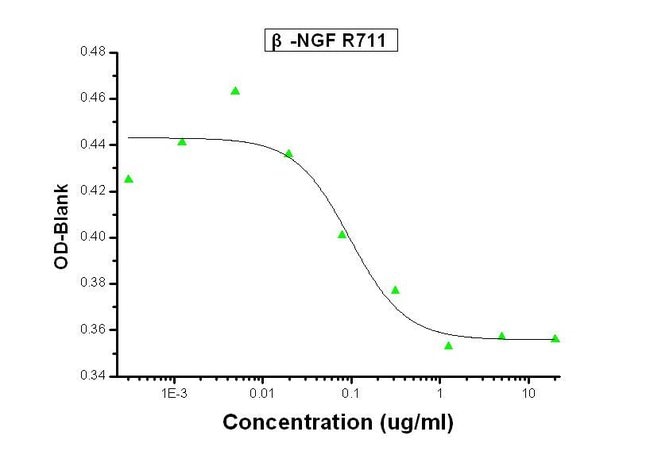
Applications Neutralization
Classification Recombinant Monoclonal
Clone R711
Concentration 1.0 mg/mL
Conjugate Unconjugated
Formulation Arginine, Histidine with 120mM NaCl, 0.02% Tween 80 and no preservative; pH 6
Gene NGF
Gene Accession No. P01138
Gene Alias B nerve growth factor; beta ngf; beta-nerve growth factor; BetaNGF; beta-NGF; bNGF; b-NGF; HSAN5; MGC161426; MGC161428; Nerve growth factor; nerve growth factor (beta polypeptide); nerve growth factor, beta; nerve growth factor, beta polypeptide; nerve growth factor, beta subunit; NGF; NGF b; NGF β; Ngfb; NGFbeta; NGFβ; β nerve growth factor; β NGF; βNGF
Gene Symbols NGF
Host Species Rabbit
Immunogen Recombinant Human NGF/NGFB Protein (Ser122-Arg239).
Purification Method Protein A
Quantity 200 μg
Regulatory Status RUO
Primary or Secondary Primary
Gene ID (Entrez) 4803
Target Species Human
Content And Storage Store at 4°C short term. For long term storage, store at -20°C, avoiding freeze/thaw cycles.
Product Type Antibody
Form Liquid
Isotype IgG
Show More Show Less
Product Title
Select an issue

By clicking Submit, you acknowledge that you may be contacted by Fisher Scientific in regards to the feedback you have provided in this form. We will not share your information for any other purposes. All contact information provided shall also be maintained in accordance with our Privacy Policy.