Learn More
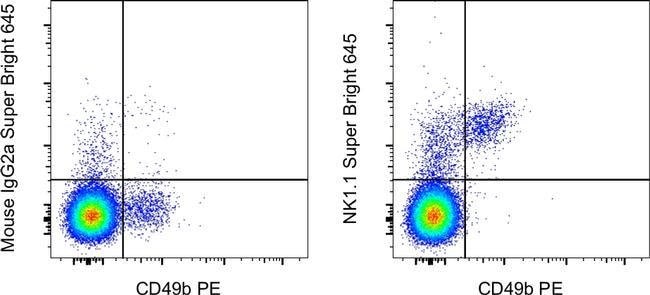
Invitrogen™ NK1.1 Monoclonal Antibody (PK136), Super Bright™ 645, eBioscience™, Invitrogen™

Description
Description: The H57-597 monoclonal antibody reacts with the beta chain of mouse TCR. TCR beta is expressed by thymocytes in a developmentally regulated manner and a majority of peripheral T cells. Crosslinking of the TCR complex with H57-597 induces activation and proliferation of T cells or apoptosis based on assay conditions. H57-597 is used as a phenotypic marker for TCR beta expressing T cells. Applications Reported: This H57-597 antibody has been reported for use in flow cytometric analysis. Applications Tested: This H57-597 antibody has been tested by flow cytometric analysis of mouse splenocytes. This may be used at less than or equal to 0.5 μg per test. A test is defined as the amount (μg) of antibody that will stain a cell sample in a final volume of 100 μL. Cell number should be determined empirically but can range from 10^5 to 10^8 cells/test. It is recommended that the antibody be carefully titrated for optimal performance in the assay of interest. Super Bright 645 is a tandem dye that can be excited with the violet laser line (405 nm) and emits at 645 nm. We recommend using a 660/20 bandpass filter. Please make sure that your instrument is capable of detecting this fluorochrome. When using two or more Super Bright dye-conjugated antibodies in a staining panel, it is recommended to use Super Bright Staining Buffer (Product No. SB-4400) to minimize any non-specific polymer interactions.

Specifications
Specifications
| Antigen | NK1.1 |
| Applications | Flow Cytometry |
| Classification | Monoclonal |
| Clone | PK136 |
| Concentration | 0.2 mg/mL |
| Conjugate | Super Bright 645 |
| Formulation | PBS with BSA and 0.09% sodium azide; pH 7.2 |
| Gene | Klrb1c |
| Gene Accession No. | P27812, P27814 |
| Gene Alias | AI462337; CD161; CD161 antigen-like family member B; CD161 antigen-like family member C; CD161b; CD161c; EMBL:AAQ11375.1}; Inhibitory receptor NKR-P1B; killer cell lectin-like receptor subfamily A member 1C; killer cell lectin-like receptor subfamily B member 1B; killer cell lectin-like receptor subfamily B member 1B allele A; Killer cell lectin-like receptor subfamily B member 1B allele B; killer cell lectin-like receptor subfamily B member 1B allele C; killer cell lectin-like receptor subfamily B member 1C; killer cell lectin-like receptor subfamily B member 1D; killer cell lectin-like receptor subfamily B member 1F; KLRB1; Klrb1b; klrb1b {ECO:0000312; Klrb1c; Klrb1d; Klrb1f; klrb1f {ECO:0000250; Ly55; Ly-55; Ly55b; ly-55b; Ly55c; ly-55c; Ly55d; Ly-55d; Ly59; Ly-59; lymphocyte antigen 55 complex, locus B; lymphocyte antigen 55 complex, locus C; lymphocyte antigen 55 complex, locus D; lymphocyte antigen 55b; lymphocyte antigen 55c; Lymphocyte antigen 55d; lymphocyte antigen 59; MGC163757; MGC163759; natural killer cell receptor protein NKR-P1B; natural killer cell receptor protein NKR-P1C; natural killer cell receptor-P1; natural killer cell surface protein NKR-P1B allele B6; Natural killer cell surface protein NKR-P1B allele RNK/SD/BN/F344; natural killer cell surface protein NKR-P1B allele SJL/BALB; natural killer cell surface protein NKR-P1B allele TO; natural killer cell surface protein NKR-P1F; Natural killer cell surface protein P1-40; natural killer cell-associated antigen 1; natural killer cells; nk cells; Nk1; Nk-1; NK1.1; Nk1.2; Nk-1.2; NKRP1; NK-RP1; NKR-P1 34; NKR-P1 40; NKR-P1.9; NKRP140; Nkrp1b; NKR-P1B; Nkrp1-b; NKR-P1B protein; Nkrp1c; NKR-P1C; Nkrp1d; NKR-P1D; Nkrp1f; NKR-P1F; RGD:2975}; UniProtKB:Q8VD98} |
| Show More |
Frequently Asked Questions (FAQs)
UltraComp eBeads microspheres (Cat. No. 01-2222) are recommended for use with Super Bright dyes.
Note: Super Bright Staining Buffer (Cat. No. SB-4400) is not compatible with UltraComp eBeads microspheres (Cat. No. 01-2222-41, 00-2222-42). If using UltraComp eBeads microspheres as a compensation tool, solely use Flow Cytometry Stain Buffer (Cat. No. 00-4222-26, 00-4222-57) for any antibody dilutions.
In some experiments, we have observed that compensation values for Super Bright 780- and Brilliant Violet 785- or Brilliant Violet 786-conjugated antibodies are higher in the violet 450/50 channel when using UltraComp eBeads microspheres as compared to single-color stained cells. In such circumstances, we would recommend setting compensation with cells. We have also observed this in some experiments using AbC Total Antibody Compensation beads, both with Super Bright 780 and Brilliant Violet 786. We have not tested Brilliant Violet 785 with the AbC beads.
We recommend that the antibody cocktails containing Super Bright-conjugated antibodies and Super Bright Staining Buffer are prepared fresh prior to staining. Discard any unused portions. We do not recommend overnight storage of prepared cocktails.
Samples that have been stained with antibodies conjugated to Super Bright dyes may be stored for up to three days, at 2-8°C, in the dark, using either IC Fixation Buffer (Cat. No. 00-8222) or 1-step Fix/Lyse Buffer (Cat. No. 00-5333) with no significant effect on brightness or compensation.
Super Bright dyes are stable in methanol-based fixation buffers.
Yes, Super Bright-conjugated antibodies are stable in formaldehyde-based fixation buffers and permeabilization buffers, such as the IC Fixation and Permeabilization Buffer Set (Cat. No. 88-8824) and the Foxp3/Transcription Factor Staining Buffer Set (Cat. No. 00-5523).
For Research Use Only
By clicking Submit, you acknowledge that you may be contacted by Fisher Scientific in regards to the feedback you have provided in this form. We will not share your information for any other purposes. All contact information provided shall also be maintained in accordance with our Privacy Policy.