Learn More
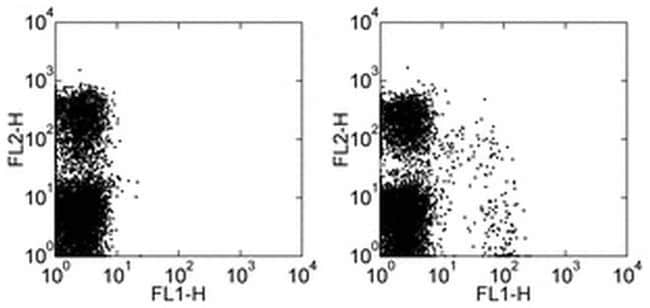
Invitrogen™ NKG2A/C/E Monoclonal Antibody (20d5), FITC, eBioscience™, Invitrogen™


Description
Description: The 20d5 monoclonal antibody reacts with the mouse NKG2A, C, and E. NKG2 molecules belong to a C-type lectin-like family of cell surface receptors expressed by mouse NK and NKT cell lineages. NKG2 molecules form heterodimeric complexes with CD94 and are responsible for recognition of non-classical MHC class I antigen Qa-1. When co-staining with NKG2A^B6 clone 16a11, it is important to stain for NKG2A-B6 first then subsequently with NKG2A/C/E, as steric hindrance has been observed if co-stained concurrently. Applications Reported: 20d5 has been reported for use in flow cytometric analysis. Applications Tested: The 20d5 antibody has been tested by flow cytometric analysis of mouse splenocytes and can be used at less than or equal to 0.125 μg per test. A test is defined as the amount (μg) of antibody that will stain a cell sample in a final volume of 100 μL. Cell number should be determined empirically but can range from 10^5 to 10^8 cells/test. It is recommended that the antibody be carefully titrated for optimal performance in the assay of interest. Excitation: 488 nm; Emission: 520 nm; Laser: Blue Laser. Filtration: 0.2 μm post-manufacturing filtered.

Specifications
Specifications
| Antigen | NKG2A/C/E |
| Applications | Flow Cytometry |
| Classification | Monoclonal |
| Clone | 20d5 |
| Concentration | 0.5 mg/mL |
| Conjugate | FITC |
| Formulation | PBS with 0.09% sodium azide; pH 7.2 |
| Gene | Klrc2 |
| Gene Accession No. | 0 |
| Gene Alias | CD159a; cd159c; cd159e; Cluster of Differentiation 159a; killer cell lectin-like receptor subfamily C, member 1; killer cell lectin-like receptor subfamily C, member 2; killer cell lectin-like receptor subfamily C, member 3; Klrc1; Klrc2; Klrc3; natural killer cell group 2E cell receptor; NKG2; NKG2A; NKG2-A/NKG2-B type II integral membrane protein; NKG2B; NKG2C; Nkg2e |
| Show More |
For Research Use Only.
By clicking Submit, you acknowledge that you may be contacted by Fisher Scientific in regards to the feedback you have provided in this form. We will not share your information for any other purposes. All contact information provided shall also be maintained in accordance with our Privacy Policy.