Promotional price valid on web orders only. Your contract pricing may differ. Interested in signing up for a dedicated account number?
Learn More

PeproTech p16INK4a-TAT Polyclonal Antibody, Biotin, PeproTech®, Invitrogen™

Catalog No. 502718539
Encompass_Preferred
Change view
Click to view available options
Quantity:
25 μg
50 μg
500 μg
3 product options available for selection
Product selection table with 3 available options. Use arrow keys to navigate and Enter or Space to select.
Catalog No. Quantity
50-271-8539 500 μg
P284TBT25 25 μg
P284TBT50 50 μg
Use arrow keys to navigate between rows. Press Enter or Space to select a product option. 3 options available.
3 options
Catalog No. 50-271-8539 Supplier PeproTech Supplier No. 500P284TBT500UG
Only null left
Add to Cart
Add to Cart

Rabbit Polyclonal Antibody

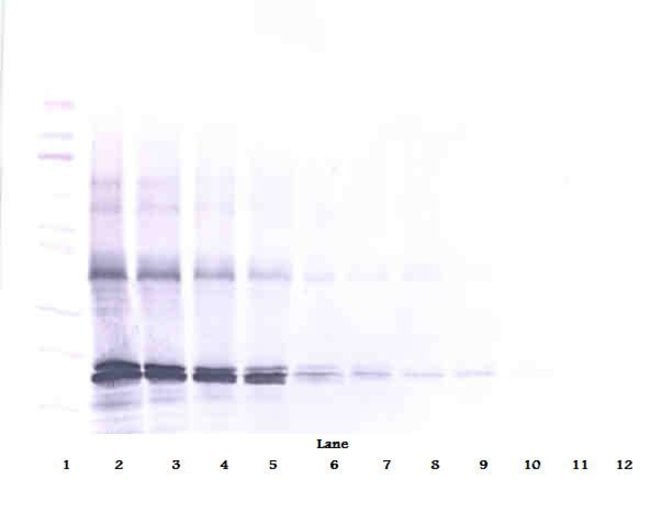
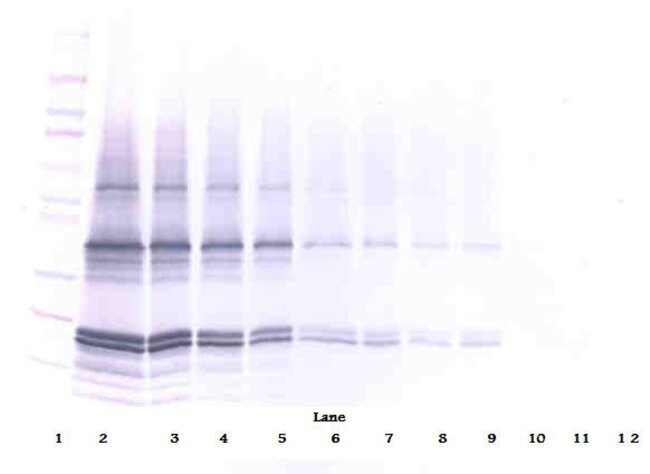
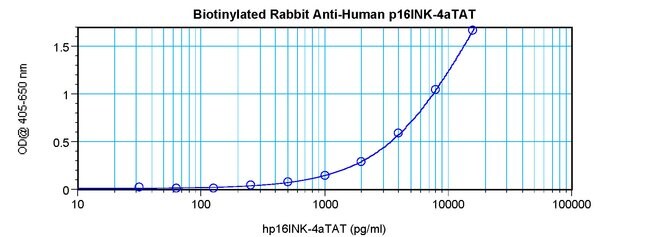
AA Sequence of recombinant protein: EPAAGSSMEP SADWLATAAA RGRVEEVRAL LEAGALPNAP NSYGRRPIQV MMMGSARVAE LLLLHGAEPN CADPATLTRP VHDAAREGFL DTLVVLHRAG ARLDVRDAWG RLPVDLAEEL GHRDVARYLR AAAGGTRGSN HARIDAAEGP SDIPDGYGR KKRRQRRR. Preparation: Produced from sera of rabbits immunized with highly pure Recombinant Human p16-INK4a-TAT. Anti-Human p16-INK4a-TAT-specific antibody was purified by affinity chromatography and then biotinylated. Sandwich ELISA: To detect Human p16-INK4a-TAT by sandwich ELISA (using 100 μL/well), a concentration of 0.25-1.0 μg/mL of this antibody is required. This biotinylated polyclonal antibody,in conjunction with PeproTech Polyclonal Anti-Human p16-INK4a-TAT (500-P284) as a capture antibody, allows the detection of at least 0.2-0.4 ng/well of Recombinant Human p16-INK4a-TAT. Western Blot: To detect Human p16-INK4a-TAT by Western Blot analysis, this antibody can be used at a concentration of 0.1-0.2 μg/mL.When used in conjunction with compatible development reagents, the detection limit for Recombinant Human p16-INK4a-TAT is 1.5-3.0 ng/lane, under either reducing or non-reducing conditions. 500-P284TBT-1MG will be provided as 2 x 500 μg

p16-INK4a is a nuclear protein that regulates the cell cycle by inhibiting cyclin-dependent kinase-4 (CDK4) and CDK6. p16-INK4a inhibits CDK activity by binding to the CDK molecules in a manner that interferes with their ability to interact with cyclin D. This activity has the effect of suppressing tumor formation and growth, and of inducing replicative senescence in various normal cells, including stem cells. The expression of p16-INK4a steadily increases with age, and tends to accumulate in stem cell compartments. The deletion, rearrangement, or mutation of the p16-INK4a gene is frequently found in melanomas, as well as in certain other types of cancer. p16-INK4a and other transcription factors have been introduced into cells by DNA transfection, viral infection, or microinjection. Protein transduction using TAT fusion proteins represents an alternative methodology for introducing transcription factors and other nuclear proteins into primary, as well as transformed, cells.
TRUSTED_SUSTAINABILITY

Specifications

Antigen p16INK4a-TAT
Applications ELISA, Western Blot
Classification Polyclonal
Concentration 0.1-1.0 mg/mL
Conjugate Biotin
Formulation PBS with no preservative
Gene CDKN2A
Gene Accession No. P42771, Q8N726
Gene Alias p16INK4a
Gene Symbols CDKN2A
Host Species Rabbit
Immunogen E.coli-derived, 18.0 kDa Recombinant Human p16-INK4a-TAT.
Purification Method Antigen affinity chromatography
Quantity 500 μg
Regulatory Status RUO
Primary or Secondary Primary
Gene ID (Entrez) 1029
Target Species Human
Content And Storage -20°C
Product Type Antibody
Form Lyophilized
Isotype IgG
Show More Show Less
Product Title
Select an issue

By clicking Submit, you acknowledge that you may be contacted by Fisher Scientific in regards to the feedback you have provided in this form. We will not share your information for any other purposes. All contact information provided shall also be maintained in accordance with our Privacy Policy.