Learn More
Invitrogen™ PAEP Monoclonal Antibody (13)

Description
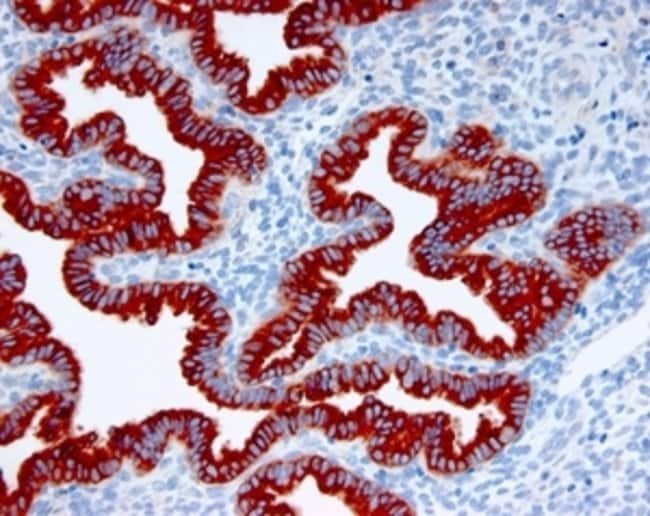
BTE 001-13-02 detects placental protein 14 from human samples. BTE 001-13-02 has been successfully used in Immunohistochemistry and ELISA procedures. BTE 001-13-02 reacts strongly to human PP14 in sandwich ELISA in combination with a polyclonal antibody. When staining formalin-fixed paraffin-embedded endometrial tissue from the late secretory phase, staining is restricted to the glandular cells. NOTE: Concentration is lot-dependent and can vary from 0.85-1.15 mg/mL.

Specifications
Specifications
| Antigen | PAEP |
| Applications | ELISA, Immunohistochemistry (Paraffin) |
| Classification | Monoclonal |
| Clone | 13 |
| Concentration | 0.87 mg/mL |
| Conjugate | Unconjugated |
| Formulation | PBS with 15mM sodium azide; pH 7.4 |
| Gene | PAEP |
| Gene Accession No. | P09466 |
| Gene Alias | alpha uterine protein; GD; GdA; GdF; GdS; Glycodelin; glycodelin-A; glycodelin-F; glycodelin-S; PAEG; PAEP; PEG; PEP; placental protein 14; PP14; PP14 protein (placental protein 14); pregnancy-associated endometrial alpha-2 globulin; pregnancy-associated endometrial alpha-2-globulin; progestagen associated endometrial protein; Progestagen-associated endometrial protein; progestagen-associated endometrial protein (placental protein 14, pregnancy-associated endometrial a; progesterone-associated endometrial protein; ZIF-1; Zona-binding inhibitory factor-1 |
| Show More |
Safety and Handling
By clicking Submit, you acknowledge that you may be contacted by Fisher Scientific in regards to the feedback you have provided in this form. We will not share your information for any other purposes. All contact information provided shall also be maintained in accordance with our Privacy Policy.