Promotional price valid on web orders only. Your contract pricing may differ. Interested in signing up for a dedicated account number?
Learn More

Invitrogen™ PCK1 Polyclonal Antibody

Catalog No. PI720266
Change view
Click to view available options
Quantity:
100 μg
1 product options available for selection
Product selection table with 1 available options. Use arrow keys to navigate and Enter or Space to select.
Catalog No. Quantity
PI720266 100 μg
Use arrow keys to navigate between rows. Press Enter or Space to select a product option. 1 options available.
1 options
Catalog No. PI720266 Supplier Invitrogen™ Supplier No. 720266

Rabbit Polyclonal Antibody

These Polyclonal antibodies are of rabbit origin developed by immunizing animals with proteins or peptides. The polyclonal antibody is purified by affinity purification from the rabbit sera generated after immunizing the rabbits with a specific type of protein or peptide. The purified antibody is tested for its functionality in various relevant research applications. The antibody is developed for Research Use Only and is non-hazardous or non-infectious in nature. This antibody is predicted to react with Monkey, Mouse, Sheep and Bovine.

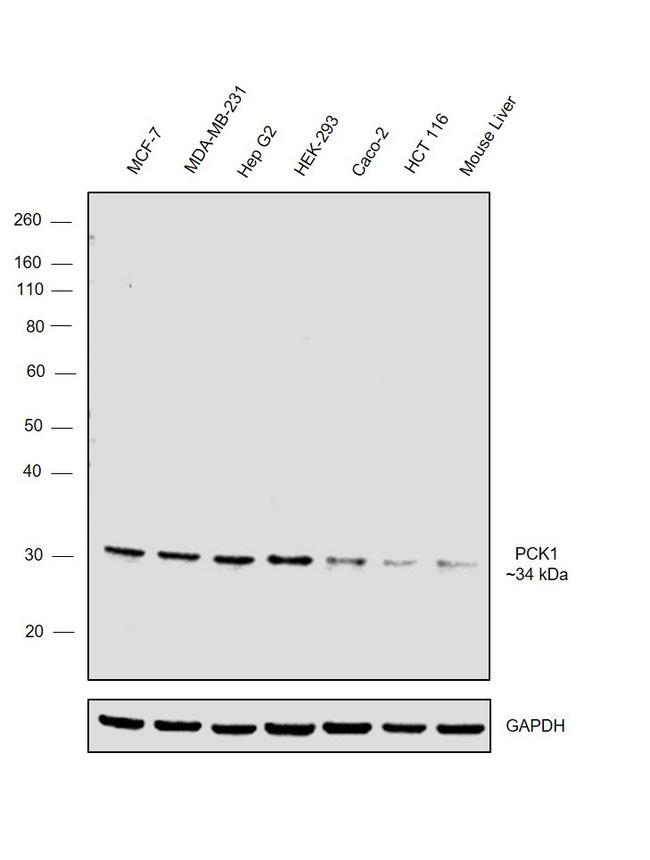
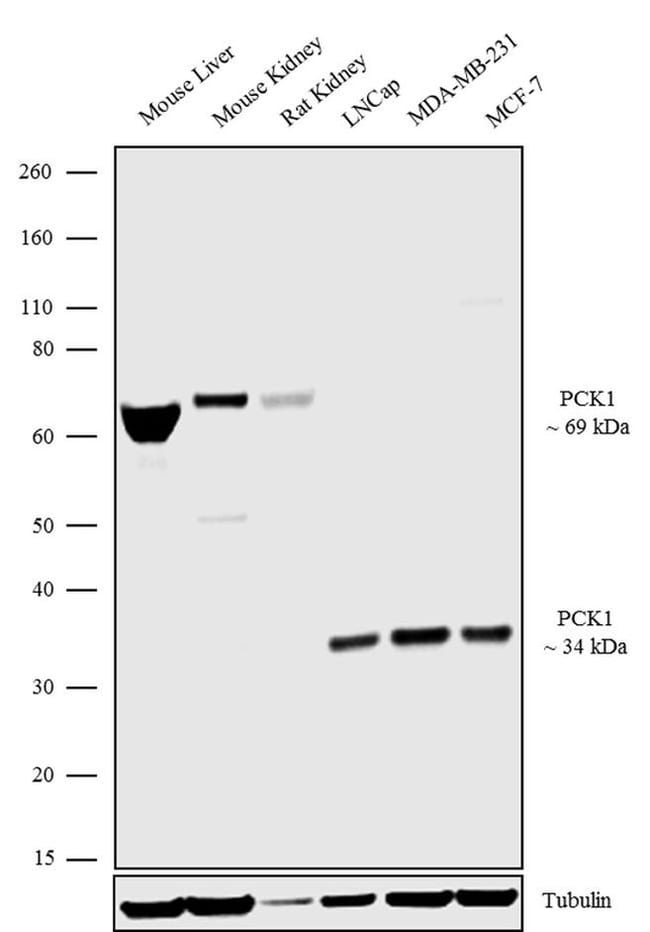
Phosphoenolpyruvate Carboxykinase 1 (PCK1) is a main control point for the regulation of gluconeogenesis. During gluconeogenesis PCK1 acts as the rate-limiting enzyme. PCK1 regulates the formation and maintenance of memory CH8(+) T-cells via gluconeogenesis. PCK1 aids in controlling the levels of metabolic intermediates in the citric acid cycle by regulating cataplerosis and anaplerosis. When glucose levels are high, PCK1 catalyzes the cataplerotic conversion of oxaloacetate to phosphoenolpyruvate (PEP). When they are low it catalyzes the anaplerotic conversion of phosphoenolpyruvate to oxaloacetate. When phosphorylated at Ser-90 by AKT1, PCK1 acts as a protein kinase by reducing the binding affinity to oxaloacetate and promotes an atypical serine protein kinase activity using GTP as the donor. This activity regulates lipogenesis by disrupting the interaction between INSIG proteins and SCAP and promoting nuclear translocation of SREBP proteins and transcription of lipogenesis-related genes. An important paralog of this gene is PCK2.
TRUSTED_SUSTAINABILITY

Specifications

Antigen PCK1
Applications Western Blot
Classification Polyclonal
Concentration 0.5 mg/mL
Conjugate Unconjugated
Formulation PBS with 30% glycerol, 0.1% BSA and 0.09% sodium azide; pH 7.4
Gene PCK1
Gene Accession No. P07379, P35558, Q9Z2V4
Gene Alias AI265463; GTP; HGNC:8724; MGC22652; PCK; Pck1; Pck-1; PE PEPCKC; PEP carboxykinase; PEPCK; PEPCK1; PEPCKC; PEPCK-C; phosphoenolpyruvate carboxykinase (GTP); phosphoenolpyruvate carboxykinase 1; phosphoenolpyruvate carboxykinase 1 (soluble); phosphoenolpyruvate carboxykinase 1, cytosolic; phosphoenolpyruvate carboxykinase, cytosolic; phosphoenolpyruvate carboxykinase, cytosolic (GTP); phosphoenolpyruvate carboxykinase, cytosolic [GTP]; phosphoenolpyruvate carboxylase; phosphopyruvate carboxylase; RATPEPCK
Gene Symbols PCK1
Host Species Rabbit
Immunogen Protein corresponding to Human PCK1 (aa 472-620).
Purification Method Affinity chromatography
Quantity 100 μg
Regulatory Status RUO
Primary or Secondary Primary
Gene ID (Entrez) 18534, 362282, 5105
Target Species Human, Mouse, Rat
Content And Storage Store at 4°C short term. For long term storage, store at -20°C, avoiding freeze/thaw cycles.
Product Type Antibody
Form Liquid
Isotype IgG
Show More Show Less
Product Title
Select an issue

By clicking Submit, you acknowledge that you may be contacted by Fisher Scientific in regards to the feedback you have provided in this form. We will not share your information for any other purposes. All contact information provided shall also be maintained in accordance with our Privacy Policy.