Promotional price valid on web orders only. Your contract pricing may differ. Interested in signing up for a dedicated account number?
Learn More
Learn More
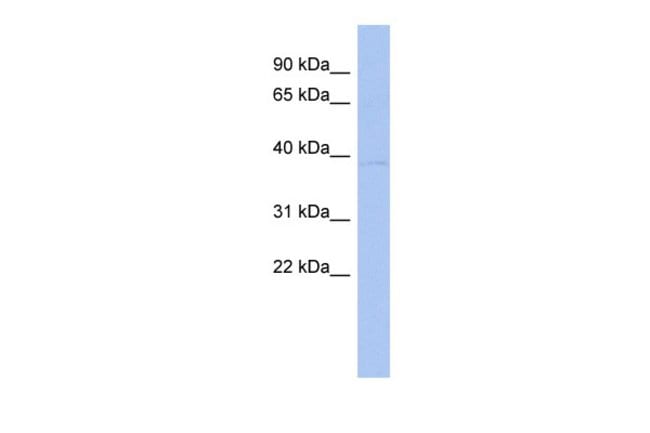
Invitrogen™ PDGF-D Polyclonal Antibody

Description
Immunogen sequence: NANLRRDESN HLTDLYRRDE TIQVKGNGYV QSPRFPNSYP RNLLLTWRLH For short term use, store at 2-8°C up to 1 week. For long term storage, store at -20°C in small aliquots to prevent freeze-thaw cycles. Predicted homology: Guinea Pig: 100%; Horse: 100%; Human: 100%; Mouse: 86%; Rabbit: 93%; Rat: 100%.
The platelet-derived growth factor (PDGF) family consists of four members; PDGF-A, PDGF-B, PDGF-C and PDGF-D (spinal cord-derived growth factor-B or iris-expressed growth factor). PDGF members form disulphide-bonded dimeric isoforms, which are important for growth, survival and function in several types of connective tissue cells. Their biological effects are mediated via two tyrosine kinase receptors, PDGFR-a and PDGFR-b, and PDGF-mediated signaling is critical for development of many organ systems. PDGF-D has a two-domain structure similar to PDGF-C and is secreted as a disulphide-linked homodimer, PDGF-DD. PDGF-D induces cellular transformation and promotes tumor growth by accelerating the proliferation rate of tumor cells and by stimulation of tumor neovascularization. PDGF-D may play a role in the development of brain tumors. The potential oncogenic activity of PDGF-DD may be important for the development and/or progression of prostate cancer. PDGF-D is expressed in fibroblastic adventitial cells, cultured endothelial cells and in a variety of tumor cell lines including those derived from ovarian, renal and lung cancers, as well as from astrocytomas and medulloblastomas. PDGF-D is expressed in the human kidney.

Specifications
Specifications
| Antigen | PDGF-D |
| Applications | Western Blot |
| Classification | Polyclonal |
| Concentration | 0.5 mg/mL |
| Conjugate | Unconjugated |
| Formulation | PBS with 2% sucrose and 0.09% sodium azide |
| Gene | Pdgfd |
| Gene Accession No. | Q9GZP0 |
| Gene Alias | 1110003I09Rik; Iegf; Iris-expressed growth factor; MSTP036; Pdgfd; PDGF-D; PDGFD latent form; PDGFD receptor-binding form; platelet derived growth factor D; platelet-derived growth factor D; Platelet-derived growth factor D, latent form; Platelet-derived growth factor D, receptor-binding form; platelet-derived growth factor, D polypeptide; rSCDGF-B; SCDGFB; SCDGF-B; spinal cord derived growth factor B; spinal cord-derived growth factor B; spinal cord-derived growth factor-B; spinal-cord derived growth factor-B protein; UNQ1899/PRO4345 |
| Gene Symbols | Pdgfd |
| Show More |
Safety and Handling
WARNING: Cancer - www.P65Warnings.ca.gov
Product Title
By clicking Submit, you acknowledge that you may be contacted by Fisher Scientific in regards to the feedback you have provided in this form. We will not share your information for any other purposes. All contact information provided shall also be maintained in accordance with our Privacy Policy.
Spot an opportunity for improvement?