Promotional price valid on web orders only. Your contract pricing may differ. Interested in signing up for a dedicated account number?
Learn More
Learn More
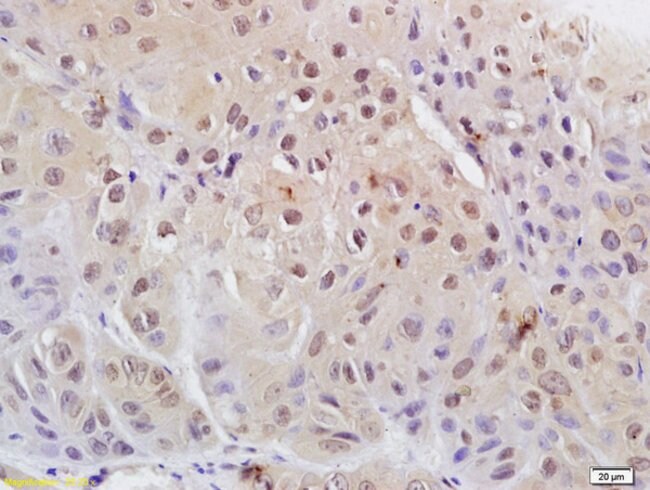
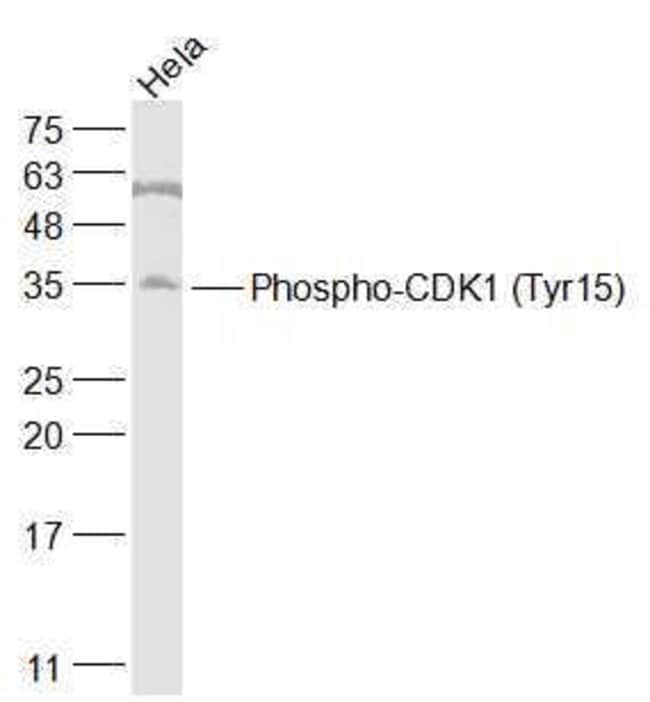
Phospho-CDK1 (Tyr15) Rabbit anti-Human, Polyclonal, Bioss


Description
CDK1 (CDC2, P34CDC2) is a member of the Ser/Thr protein kinase family. CDK1 is a catalytic subunit of the highly conserved protein kinase complex known as M-phase promoting factor (MPF), which is essential for G1/S and G2/M phase transitions of eukaryotic cell cycle. Mitotic cyclins stably associate with this protein and function as regulatory subunits. The kinase activity of CDK1 is controlled by cyclin accumulation and destruction through the cell cycle. The phosphorylation and dephosphorylation of CDK1 also play important regulatory roles in cell cycle control. Destruction of cyclin B during metaphase results in inactivation of CDK1, allowing mitotic exit and cell division. CDK1 also contributes to the control of DNA replication and can be inhibited by several transcriptional targets of p53, such as p21WAF. The ability of CDK1 to exercise control over the cell cycle is dependent upon the phosphorylation of Tyr15 in cdc2. Research studies have shown that expression of CDK1 in the brain has been linked to both neurogenesis and apoptosis. In vertebrates, multiple cyclins like CDK1 have been identified, including a total of eight such regulatory proteins in mammals. Alternatively spliced transcript variants encoding different isoforms of CDK1 have been found.
Specifications
Specifications
| Antigen | Phospho-CDK1 (Tyr15) |
| Applications | Immunofluorescence, Immunohistochemistry (Paraffin), Western Blot |
| Classification | Polyclonal |
| Concentration | 1 μg/mL |
| Conjugate | Unconjugated |
| Formulation | PBS with 1% BSA, 50% glycerol and 0.09% sodium azide; pH |
| Gene | CDK1 |
| Gene Accession No. | P06493 |
| Gene Alias | 5363; ABL1; BOS_24079; cdc; CDC2; cdc-2; cdc2 kinase; CDC28A; Cdc2a; cdc2-a; cdc2Dm; cdc2x1.1; CDCDm; CDK1; Cdk-1; cdk1.S; CDK1/CDC2; cdk1-a; cdk1-b; Cdk1-PA; CDKN1; cell cycle controller CDC2; cell cycle p34 CDC2 kinase protein; cell division control; Cell division control protein 2 homolog; Cell division control protein 2 homolog 1; Cell division control protein 2-A; cell division cycle 2 homolog A; cell division cycle 2 like; cell division cycle 2, G1 to S and G2 to M; Cell division cycle control protein 2; cell division cycle control protein 2a; Cell division protein kinase 1; Cell division protein kinase 1-A; CG5363; CG5363 gene product from transcript CG5363-RA; CG5363-PA; cyclin dependent kinase; cyclin dependent kinase 1; cyclin-dependent kinase; Cyclin-dependent kinase 1; cyclin-dependent kinase 1 S homeolog; Cyclin-dependent kinase 1-A; D2366; Dcdc2; dCdk1; DKFZp686L20222; Dm cdc2; Dmcdc2; DmCdk1; Dmel\CG5363; Dmel_CG5363; DNA polymerase delta catalytic subunit; DNA polymerase III; DNA-directed DNA polymerase delta POL3; group 4; HPR6; KCIP-1; l(2)31Eh; maturation-promoting factor; MGC111195; MGC53829; MPF; OTTHUMP00000019660; P34 CDK1; P34 MGC111195; p34 protein kinase; p34 protein kinase 1; p34 |
| Gene Symbols | CDK1 |
| Show More |
Product Title
By clicking Submit, you acknowledge that you may be contacted by Fisher Scientific in regards to the feedback you have provided in this form. We will not share your information for any other purposes. All contact information provided shall also be maintained in accordance with our Privacy Policy.
Spot an opportunity for improvement?