Promotional price valid on web orders only. Your contract pricing may differ. Interested in signing up for a dedicated account number?
Learn More
Learn More
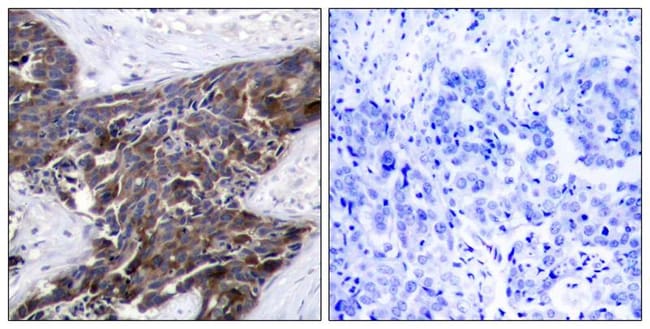
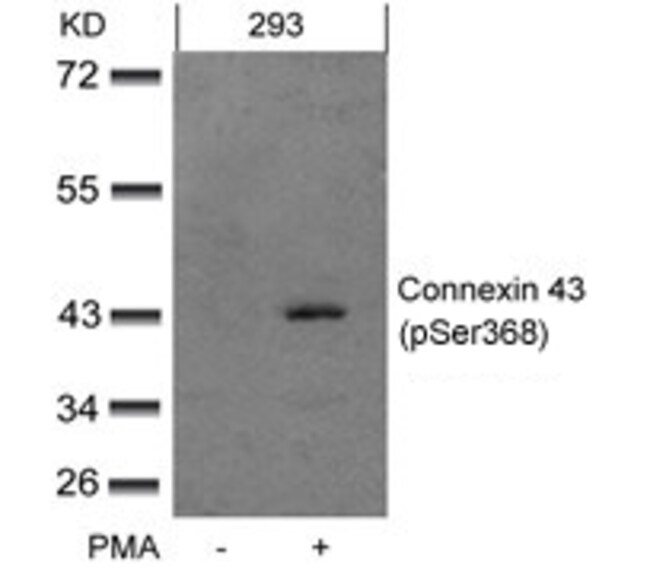
Invitrogen™ Phospho-Connexin 43 (Ser368) Polyclonal Antibody

Description
The antibody detects endogenous level of Connexin43 only when phosphorylated at serine 368. A suggested positive control for Western blot is 293 cells; suggested positive control for IHC is human breast carcinoma.
Connexin 43 (Cx43) is a member of the gap junction protein family. Connexins assemble as a hexamer and are transported to the plasma membrane to create a hemichannel that can associate with hemichannels on nearby cells to create cell-to-cell channels. Clusters of these channels assemble to make gap junctions. Gap junction communication is important in development and regulation of cell growth. Phosphorylation of Cx43 is important in regulating assembly and function of gap junctions. Ser368 of Cx43 is phosphorylated by protein kinase C (PKC) after activation by phorbol esters, which decreases cell-to-cell communication. Src can interact with and phosphorylate Cx43 to alter gap junction communication. GFAP are membrane-spanning proteins that facilitate the transfer of ions and small molecules between cells. According to sequence similarities at the nucleotide and amino acid levels, the gap junction proteins are divided into two categories, alpha and beta. Connexin 43 is the major protein of gap junctions in the heart, and gap junctions are thought to have a crucial role in the synchronized contraction of the heart and in embryonic development. Connexin 43 is also targeted by several protein kinases that regulate myocardial cell-cell coupling. A related intron-less connexin 43 pseudogene, GJA1P, has been mapped to chromosome 5. Mutations in the GFAP gene cause X-linked Charcot-Marie-Tooth disease, an inherited peripheral neuropathy, oculodentodigital dysplasia and heart malformations. Alternatively spliced transcript variants of GFAP have been found.

Specifications
Specifications
| Antigen | Phospho-Connexin 43 (Ser368) |
| Applications | Immunohistochemistry (Paraffin), Western Blot |
| Classification | Polyclonal |
| Concentration | 1 mg/mL |
| Conjugate | Unconjugated |
| Formulation | PBS with 50% glycerol and 0.02% sodium azide; pH 7.4 |
| Gene | GJA1 |
| Gene Accession No. | P08050, P17302, P23242 |
| Gene Alias | alpha 1 connexin; AU042049; AVSD3; AW546267; CMDR; Cnx43; connexin 43; connexin43; connexin-43; cx43; Cx-43; cx43 protein; cx43a1; Cx43alpha1; CXA1; Cxn-43; DFNB38; EKVP; etID309742.9; gap junction 43 kDa heart protein; Gap junction alpha-1 protein; gap junction membrane channel protein; gap junction membrane channel protein alpha 1; gap junction protein; gap junction protein alpha 1; gap junction protein connexin 43; gap junction protein, alpha 1; gap junction protein, alpha 1, 43 kD (connexin 43); gap junction protein, alpha 1, 43kDa; gap junction protein, alpha 1, 43kDa (connexin 43); gja1; Gja-1; GJAL; HLHS1; HSS; Npm1; ODD; ODDD; ODOD; PPKCA; SDTY3; shf; Short fin protein; sof; stopsel; stp; Syndactyly type III; vascular smooth muscle connexin43; Vascular smooth muscle connexin-43; zfCx43.3 |
| Gene Symbols | GJA1 |
| Show More |
Product Title
By clicking Submit, you acknowledge that you may be contacted by Fisher Scientific in regards to the feedback you have provided in this form. We will not share your information for any other purposes. All contact information provided shall also be maintained in accordance with our Privacy Policy.
Spot an opportunity for improvement?