Promotional price valid on web orders only. Your contract pricing may differ. Interested in signing up for a dedicated account number?
Learn More
Learn More
Invitrogen™ Phospho-Histone H4 (Tyr72) Polyclonal Antibody

Description
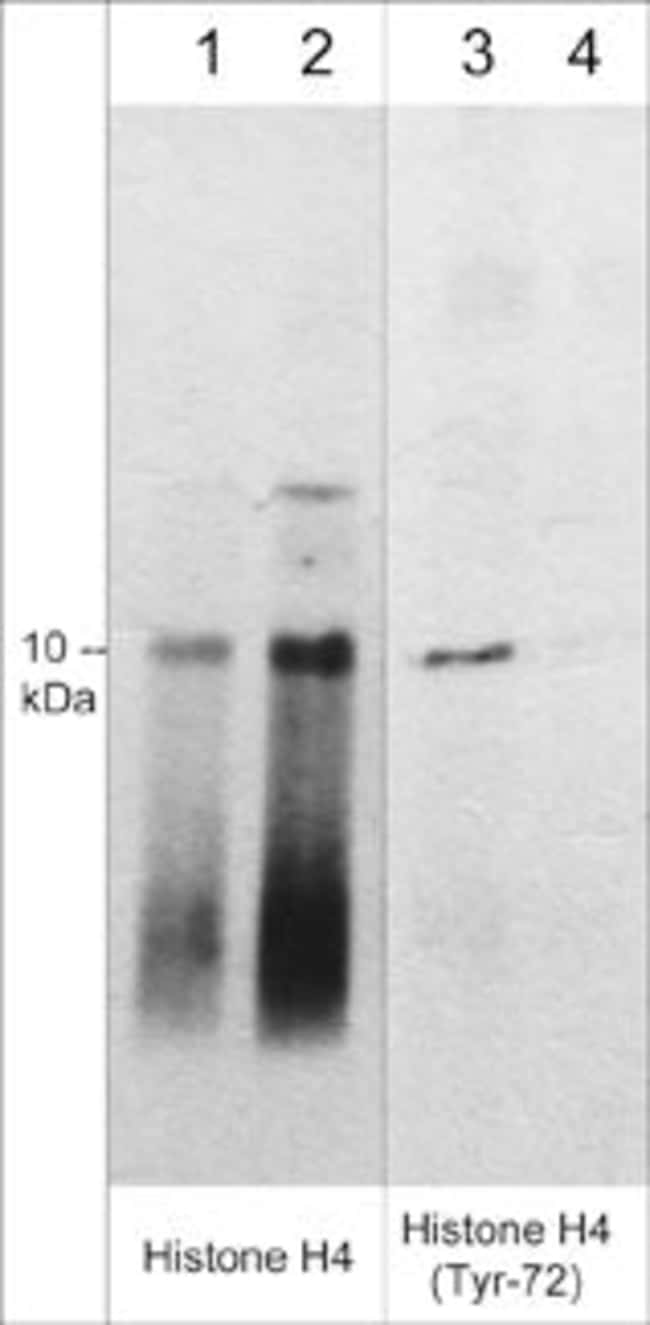
The antibody was cross adsorbed to unphosphorylated histone H4 (Tyr-72) peptide before affinity purification using phospho-histone H4 (Tyr-72) peptide. This antibody antibody detects a 10 kDa* protein on SDS-PAGE immunoblots of human PC3 and A431 cells. This reactivity is not observed after alkaline phosphatase dephosphorylation of histone H4.
Histones are basic nuclear proteins that are responsible for the nucleosome structure of the chromosomal fiber in eukaryotes. Two molecules of each of the four core histones (H2A, H2B, H3, and H4) form an octamer, around which approximately 146 bp of DNA is wrapped in repeating units, called nucleosomes. The linker histone, H1, interacts with linker DNA between nucleosomes and functions in the compaction of chromatin into higher order structures. This gene is intronless and encodes a member of the histone H4 family. Transcripts from this gene lack polyA tails but instead contain a palindromic termination element. This gene is found in the large histone gene cluster on chromosome 6.

Specifications
Specifications
| Antigen | Phospho-Histone H4 (Tyr72) |
| Applications | Western Blot |
| Classification | Polyclonal |
| Concentration | 0.5 mg/mL |
| Conjugate | Unconjugated |
| Formulation | PBS with 1mg/mL BSA, 50% glycerol and 0.05% sodium azide |
| Gene | H4C1 |
| Gene Accession No. | P62804, P62805, P62806 |
| Gene Alias | BcDNA:RH52884; BUR5; CELE_T10C6.11; CG31611; CG3379; CG3379-PA; CG3379-PB; CG3379-PC; CG3379-PD; CG33869; CG33871; CG33873; CG33875; CG33877; CG33879; CG33881; CG33883; CG33885; CG33887; CG33889; CG33891; CG33893; CG33895; CG33897; CG33899; CG33901; CG33903; CG33905; CG33907; CG33909; Dmel\CG3379; Dmel_CG3379; F07B7.11; F07B7.4; F45F2.12; FBtr0082962; FO108; germinal histone H4; H1ft; H4; H4 clustered histone 11; H4 clustered histone 2; H4 histone family, member A; H4 histone family, member I; H4 histone family, member J; H4 histone family, member M; H4 histone family, member N; H4 histone, family 2; H4.1; H4/A; H4/B; H4/C; H4/D; H4/E; H4/G; H4/H; H4/I; H4/J; H4/K; H4/M; H4/N; H4/O; H4/p; H4-12; H4-16; H4-53; H4c1; H4C11; H4c12; H4C13; H4c14; H4C15; H4C2; H4c3; H4C4; H4C5; H4c6; H4c8; H4C9; H4f16; H4F2; H4FA; H4FB; H4FC; H4FD; H4FE; H4FG; H4FH; H4FI; H4FJ; H4FK; H4FM; H4FN; H4FO; H4ft; H4M; H4r; HHF1; HHF2; HHT1; HHT2; his-20; his-22; His4; his-4; His4:CG31611; His4:CG33869; His4:CG33871; His4:CG33873; His4:CG33875; His4:CG33877; His4:CG33879; His4:CG33881; His4:CG33883; His4:CG33885; His4:CG33887; His4:CG33889; His4:CG33891; His4:CG33893; His4:CG33895; His4:CG33897; His4:CG33899; His4:CG33901; His4:CG33903; His4:CG33905; His4:CG33907; His4:CG33909; His4-88CD; His4r; His4r-PA; His4r-PB; His4r-PC; His4r-PD; his-52; his-54; his-8; HIST1H46L2; HIST1H4A; hist1h4a.L; Hist1h4b; HIST1H4C; HIST1H4D; HIST1H4E; Hist1h4f; Hist1h4h; Hist1h4i; Hist1h4j; HIST1H4K; HIST1H4L; Hist1h4m; HIST2H4; Hist2h4a; HIST2H4B; Hist4; Hist4h4; histone 1, H4a; histone 1, H4b; histone 1, H4e; histone 1, H4i; histone 1, H4l; histone 2, H4; histone 2, H4a; Histone 4; Histone 4 family, member M; histone 4, H4; histone cluster 1, H4a; histone cluster 1, H4a L homeolog; histone cluster 1, H4b; histone cluster 1, H4e; histone cluster 1, H4i; histone cluster 1, H4-IV, germinal H4-like 2; histone cluster 1, H4-IV, germinal H4-like 2 (similar to human histone cluster 1, class H4 genes); histone cluster 2, H4; histone cluster 2, H4a; Histone Cluster 4; histone cluster 4, H4; histone family member; Histone H2B 2; Histone H3; histone H4; histone H4 replacement; histone H4.1; Histone H4A; histone IV, family 2; K06C4.12; K06C4.4; N2749; N2752; OGP; Osteogenic growth peptide; RH52884p; SIN2; T10C6.11; X04652; XELAEV_18001418mg; YBR009C; YBR010W; YBR0122; YBR0201; YNL030W; YNL031C |
| Gene Symbols | H4-16, H4C1, H4C11, H4C14, H4C2, H4C5, H4C9, HIST1H4A |
| Show More |
Product Title
By clicking Submit, you acknowledge that you may be contacted by Fisher Scientific in regards to the feedback you have provided in this form. We will not share your information for any other purposes. All contact information provided shall also be maintained in accordance with our Privacy Policy.
Spot an opportunity for improvement?