Promotional price valid on web orders only. Your contract pricing may differ. Interested in signing up for a dedicated account number?
Learn More

Invitrogen™ Phospho-N-cadherin/E-cadherin (Tyr820, Tyr835, Tyr860) Polyclonal Antibody
GREENER_CHOICE

Catalog No. PIPA5143660
Change view
Click to view available options
Quantity:
100 μL
1 product options available for selection
Product selection table with 1 available options. Use arrow keys to navigate and Enter or Space to select.
Catalog No. Quantity
PIPA5143660 100 μL
Use arrow keys to navigate between rows. Press Enter or Space to select a product option. 1 options available.
1 options
Catalog No. PIPA5143660 Supplier Invitrogen™ Supplier No. PA5143660
Add to Cart
Add to Cart

Rabbit Polyclonal Antibody

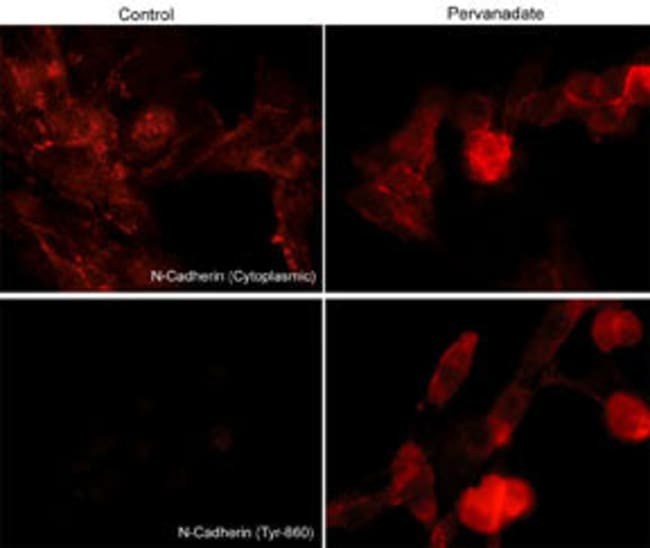
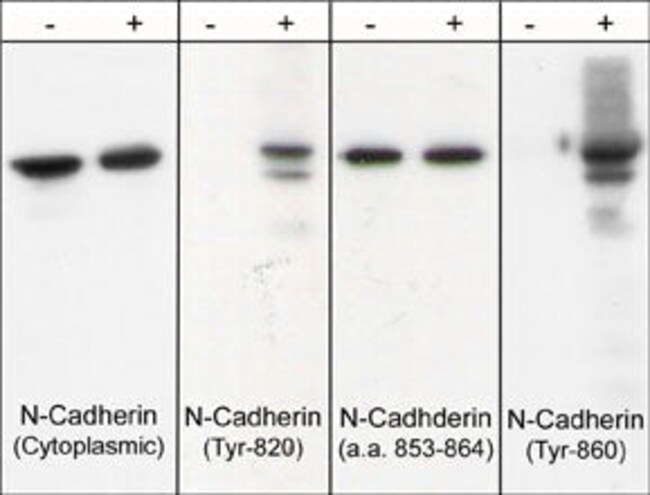
This antibody was cross-adsorbed to phospho-N-Cadherin (Tyr-820) and unphosphorylated N-cadherin (Tyr-860) peptides before affinity purification using phospho-N-cadherin (Tyr-860) peptide. In western blots, the antibody detects a 130 kDa* band corresponding to N-cadherin (Tyr-860) in human endothelial cells treated with pervanadate and detects a 120 kDa band corresponding to E-cadherin (Tyr-835) in human A431 cells treated with pervanadate.

Cadherins are transmembrane glycoproteins vital in calcium-dependent cell-cell adhesion during tissue differentiation. Cadherins cluster to form foci of homophilic binding units. A key determinant to the strength of the cadherin-mediated adhesion may be by the juxtamembrane region in cadherins. This region induces clustering and also binds to the protein p120 catenin. The cytoplasmic region is highly conserved in sequence and has been shown experimentally to regulate the cell-cell binding function of the extracellular domain of E-cadherin, possibly through interaction with the cytoskeleton. Many cadherins are regulated by phosphorylation, including N-cadherin and E-cadherin. N-cadherin is phosphorylated by c-Src at Tyr-820, Tyr-853, Tyr-860, Tyr-884, and Tyr-886. Phosphorylation of Tyr-860 can disrupt cadherin binding to beta-catenin. Since many of these tyrosine sites are conserved in the cadherin family, phosphorylation of these sites may be critical for cadherin function.
TRUSTED_SUSTAINABILITY

Specifications

Antigen Phospho-N-cadherin/E-cadherin (Tyr820, Tyr835, Tyr860)
Applications Western Blot, Immunocytochemistry
Classification Polyclonal
Concentration 0.25 mg/mL
Conjugate Unconjugated
Formulation PBS with 1mg/mL BSA, 50% glycerol and 0.05% sodium azide
Gene CDH2
Gene Accession No. P15116, P19022, Q9Z1Y3
Gene Alias Cadherin-2; CD325
Gene Symbols CDH2
Host Species Rabbit
Immunogen Phospho-N-Cadherin (Tyr-860) synthetic peptide (coupled to carrier protein) corresponding to amino acids surrounding tyrosine 860 in human N-cadherin. This sequence is conserved in human E-cadherin (Tyr-835), P-cadherin (Tyr-782), R-cadherin (Tyr-870), and has significant homology to VE-Cadherin (Tyr-733).
Purification Method Antigen Affinity Chromatography
Quantity 100 μL
Regulatory Status RUO
Primary or Secondary Primary
Gene ID (Entrez) 1000, 12558, 83501
Target Species Human, Mouse, Rat
Content And Storage -20°C, Avoid Freeze/Thaw Cycles
Product Type Antibody
Form Liquid
Isotype IgG
Show More Show Less
Product Title
Select an issue

By clicking Submit, you acknowledge that you may be contacted by Fisher Scientific in regards to the feedback you have provided in this form. We will not share your information for any other purposes. All contact information provided shall also be maintained in accordance with our Privacy Policy.