Promotional price valid on web orders only. Your contract pricing may differ. Interested in signing up for a dedicated account number?
Learn More
Learn More
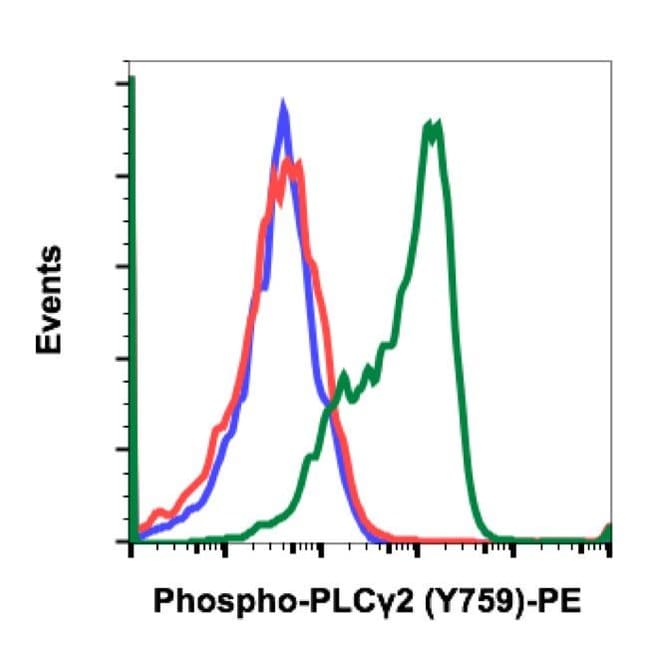
Invitrogen™ Phospho-PLCg2 (Tyr759) Recombinant Rabbit Monoclonal Antibody (PLCG2Y759-G3), PE, Invitrogen™
Description
Phosphoinositide-specific phospholipase C (PLC) plays a crucial role in the initiation of receptor mediated signal transduction through the generation of the two second messengers, inositol 1,4,5-triphosphate and diacylglycerol from phosphatidylinositol 4,5-bisphosphate. There are many mammalian PLC isozymes, including PLC beta1, PLC beta2, PLC beta3, PLC beta4, PLC gamma1, PLC gamma2, PLC delta1, PLC delta2 and PLCe. PLC delta exists as four different isoforms. PLC delta1, a calcium signal amplifier, is activated by an atypical GTP-binding protein. In addition, PLC delta1 is an effector for GTP-binding protein transglutaminase II-mediated oxytocin receptor and alpha1B-adrenoreceptor signaling. Mouse PLC delta1 is highly expressed in brain, heart, lung and testis. PLC delta is abnormally accumulated in autopsied brains with Alzheimer's disease (AD), suggesting that it may play a role in the pathology of AD. PLC delta2 is markedly expressed in type II intestinal metaplasia and in the adenocarcinoma. When PLC delta2 is expressed in type I intestinal metaplasia, the metaplasia is generally considered benignant, yet evolves toward neoplastic transformation. Thus, PLC delta2 expression may be a possible marker of gastric malignant transformation.

Specifications
Specifications
| Antigen | Phospho-PLCg2 (Tyr759) |
| Applications | Flow Cytometry |
| Classification | Recombinant Monoclonal |
| Clone | PLCG2Y759-G3 |
| Conjugate | PE |
| Formulation | PBS with 0.20% BSA and 0.09% sodium azide |
| Gene | Plcg2 |
| Gene Accession No. | P16885, Q8CIH5 |
| Gene Alias | 1-phosphatidylinositol 4,5-bisphosphate phosphodiesterase gamma-2; 1-phosphatidylinositol-4,5-bisphosphate phosphodiesterase gamma-2; APLAID; FCAS3; phosphoinositide phospholipase C; phosphoinositide phospholipase C-gamma-2; phospholipase C gamma 2; phospholipase C, gamma 2; phospholipase C, gamma 2 (phosphatidylinositol-specific); phospholipase C-gamma-2; Phospholipase C-IV; PLC gamma 2; PLC gamma2; PLC- gamma2; PLC gamma-2; PLCG2; Plcg-2; PLC-gamma; PLCgamma2; PLC-gamma-2; PLC-IV |
| Gene Symbols | Plcg2 |
| Show More |
Safety and Handling
WARNING: Cancer - www.P65Warnings.ca.gov
Product Title
By clicking Submit, you acknowledge that you may be contacted by Fisher Scientific in regards to the feedback you have provided in this form. We will not share your information for any other purposes. All contact information provided shall also be maintained in accordance with our Privacy Policy.
Spot an opportunity for improvement?